
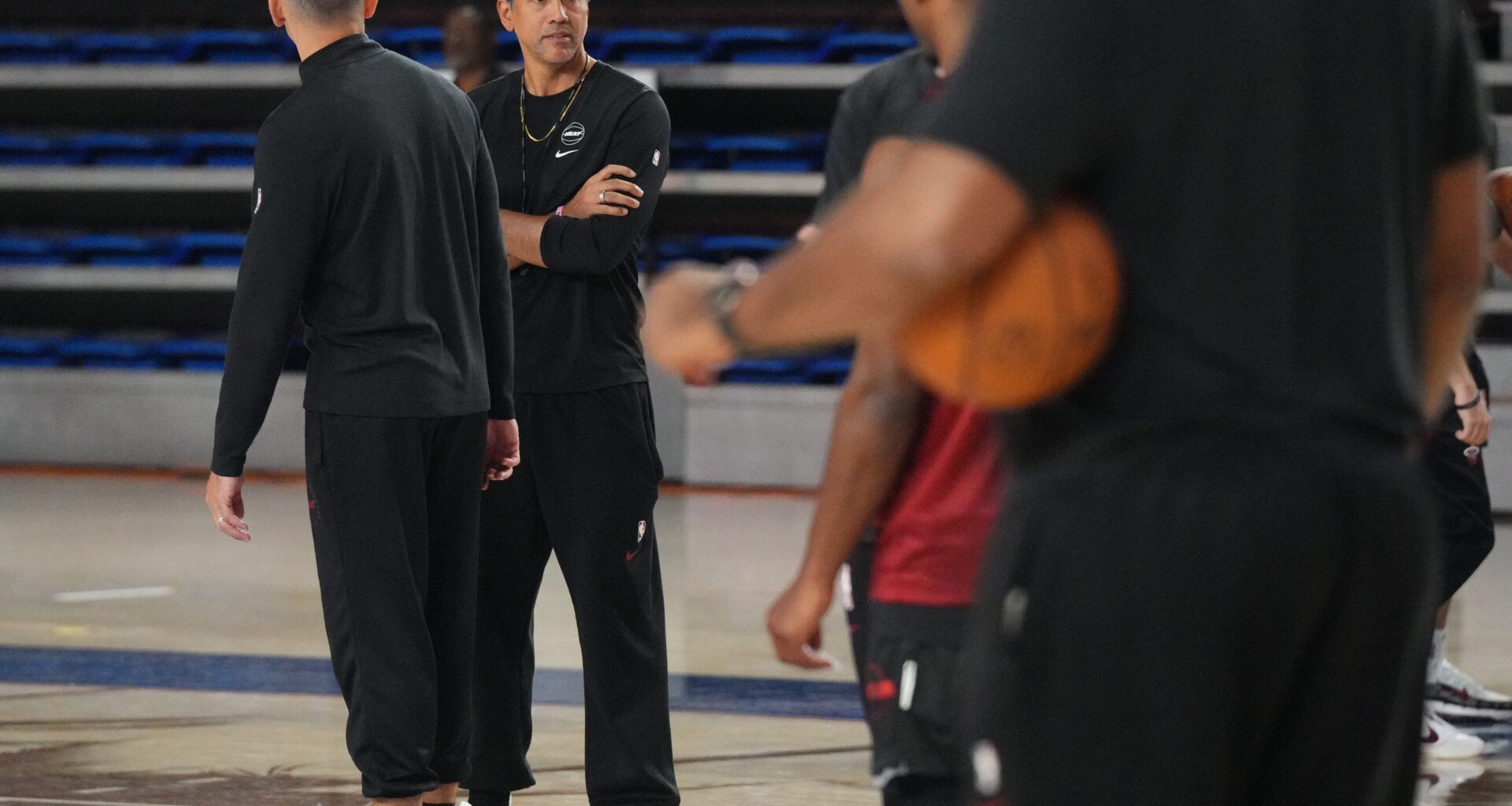
MIAMI — For all the adjustments to Erik Spoelstra’s Miami Heat staff this offseason — from adding former NBA big man Vin Baker as an assistant coach, to losing shooting coach Rob Fodor to the Dallas Mavericks, to bringing back G League coach Dan Bisaccio to his developmental staff — one of the most intriguing elements remains, albeit again somewhat in the shadows.
No, you won’t find Noah LaRoche listed anywhere on the Heat organizational chart in the team’s preseason media guide. But there he was during last week’s training camp at Florida Atlantic University, a routine presence on the sidelines in Boca Raton as Spoelstra again installed LaRoche’s “chasing space” offense, the ball-movement, player-movement non-traditional approach that eschews pick-and-roll basketball and helped leapfrog the Heat to first in the NBA in place last season and second in scoring.
It has been a delicate dance from the outset, one that has reduced pet plays for several players — including Tyler Herro last season and potentially Giannis Antetokounmpo this season — and one that Spoelstra has made sure gets credit beyond LaRoche’s role as consultant.
“We’re definitely going in the lab and Chris Quinn is our offensive coordinator,” Spoelstra stressed of his lead assistant. “Noah’s back as a consultant. So we’ve had a lot of meetings, not only with Quinny and Noah, but the full staff. And once we understood what our roster was, we went to work on what we think makes the most sense.”
The sense from Saturday night’s preseason opener against the Toronto Raptors, a game the Heat won 129-105 and scored 76 points in the first half, is that LaRoche’s precepts remain omnipresent, with newcomers Antetokounmpo and Tim Hardaway Jr. thriving in the system, and with newcomers Klay Thompson and Bobby Portis working their way through.
“There’ll be some principles that we keep from last year,” Spoelstra said, with the Heat moving on to Thursday night’s preseason home opener against the New Orleans Pelicans. “There’ll be things that we will incorporate that the guys that are coming in, obviously Giannis, Klay, Timmy, Bobby, that they’re comfortable with. So we want to make them feel like they’re playing to their strengths.”
That at the moment has half the Heat roster fully familiar (those who returned from last season) and other curiously contemplating (the newcomers).
“And then ultimately,” Spoelstra said, “we want to bring this group together and create something that’s going to create something bigger and more offensively. That is the part that we’ll have to see and make adjustments as we go.
“But the base part of it, we have a pretty good idea of what we want to start with.”
In an interview a year ago, before joining the Heat staff, with the Slapping Glass Podcast, LaRoche opened a window into his philosophy, including:
— “Everything is about managing space: Chasing space when you have the ball, chase space when you’re off the ball, chase space. That encompasses all these other things that create great offense and create great defense.”
— “Elite players, they don’t think about the move they’re going to make. They find space and they get there and then from that the move actually emerges.”
It was LaRoche’s connection to former Heat guard Duncan Robinson that initially caught Spoelstra’s attention. From there, as he is wont to do, Spoelstra began picking his brain, just as he has over the year for strategy, inspiration and motivation nuggets from football savants Chip Kelly and Pete Carroll, Division II championship coach Jim Crutchfield at Nova Southeastern, and others who had had success at the highest levels of their endeavors.
A touchstone of a Spoelstra era as head coach that enters its 19th season is the ability and willingness to evolve.
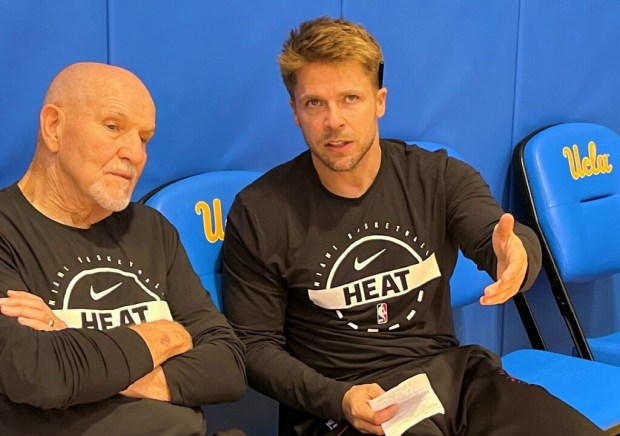 Heat consultant Noah LaRoche (right) sits with Heat draft consultant Chet Kammerer during a practice session last season. (Ira Winderman, Sun Sentinel)
“I think there should be some excitement about our offense,” Spoelstra said, as the Heat move toward their Oct. 21 regular-season opener against the visiting Minnesota Timberwolves. “There are a lot of possibilities. We want to put up a lot of points on the board.
“There’s things that we did last year that make a lot of sense for Giannis, but also all the guys coming in. But we want them also to feel comfortable. We don’t want to reinvent guys, we just want to add, so hopefully we can make guys better.”
So, no, Spoelstra said, it’s not about the coaches, the consultant, or even the precise nuances. It’s about the adaptation to an evolving roster.
“Just really accentuate what they already do and maximize that and put it all together where everybody’s maximizing each other’s strengths,” he said. “But I think the possibilities for us are exciting, not just for the staff — I mean, who cares about staff? — I think the players feel that.
“And we’ll put it together. Yeah, there’ll be certainly some principles that we’ll lean on from last year. In many ways, it’s great that we’re able to go through that. We learned a lot last year and we’ll see how it all plays out.”
To the doubters, Spoelstra merely asks what he asked ahead of last season.
“I know it would probably make all of you a little bit more comfortable if we just played a little bit more conventional,” he said during a media scrum in the bowels of Kaseya Center earlier this week. “I think that would help your brains. That is not my mindset at all. We will find the balance of conventional versus what also can really put some pressure on defenses.”