
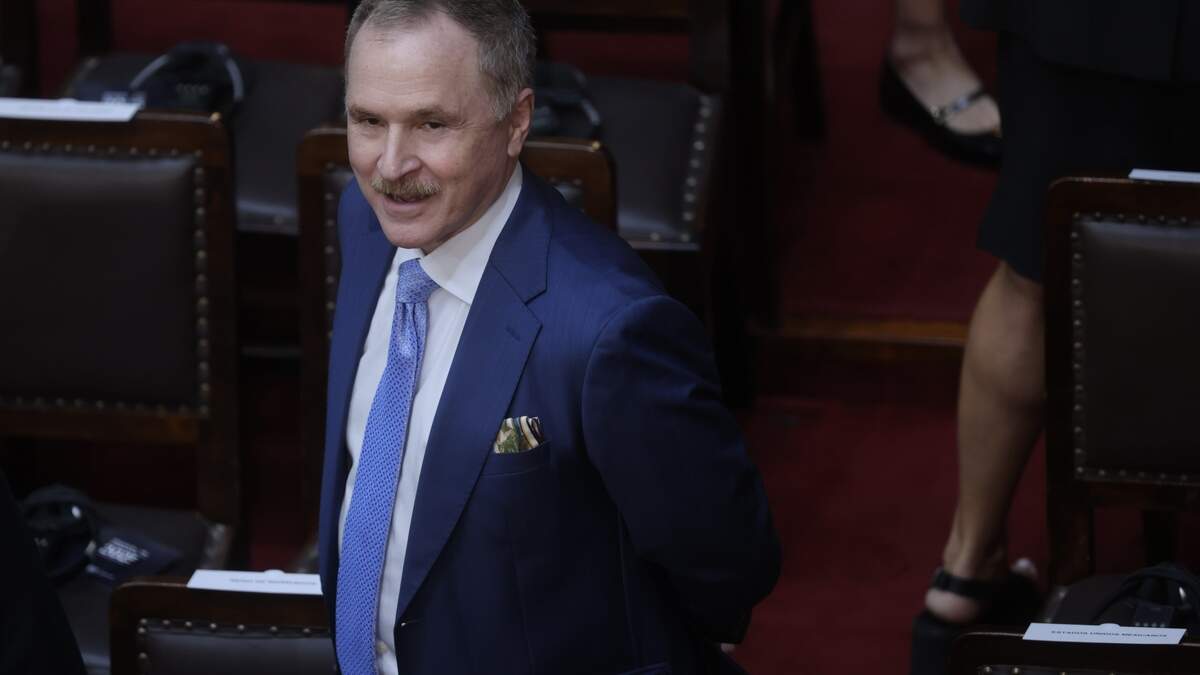
Peter Lamelas, the U.S. ambassador to Argentina, waits for President of Argentina Javier Milei during the opening session of the Argentine Congress on March 1, 2026 in Buenos Aires.
Tomas Cuesta
Getty Images
Buenos Aires, Argentina
The U.S. ambassador to Argentina, the Cuba-born, Miami-raised Peter Lamelas, arrived in Buenos Aires with a clear mission: to “reduce dependence” on China economically and technologically, and strengthen the strategic alliance between Washington and South America’s second-largest economy.
With an “anti-communist” rhetoric and an America First approach, the pharmaceutical entrepreneur assumed his post on November 4, 2025, at a moment of unprecedented bilateral alignment.
Argentine President Javier Milei has forged intimate diplomatic, trade and business ties with the White House while turning away from other global players, particularly members of the BRICS organization of emerging economies that includes China.
Born in Cuba in December 1958, Lamelas, 67, moved to Miami at the age of 9. He studied medicine and eventually built a pharmaceutical business empire, founding MD Now Urgent Care and turning it into one of Florida’s largest urgent-care networks.
“My family legally emigrated from Cuba,” he often recalls in his public appearances, describing the hostility they faced when they left the island.
He is also a strong critic of both former leader Fidel Castro and the communist political system. Lamelas often says that he “achieved the American Dream,” highlighting his career as a physician and businessman.
His ties to President Donald Trump date back to his first administration, when Lamelas was appointed to serve on the Department of Justice’s Medal of Valor Review Board. In 2024, he donated more than $500,000 to political committees supporting Trump. After being nominated as ambassador, he also donated $250,000 to the Trump-Vance inaugural committee in January 2025.
During his 2025 confirmation hearing before the U.S. Senate, he emphasized that his mission would focus on “reducing dependence” on China, Argentina’s main trading partner, amid the global strategic competition over telecommunications, infrastructure and critical rare-earth minerals.
“I stand firm against the malign influence of adversarial powers in the region, whether bad actors or authoritarian regimes like Cuba, Venezuela, Nicaragua, China, Iran, and others seeking to undermine democratic values,” he said, prompting criticism from China’s embassy in Buenos Aires.
Lamelas also stirred controversy by promising to “personally travel” to Argentina’s 24 provinces to “push back against the Chinese Communist Party.”
China’s diplomatic mission in Argentina rejected his remarks, describing them as “steeped in ideological bias” and rooted in a “Cold War mentality”.
The Miami Herald contacted the U.S. Embassy in Argentina to request an interview with Lamelas for this story. Embassy officials said they would report the request to the appropriate authorities.
Tenure in Buenos Aires
Since arriving in the Argentinian capital, Lamelas has been highly active on social media and at public events. With his characteristic charisma, blunt style and Cuban-accented Spanish, the ambassador has focused on putting into practice what he promised during his 2025 confirmation hearing before the U.S. Senate.
Since presenting his credentials to Argentine authorities, Lamelas has accelerated his anti-China agenda, framed within the regional realignment process that followed the announcement of the U.S. New National Security Doctrine.
As Washington’s ambassador to Argentina, Lamelas’ numerous statements against China have made him a prominent figure in the local political debate, which eventually led to his being summoned to a congressional hearing last September.
Among his controversial interjections in the national debate was his recent accusation that Huawei, the communications technology company, “spies” for the Chinese Communist Party. “Data security is national security for both countries,” he said in August at an American Chamber of Commerce event in Argentina. “China requires its companies to give the state any data that passes through its technology and artificial intelligence networks. Everything is controlled by the Communist Party.”
For Fabián Calle, an international relations analyst and senior fellow at Florida International University, Lamelas has a central mission: to hold back China’s presence in the Southern Cone, home to one of the world’s strategic routes connecting the Atlantic and Pacific oceans between Chile and Argentina towards the Antarctic.
Calle, who also heads the Institute for International Security and Strategic Affairs at the think tank Argentine Council on Foreign Relations, described it as “a clear White House policy line” that, in his view, began during Trump’s first term and continued uninterrupted to the present – even during Joe Biden’s administration – although now more openly.
“The traditional U.S. strategy in a strategic competition is to reinforce its control over the hemisphere. It did so in the 1930s and 1940s with Nazi Germany, and in the 1960s and 1970s, starting with Cuba and the USSR. And now, after a long sleep in which it allowed China to advance in the region, there is a new strategy,” Calle told the Miami Herald.
Along those lines, he highlighted Lamelas’ profile as a billionaire who moved into politics, compared with career diplomats. “He is much more direct, straightforward, when issuing warnings about the ‘red lines’ that governments in the region should not cross, such as 5G, the Paraná-Paraguay Waterway, strategic ports, nuclear technology, weapons, artificial intelligence or rare earths.”
Calle also highlighted the “excellent” and “close personal relationship” between President Milei and Trump’s envoy, and linked it to the U.S. shift to turn its effort to “push China out” of strategic sectors of Argentina from rhetoric into action.
“It has been a long time since the U.S. took out its wallet and signed deals. Before, it was the Chinese who put up the money. The U.S. realized that there is no such thing as leadership for free or based only on words,” he said.
Since Trump began his second term, the U.S. has pushed through a string of policies favoring Argentina.
These include a 2025 swap agreement between the U.S. and Argentina, which provided for up to $20 billion in liquidity support before the mid-term elections in October; a March 2026 U.S. court ruling overturning a $16.1 billion judgment in the oil expropriation case involving the state-owned YPF energy company after Trump sided with Argentina; the bilateral trade agreement signed in February 2026 to expand U.S. market access for Argentine goods and strengthen the trading of critical minerals, and the recently announced Andes-Atlantic corridor, which is expected to channel $7 billion investment for energy, mining and infrastructure projects in the country through the U.S. Export-Import Bank.
Lourdes Puente, an international relations and defense specialist who previously served as Argentina’s director of National Military Strategic Intelligence, said there is “a tug-of-war between powers that has to do with competition” and that the U.S. is seeking to ensure that China “does not gain ground within its sphere of influence.”
In that context, she said: “I think there is an effort to influence positively in favor of their own technologies.”