
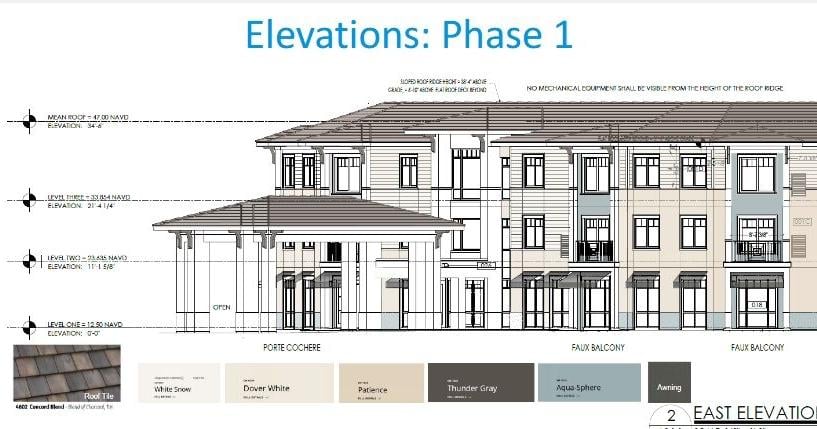
PORT ST. LUCIE – When the City Council here quietly approved the major site plan Sept. 28 for an assisted living facility initially planned by Ravello in the Sandpiper neighborhood years ago, it turned the page on a complicated chapter whose resurrection nearly two years ago began anything but quietly.
On May 7, 2024, some 22 Sandpiper residents attended the Planning & Zoning Board meeting to hear the Ryan Law Group’s proposal for an assisted living facility near the northwest corner of Morningside and Westmoreland boulevards.
The company’s request was to change the future land use on the 7.11-acre parcel from limited commercial general and low density residential to medium density residential and institutional zoning.
Most of those who spoke opposed the plan that night said they always believed the land was part of the adjacent preserve and would remain vacant.
The same crowd returned for the subsequent City Council hearing on May 28, which was ultimately tabled to give the developer time to meet with the residents and the staff time to research the history of the Ravello Planned Unit Development, which had an official name change at one point to Rivella but is still officially referred to by its old name.
By the time it came back to the Council on Jan. 27 of the next year, its members realized they’d inherited a zoning and land-use quagmire. A previous Council in 2021 had changed one of the parcels to a different use that prohibited assisted living facility on the property, which had actually already been approved for the site years before.
One of the most vocal ALF critics, Cecile Renna, even asked Council members to consider buying the property so it could remain vacant.
City staff eventually inquired about that possibility but the Ryan Group refused.
On Feb. 10, 2025, the City Council restored the applicant’s right to Institutional Land Use needed for the ALF, to the chagrin of local residents in opposition.
Fast-forward to Sept. 28 of this year, and Planner Bethany Grubbs provided a brief presentation on the company’s major site plan for the facility, making a reference to that Council’s 2025 decision that now enabled its review.
“This application is a follow-up to the January 2025 Amendment for Ravello’s PUD,” she said. “As part of the PUD amendment, the parcel use was changed to institutional, and this designated the parcel for assisted living facility use consistent with the Ravello PUD standards. At the time of approval, it was requested the application come back at the time of site plan with a full traffic analysis and figures for emergency evacuation. Therefore, I am here to present this presentation of behalf of PSL Westmoreland ALF.”
Grubbs then turned her attention to the site plan itself.
“Phase 1 consists of 150 assisted living units, which has a base footprint of 53,178 square feet and creates a three-story building,” she explained. “Phase 2 will be a one-story proposed building with 26 memory care units with a base footprint of 26,351 square feet. Phase 1 includes a median opening and left-turn lane on Westmoreland for offsite improvements to be completed before the certificate of occupancy and water permit is completed for a Phase 1 structure. The site provides two full-access driveways, one on Westmoreland Boulevard and one on Morningside Boulevard. All perimeter landscape buffers for Phase 1 and 2 will be installed during Phase 1.”
The city’s Site Plan Review Committee had previously reviewed the major site plan on Sept. 9 and recommended approval. Grubbs wrapped up her presentation with data from the traffic analysis that included emergency response statistics.
During the earlier discussions, at least one resident feared the number of emergency vehicles needed for the elderly might pose a danger to school buses and traffic utilizing the adjacent roundabout.
The planner acknowledged that the traffic engineer utilized a more intense code than required by the Institute of Traffic Engineer’s Handbook for assisted living facilities and still came up with minimal traffic impacts.
“The traffic analysis indicated that there’s going to be 36 p.m. peak-hour trips under the ITE assisted living facility code use,” she concluded. “Even using the higher trip rate [75 p.m. peak-hour], traffic impacts remain low and do not warrant additional right-of-way improvements. Westmoreland Boulevard, Morningside Boulevard and the roundabout operate at acceptable levels under existing and future conditions. Emergency call data averages approximately 22 calls per month for a 150-bed facility, or less than one call per day. The AutoTURN [software] confirms fire truck access and maneuverability are sufficient. There’s no dead-ends, and the drive isles and roadways are capable of carrying the Fire District’s largest engines.”
When no one on the Council had questions for either staff or the applicant, Councilwoman Stephanie Morgan made a motion for approval, which was seconded by Councilman Anthony Bonna and passed unanimously.