
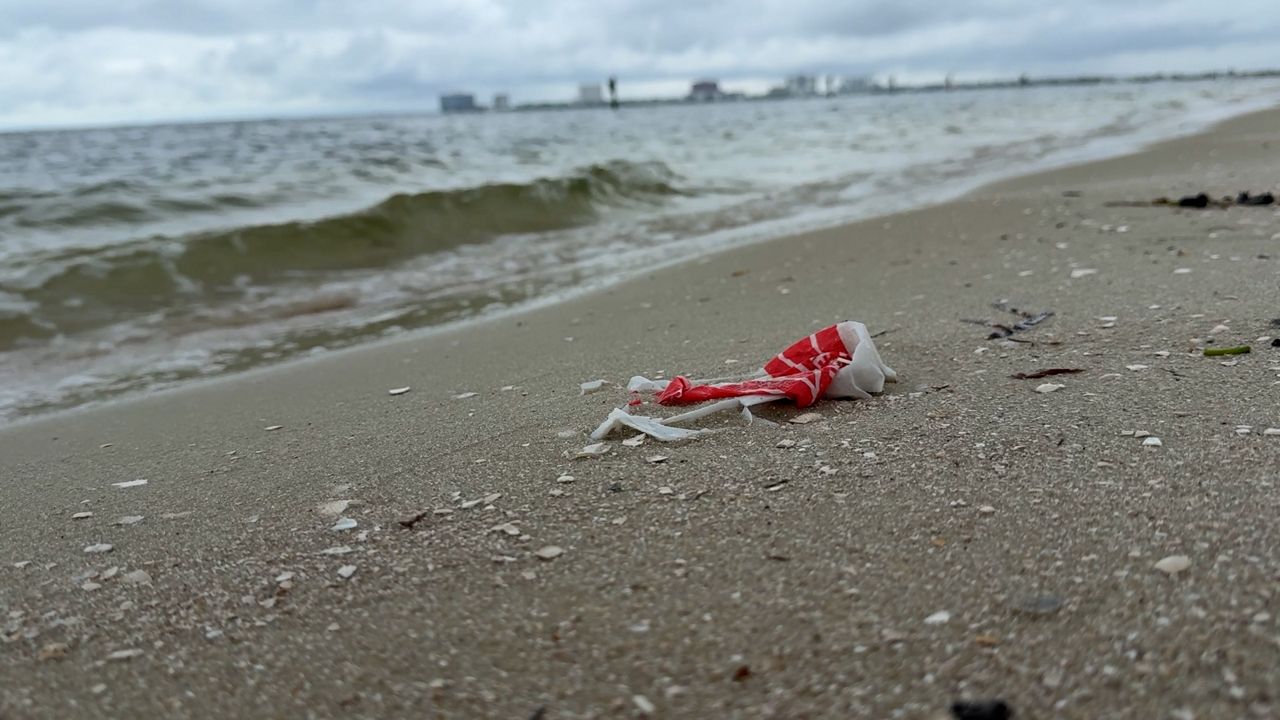
TAMPA, Fla. — New research at the University of South Florida is examining how microplastics are affecting marine organisms in Tampa Bay, including red mangrove leaves and mangrove tree crabs.
Kate Mclendon, an integrative biology Ph.D. candidate at the University of South Florida, is measuring microplastics in marine ecosystems. Her work focuses on red mangrove leaves and mangrove tree crabs, which feed largely on those leaves.
“Microplastics are pieces of plastic less than five millimeters in size,” Mclendon said. “And they can be broken down from larger pieces of plastic. Or they can just be already created to be that small.”
Mclendon said mangrove tree crabs may be consuming microplastics from leaves.
“Mainly because the majority of the diet of the mangrove tree crabs is red mangrove leaves,” Mclendon said. “So there’s the idea that they’re either consuming these microplastics from the leaves or they’re breathing them in by being around them and being around the leaves.”
After collecting samples, Mclendon performs experiments to measure how many fibers the crabs have consumed. She said previous research has found microplastic buildup in crabs can lead to starvation because it makes the animals feel full.
A 2019 USF study estimated there were 4 billion microplastics in Tampa Bay waters. Much of the pollution starts upstream, according to Kristina Moreta, executive director of Keep Tampa Bay Beautiful.
“All of our storm drains lead to a body of water,” Moreta said. “So no matter where you are at, it’s going to end up in our beautiful Hillsborough River, which then ends up into the bay.”
Moreta said Keep Tampa Bay Beautiful and its volunteers collected more than 200,000 pounds of trash in Hillsborough County last year. The organization is still compiling how much trash it has collected this year.
Mclendon said she has finished processing the red mangrove leaves and has started processing the crabs, a step she expects to take about a month.
Once the results are analyzed, Mclendon plans to publish them in an academic journal for other biologists to reference. Her work could help inform future efforts to address the impacts of microplastics on marine ecosystems.