
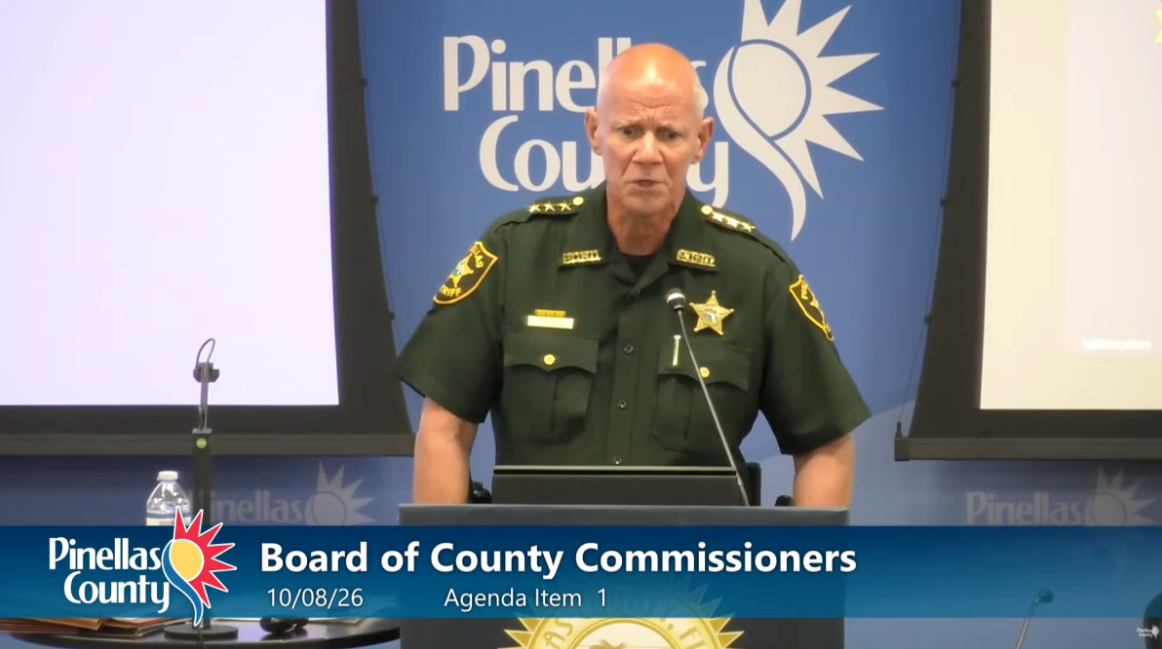
Pinellas County Sheriff Bob Gualtieri responds to questions about ALPR sponsorships at the Oct. 8, 2026, Pinellas County Commission meeting.
Credit: Pinellas County Government / Pinellas County Government
Pinellas County Sheriff Bob Gualtieri is once again moving the needle on nationwide policy, this time to promote one of the most controversial pieces of police tech this decade: Flock cameras.
Gualtieri leads the Major County Sheriffs of America (MCSA) a group of sheriffs overseeing the nation’s largest counties. This year, Gualtieri is spearheading a national campaign through MCSA promoting Flock-style cameras. That was the subject of some controversy at the latest Pinellas County Commission meeting.
Commisioners asked Gualtieri to come to its Oct. 8 meeting to answer their questions about automated license plate readers (ALPRs), which have received bipartisan backlash over privacy, stalking and 4th Amendment concerns.
Gualtieri began with an eight-minute video produced by the Major County Sheriffs of America highlighting ALPR success stories. He said he’s used the video “across the country” to advocate for ALPRs, including in Washington D.C.
“I think it is good background information, and it was produced in my capacity as the president of the Major County Sheriffs of America,” Gualtieri told the commission.
The video highlighted an Alzheimer’s patient returned to his family, a six-year-old whose kidnapper was caught, and a serial rapist put behind bars. All, according to the video, done with the help of ALPRs. The video ended with a “myth busting” segment featuring Gualtieri himself.
Later in the meeting, Commissioner Vince Nowicki asked Gualtieri about MCSA sponsorships from three ALPR companies.
“The Major County Sheriffs of America … listed Flock, Axon and Motorola as major sponsors. Do you have any information on that?” Nowicki asked, also noting that MCSA put out a wealth of information supporting ALPRs.
“What you’re insinuating’s offensive, so don’t even go there,” replied a visibly-frustrated Gualtieri. “I’m not being bought and paid by anybody, and that’s a bunch of B.S.”
Nowicki said he wasn’t trying to insinuate anything. Gualtieri didn’t buy it, saying, “You knew exactly what you were doing.”
Nowicki told Creative Loafing Tampa Bay he respects Gualtieri and believes the sheriff was exhausted after a long round of questioning. Still, he disagrees with the sheriff’s argument that Flock cameras don’t track people.
“It’s not physically tracking you, there’s no tracking device, but it is collecting people’s and vehicles’ movements, and it’s storing those movements in a chronological timestamped database to see where you go,” Nowicki told CL.
Gualtieri says ALPRs have been in use for 20 years, prompting auditing concerns
Gualtieri reassured the commission that this wasn’t new technology, and said his office had used ALPRs for 20 years
Commissioner Brian Scott was alarmed by this figure. He mentioned the deputy arrested last week for allegedly searching the sheriff’s ALPR database 200 times for a love interest.
Scott noted that a media inquiry—made by TCPalm reporter Jack Lemnus—was the reason for the audit. “We’ve had these in place for 20 years. Have we been under-auditing for 20 years?”
Gualtieri said that a review of the audit system was underway before saying that “we’re not gonna catch everything.”
ALPRs buy $450,000 worth of MCSA sponsorship
Flock, Motorola and Axon are each “sheriff level” MCSA sponsors, according to MCSA’s website—the highest sponsorship package the organization sells.
Each of the five available slots costs $150,000 and comes with benefits including a speaking role at the conference, being featured in the organization’s resource guide, and a “quarterly content post on YouTube.”
The pitch from MCSA to its corporate sponsors says buyers will “form a powerful voice on issues of public concern in the law enforcement community.”
A YouTube page linked on the MCSA website seems to have been removed.
MCSA has a big banner on the front page of its website reading, “ALPR RESOURCES.” It’s also the very first option in the menu on the website.
That leads to a page with five documents and the eight-minute video, all explaining how useful ALPRs are in helping fight crime and that they are not 4th Amendment violations.
One document features Gualtieri’s headshot and his pro-ALPR message at the bottom. It also features the six-year-old from the video alongside her kidnapper’s mugshot, and a quote from her that says, “I feel good because he’s in jail.”
MCSA also signed a joint letter opposing a bill amendment that would have prohibited agencies from receiving federal funds if they use ALPRs.
There are Constitutional concerns over the use of ALPRs
One of the “myths” addressed in the video was the concern that ALPRs violate the 4th Amendment by invading one’s reasonable expectation of privacy. “FACT: Courts have ruled ordinary use of ALPR does not violate the constitution,” the video says.
But last week—after the video was made—a federal judge in Oklahoma ruled that an officer’s use of an ALPR database was an unreasonable search. Evidence obtained through that search had to be thrown out—including 91 pounds of meth.
The judge said that a solitary ALPR camera isn’t unconstitutional, but a vast network of them can constitute an invasion of privacy.
The judge’s opinion reads:
“Think about it this way. We might reasonably expect our friends and family to tell us something like: ‘Hey, I saw you out driving by the store last week.’ But we do not expect people we know—let alone strangers, and especially not law enforcement—to randomly approach us to say: ‘Hey, I have been following your car for the last 30 days, and here is a detailed log of every place your vehicle has been with supporting photographic evidence. I am also going to share this information with law enforcement throughout the country so they know your whereabouts, too.’
Freedom from persistent, dragnet-style surveillance while in public is not a foreign concept in our society, and it is a reasonable expectation that society already accepts.”
Beryl Lipton investigates police surveillance tech for digital civil liberties organization Electronic Frontier Foundation. She told CL that ALPRs do track people, contrary to Gualtieri’s repeated claims that they don’t.
“That is the whole premise of the license plate reader system, right?” she told CL. “If you have a car that is of interest—maybe because it contains a kidnapped child, maybe because it contains your ex wife—you will be able to find that vehicle more quickly using a license plate reader system.”
“So I don’t know if we’re just working on different definitions of ‘track,’ but license plate readers certainly can be used to track individuals or at least to get a very good idea of where they have been and at what time,” she continued.
Another top-level MCSA sponsor—controversial police software company Peregrine—aims to do just that.
The federal judge who ruled against ALPR use in Oklahoma noted that she was required to consider that possibility.
“It is also no longer difficult to imagine law enforcement using a fleet of drones hovering over an entire city so they don’t miss the movement of a single vehicle,” her ruling reads. “This is not hypothetical catastrophizing. The Court ‘must take account of more sophisticated systems that are already in use or in development.’”
Commissioners said they want to have more conversations with Gualtieri about Flock before voting on the tech. DeFlock St. Pete organizer Zach Schira previously told WMNF that he believes advocates for civil liberties should be included in conversations like that, and that commissioners shouldn’t rely exclusively on the opinion of the police when evaluating police tech.