
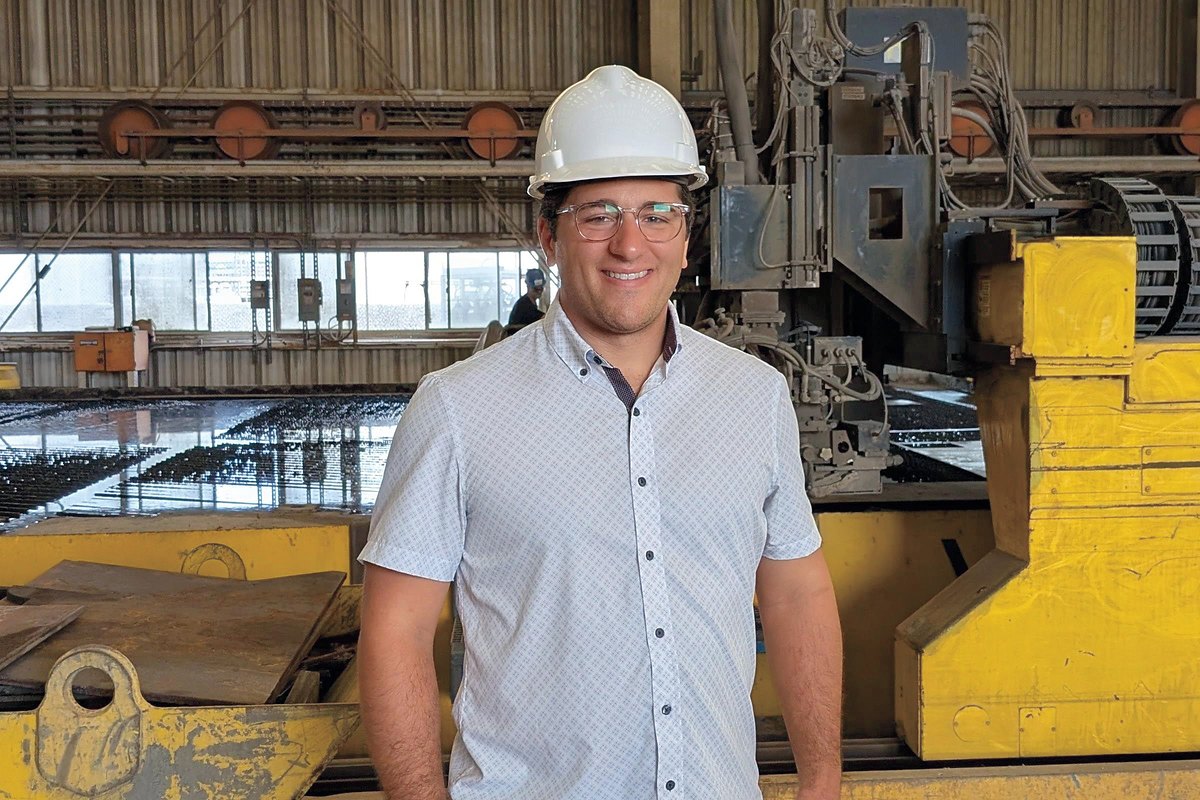
THE ENTREPRENEUR
MICHAEL ANDERSON, 35
Co-Founder & CEO
Seagate Space, St. Petersburg
Growing up between Washington, D.C., and Baltimore, Michael Anderson was the kid who spent more time tinkering with models of transportation systems than paying attention in class. “I had a broad array of interests in all things physical world — transportation, buildings, beams, rockets, ships, all of that,” he says.
Anderson left Maryland for a very different environment: the University of Miami, where he majored in economics and minored in psychology and mathematics. “From the perspective of macroeconomics and what makes the world flow and move, it just fit so well with the things I spent time daydreaming about,” he says. After graduating, Anderson entered the Big Four consulting world in 2014 at PwC in Miami’s financial district. There, he worked with cruise lines and aerospace giants, industries that mirrored his childhood interests.
A career switch to Deloitte’s Manhattan office in 2016 brought him deeper into transportation strategy, including high-speed rail planning. He also finished a master’s degree in applied economics from Johns Hopkins and passed the chartered financial analyst exam. But he felt increasingly drawn to industries that required long-term thinking — industries built on hard assets, not computer code. “When you’re investing in hard assets that have 20-plus-year useful lives, you really need to have a perspective on where the world is going to be in year 10, 11, 12,” he says. “That fits my way of thinking. I also think a lot of those areas have been neglected, at least in American society.”
A NEW DIRECTION
In early 2020, Anderson and his wife moved to Tampa after she landed a medical residency at Tampa General Hospital. A few years later, Anderson joined Crowley Maritime as director of corporate strategy, working closely with experts in the U.S. maritime sector who were “passionate, that were driven, that want to do big things,” he says. One of them was Sean Fortener, a longtime executive who would leave Crowley with Anderson in early 2025 to co-found Seagate Space.
Seagate Space develops offshore launch platforms capable of sending rockets to orbit. The St. Petersburg-based startup sits at the intersection of three industries important to Florida: maritime, space tech and defense innovation. “We’re the maritime partner for the space industry. We’re building specialized assets that don’t look like anything else that can launch small rockets at sea,” says Anderson, Seagate’s CEO.
A TEAM BUILT TO LAUNCH
For Anderson, it’s all about the strength of the team, now 10 people, and empowering them “to be their best selves.” The co-founders recruited founding CTO Charlie Nordstrom, formerly head of Google X’s Project Makani and Seagate’s “idea guy,” and quickly assembled a senior team of maritime leaders, including Offshore Mission Manager Allan Storm, a former U.S. Coast Guard waterways management chief; vice president of Engineering Mustafa Kara, who brings two decades of experience in naval architecture, robotics and vessel design; and 40-year maritime veteran Cole Cosgrove, who runs operations. Their advisory board includes experts who have shaped modern rocket technology, including Jim Maser, the former president of both Sea Launch and SpaceX, and Air Force Research Laboratory veteran Sean Phillips.
Last December, Seagate Space became the first company to receive preliminary approval from the American Bureau of Shipping for its offshore spaceport design. “You can’t redo a first,” Anderson said. “We want to be the first to launch as well.”
MOVING TOWARD LAUNCH
This spring, Anderson announced partnerships with Lockheed Martin, Firefly Aerospace and Oceaneering, calling their dual maritime and space expertise “the perfect fit.” With Lockheed and Firefly, “we are moving toward a first launch,” says Anderson, though he can’t disclose timelines.
In June, Seagate Space secured funding from Space Florida, the state’s aerospace economic development agency, to develop a prototype offshore launch platform with Tampa Ship at Port Tampa Bay. In August, Seagate announced it will support the offshore launch of a test vehicle off Florida’s Gulf Coast planned for next May as part of the University of Central Florida’s Project Neptune, alongside UCF student aerospace organizations.
The company has received upfront payments on multimillion-dollar charter agreements, unusual for a startup, Anderson says. “Our customers are willing to put money up front. It’s changed the course for us as far as the need to raise equity capital.” Even so, Seagate raised early funding from Phase Shift Ventures and New World Angels in Florida, and DraperU in Silicon Valley, and it plans to raise more.
WHAT’S AHEAD
The next two years will be transformative, Anderson says. “We want to have multiple launches. We want to have multiple assets on the water capable of launching orbital-class rockets at sea.” Anderson reports Seagate is contracting for its first launches, planned within the next 18 months.
Beyond launches, Seagate sees opportunities in recovery operations, offshore logistics and just solving more big problems that space companies face. “We’re not going to be a one-trick pony. We’re going to innovate,” Anderson says. “Let’s unlock new thinking for these unique challenges.”
WHY FLORIDA?
Florida is positioned to lead the next generation of maritime, space and defense innovation, Anderson believes. He credits Space Florida under CEO Rob Long for embracing new ideas over protecting legacy systems. “Their mindset is not ‘let’s hold on to what we have.’ Their mindset is ‘let’s build the future.’”
And why has St. Petersburg become Seagate Space’s home? Anderson points to the spARK Labs by ARK Invest innovation hub as a catalytic force. “There’s a need to embrace what they bring to the table. Other ecosystems have interesting things, but they don’t have Cathie Wood.”