
Dyllan Furness, College of Marine Science
In a field that revolves around the ocean, Orion Scharton-Witmer has built an impressive
résumé on the water: 16 scientific cruises aboard large research vessels, some 70
small boat expeditions, and more than 130 days on the water, all while earning his
master’s in physical oceanography at the USF College of Marine Science.
A recent graduate, Scharton-Witmer credits that degree and the hands-on experience
he gained at USF with landing a job as a research fellow and marine technician at
the University of New South Wales in Sydney, Australia.
“Growing up, I probably spent more time in the water than on land,” he said. “But
I didn’t have specific instrumentation skills when I arrived at the college. The skills
I gained here are what really helped me get this prestigious job doing what I want
to do.”
Scharton-Witmer joined Yonggang Liu’s Ocean Circulation Laboratory in June 2023, bringing with him an affinity for math and physics, familiarity with
circulation modeling, and a bachelor’s degree in oceanography from the University
of North Carolina Wilmington.
He quickly found an outlet for these interests at the College of Marine Science. After
arriving in St. Petersburg, Scharton-Witmer was introduced to the lab’s operational
team, which maintains an array of surface buoys and subsurface moorings in Tampa Bay
and the Gulf, each equipped with a suite of instruments for recording ocean data.
Jay Law, a research scientist and head of the lab’s field operations, invited Scharton-Witmer
on a research cruise and encouraged him to earn his scientific diving certification.
Within a few weeks, he embarked on his first trip aboard the R/V Weatherbird II, where Law and graduate student Sam D’Angelo served as mentors and taught him the
ropes of mooring operations.
“I feel a deep connection to the ocean, and being on these vessels keeps the connection
close while working.” he said. “I like the truth of the observational data that these
instruments record from the water while they’re in the field.”
Collecting data from the instruments can involve long hours and rough conditions.
On a recent cruise in the Gulf, Scharton-Witmer worked the night shift, 4 p.m. to 4 a.m., deploying and retrieving sampling devices, buoys, chains, and anchors from the deck
of the Weatherbird II. In the ship’s lab, he troubleshot issues with tools and instruments with skills he
developed at the college.
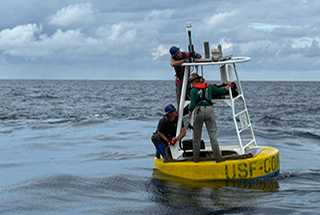
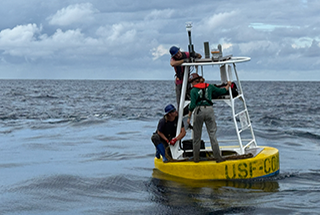
Researchers deploy a buoy in the Gulf during a recent cruise.
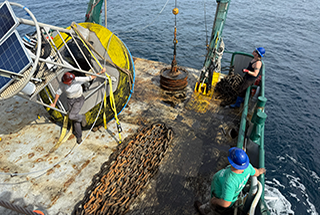
Recovering a buoy means hauling thousands of pounds of chain and anchor onto the deck.
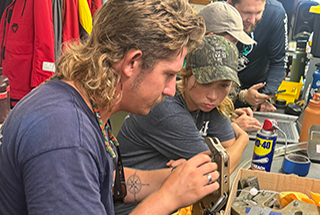
Orion Scharton-Witmer and Lillian Ring troubleshoot issues with mechanisms on a recent
research cruise.
“This is the side of science most people don’t get to see,” Scharton-Witmer said while
tinkering with a box of mechanisms used to open and close nets for biological sampling.
Working alongside Lillian Ring, a recent environmental science and geographic information
systems graduate from USF and field technician in the Ocean Circulation Lab, he tested,
lubricated, and adjusted the devices, carefully labeling the most reliable ones.
“I went into oceanography to work in this kind of environment,” he added later. “I
like fixing things. I like the sweaty, dirty, manual-labor side of science and data
collection.”
Many of these data are used to inform the circulation models that forecast the movement
of water along Florida’s coastline. Scharton-Witmer’s master’s thesis involved expanding
his lab group’s modeling coverage by developing a new application for the East Coast
of Florida.
“These circulation models can help us understand how the movement of water can influence
issues of societal importance, from red tides to safe maritime navigation, through
the integration of observing platforms and circulation models,” he said.
Scharton-Witmer received several awards to support his degree, including internal
fellowships from the College of Marine Science and a travel grant from the Hydrographic
Society of America that allowed him to present his research at the Ocean Sciences
Meeting in Glasgow, Scotland. Additional funding came from the Southeast Coastal Ocean
Observing Regional Association and the National Oceanic and Atmospheric Administration.
For students hoping to pursue a career in marine science, Scharton-Witmer encourages
them to develop as well-rounded oceanographers with a strong foundation in physical
principles of the ocean and a focus on building technical skillsets.
“Go into the field, go offshore, and see how the work is done,” he said. “No matter
your discipline, being actively involved in collecting your data gives you a new appreciation
of the data. Don’t be afraid of uncomfortable situations or let a lack of knowledge
hold you back from trying something new.”