
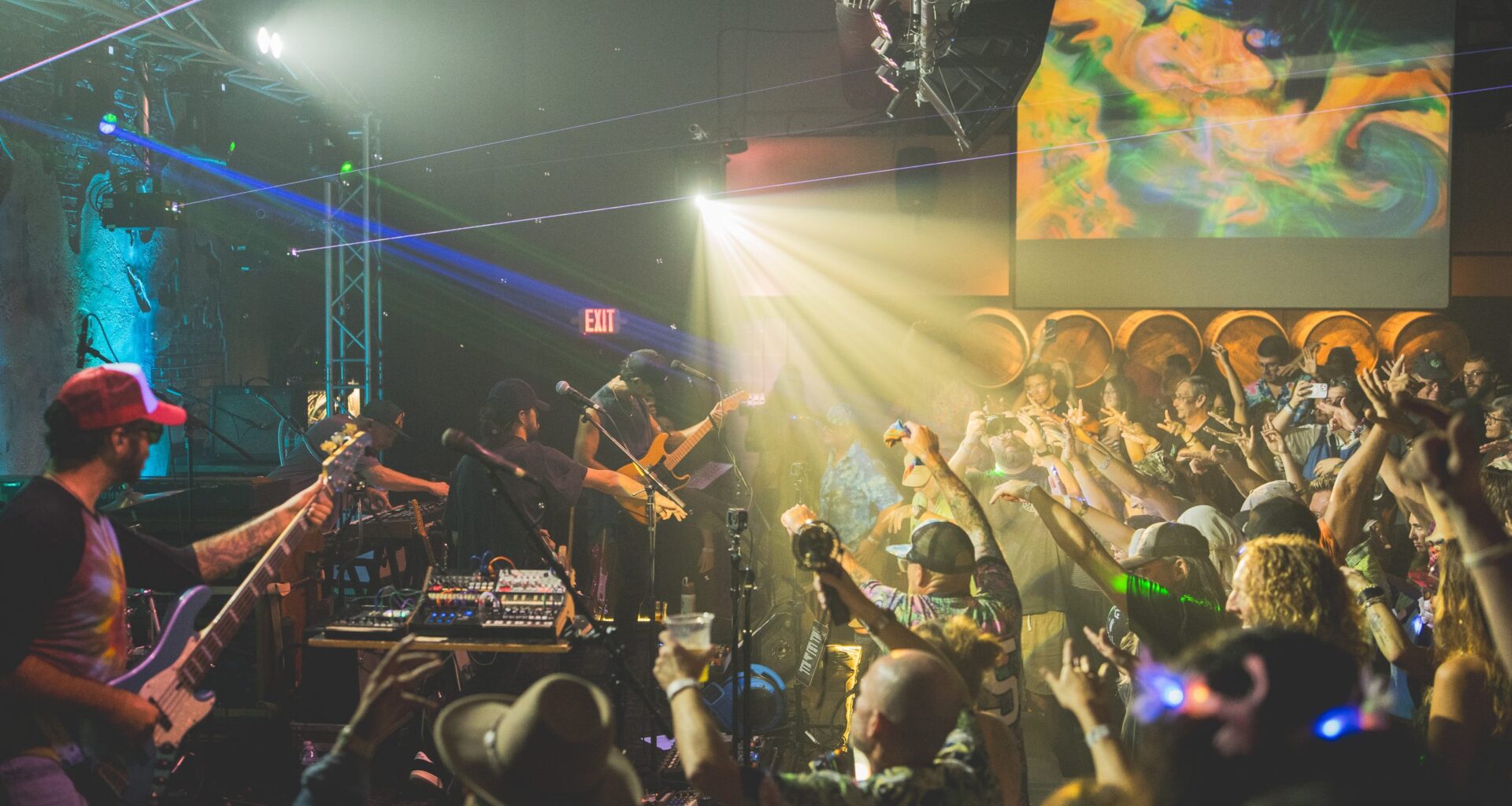
St. Petersburg, Florida boasts some of the best coastlines in the state, and it’s a surprisingly swimming environment for live music, too. Venues like Jannus Live and Ruby’s Elixir show off the city’s love of jazz, blues, rock, soul, and yep, jam bands, like upstart five-piece Ajeva, a group of St. Pete natives who’ve joined the likes of Heavy Pets, Electric Kif, Guavatron, and TAND in putting Florida’s jam scene very much on the national radar.
What does “Ajeva” mean, you ask? According to the band, the name derives from the Sanskrit word “jiva,” meaning “one soul,” and that’s how the band’s members like to think of it—as a collective mind, an integrated life form through which they each express their artistic visions.
With a new studio album, Sidequests—just released this past September with a launch show at Bayboro Brewing in St. Pete—and a ferocious live sound that blurs the lines between classic jam, jazz-funk, heavy-prog, and even whiffs of heavy riff rock, Ajeva grabs your attention the old-fashioned way; these cats can play. Wicked Allmans-style guitar harmonies? Check. Tight syncopated dance grooves reminiscent of STS9? Check. And Ajeva is keen to show its live bonafides, releasing live jams from every show on its packed-with-goodies Bandcamp page, as well as Spotify.
With his gutsy progressive blues vocabulary, guitarist Mike Nivens calls to mind players who dig in and strike the strings with serious heat. An admirer of former D’Angelo axman Isaiah Sharkey, Nivens calls to mind players like Commander Cody’s Bill Kirchen, blues master Eric Gales, and the New Bohemian’s Kenny Withrow. Singer/guitarist Reed Skahill, a funky axslinger who duels with Nivins aplenty on lead work, shifts vocally from tuneful to terrifying at will, with a rich, grainy tenor that seems to cover any hybrid style the band dishes out. With Lyndon Thacker on keys, Taylor Gilchrist on bass, and drummer Tucker Sody, the band has talent to spare, and improv is as integral to its ethos as their compelling songcraft.
We caught up with the band just after its album release show, with a raft of gigs across the South in front of it, including a Halloween show at FL’s Blueberry Patch, and a Fall tour with North Carolina’s like-minded jam/psych assassins, Big Something.
What are a couple recent shows that come to mind where you feel Ajeva hit some new levels?
Nivins: The album release show we just did was sold out, and the vibe was amazing. Y’know, when you walk in to play a show and you feel the anticipation of the crowd, everyone is buzzing, they’re ready for you to get up there and go, and everyone knows the songs. That was definitely a good one for us. And then the Whippersnapp Music & Arts Festival [see video]—we always play that on Saturday night right before whoever’s headlining. We’ve delivered some good performances the last few years, so I feel like there’s a little bit of buzz usually for us at that fest, too.
Do you tend to have set structures for your improvisations within a tune—an acknowledged stretch of, say, 64 bars, the way jazz players might—or are you willing to just throw down and see where it lands?
Nivins: I feel like we really do a no-parameters situation most of the time. It’s just being open in that moment to whatever’s happening, and we try not to rush things along just for the sake of getting back to the “head,” y’know? The idea is to really hear out whatever is going on in that moment and try to develop those ideas and evolve them right there onstage.
That’s a great phrase: not just listening in the moment, but mindfully “hearing out” what’s happening.
Nivins: Yeah, like hearing out whatever is going on in that particular moment, letting it live, instead of just trying to think of the next idea immediately. To jam well, it helps to be really comfortable just hanging in a space for a second and exploring that, you know? In the words of J. Dilla, “You gotta ride the track like a Cadillac”!

[Photo: Danirl Cura — Ajeva]
I also think there’s a sort of misconception about what “jamming” actually means for a band like ours. For us, it’s not just someone in the band taking a solo over a static groove. We’re all improvising with the soloist, we’re building a spontaneous composition together. I feel like we all try to leave space for the others to develop their ideas too. Obviously, as a guitar player it is somewhat of my role to do melodic things, just like Reed does when he’s playing guitar, or with Lyndon playing keys. But while that’s a part of your instrument’s job, you can’t just play melodies and licks all the time—you need to let the other musicians develop their ideas, too. If someone’s got a great idea and is suddenly taking the reins, then we’ll follow that!
While you improvise a great deal live, I noticed that Sidequests leans much heavier on traditional songform, which seems as natural to you all as jamming. This seems common among so-called “jam bands,” who are almost always much more than that.
Skahill: We’ve never really shied away from the term “jam band,” but we’ve always been open about what we are—we don’t like putting parameters on what we play, and we stay open to playing what we feel, even if that means sounds that are closer to hard-rock than the typical jam band might play. On some of our studio albums, for example, there’s barely any jamming on it at all, and quite a lot of our songs lean toward thrash and metal a bit. In the end, I’m proud of the fact that we’re all so open and willing to try new and different things, and really, just to be ourselves, whatever the genre is where we might get placed. And we love our fans and the community around this style of music. That’s key.
Ajeva | Whippersnapp Music & Arts Festival | Brooksville, FL | 2.22.25 | Full Video