
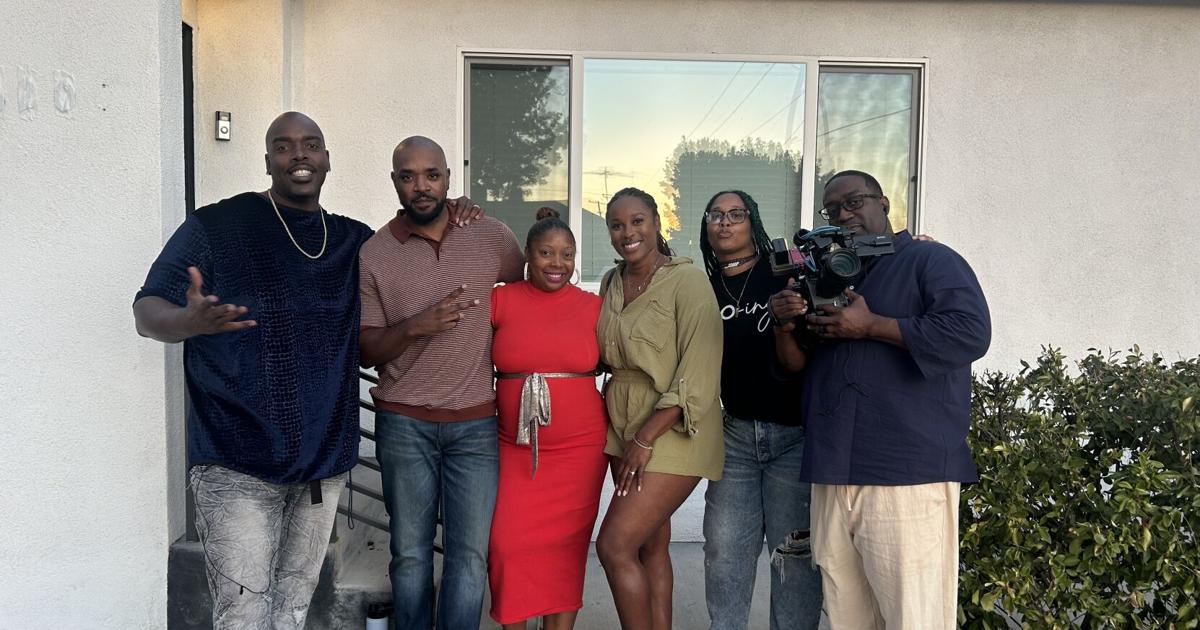
With roughly $500 and two days of filming, writer and executive producer Billi Sarafina turned a childhood experience she had kept secret for years into Hard Conversations: Jayla and Malcolm, a short film confronting sexual abuse, family silence and the lasting effects of trauma.
“I’m still healing,” Sarafina said.
She told The Miami Times she was sexually abused by an older cousin at age 6. For years, she feared that speaking out could fracture relationships with relatives she loved. But remaining silent carried its own emotional cost.

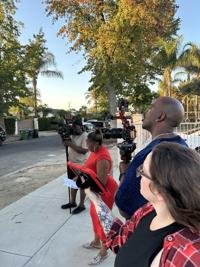
Behind the scenes of Hard Conversations: Jayla and Malcolm, featuring director of photography Qualo, actress Del Harrison, director Jahdai “Bigg Jah” Pickett and first assistant director Kali Ruth.
Directed by Marche Howell-Wright and Jahdai “Bigg Jah” Pickett, the Black-led film follows Jayla as she reveals her childhood abuse to her fiancé, Malcolm.
At a family gathering, Malcolm notices that Jayla, normally outgoing, has become unusually quiet. When he asks about her behavior, she offers explanations that leave him unconvinced. The exchange sets the stage for a conversation about the childhood trauma she has struggled to disclose.
The film was among eight short films selected from more than 60 submissions for NAMI Miami-Dade County’s Reel Minds Mental Health Film Festival, held Oct. 10 at the Little Haiti Cultural Complex on World Mental Health Day. It finished as runner-up for the festival’s People’s Choice Award.
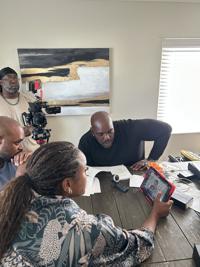
Behind the scenes of Hard Conversations: Jayla and Malcolm, featuring director of photography Qualo, directors Marche Howell-Wright and Jahdai “Bigg Jah” Pickett, and actor Harold Warren.
Among those in attendance were Miami-Dade County Mayor Daniella Levine Cava and City of Miami Mayor Eileen Higgins.
The weight of silence
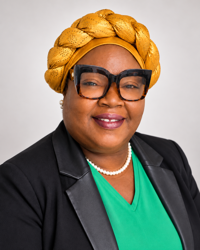
Shara Johnson, NAMI Miami-Dade County, Outreach Coordinator, Black and Underserved Communities Initiative.
(NAMI Miami-Dade County)
Shara Johnson, NAMI Miami-Dade County’s Black and Underserved Communities outreach coordinator, said silence surrounding sexual abuse is not unique to Black families. Whether someone feels comfortable speaking out can depend on family dynamics, cultural expectations and a sense of safety.
“Everybody wants to feel safe,” Johnson said, explaining that trauma can make disclosure especially difficult when the abuse involves someone a person trusted.
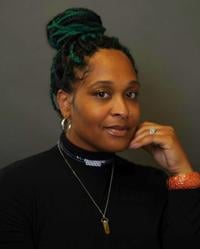
Billi Sarafina, executive producer, writer and creator of Hard Conversations.
(Black Light Imaging)
For Sarafina, those concerns extended into adulthood.
She disclosed the abuse to her future husband during couples therapy in 2017. His support helped her confront experiences she had struggled to discuss and establish boundaries within her family.
The consequences she feared became reality. Sarafina said her relationship with an aunt and uncle, whose son she identified as her abuser, deteriorated after she spoke out.
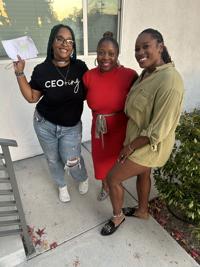
Hard Conversations executive producer Billi Sarafina, actress Del Harrison and director Marche Howell-Wright.
“I knew once I said something, our relationship would change — and it did,” she said.
But she also found unexpected support. A younger cousin cut ties with those relatives, a gesture Sarafina said helped her feel supported.
“So it stops with me,” Sarafina said, reflecting on her determination to break the cycle of silence.
After sharing her experience publicly in 2020, Sarafina said she heard from other survivors whose responses inspired her to write Hard Conversations during the pandemic.
Working with a small cast and crew, the filmmakers shot the film over two days in October 2025. Sarafina said they spent roughly $500, primarily on food, with expenses covered by her and Howell-Wright.
Sarafina, a mother of two, said her childhood experiences continue to shape how she raises her children. She is cautious about allowing them to spend the night away from home, a reflection of the protection she said she lacked growing up.
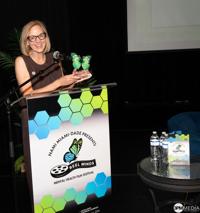
City of Miami Mayor Eileen Higgins presents the People’s Choice Monarch Award at the Reel Minds Mental Health Film Festival.
(3PM Media and NAMI Miami- Dade County)
“Just because it’s common doesn’t make it normal,” Sarafina said, repeating a line from the film that she considers particularly meaningful.
Beyond the screen
For filmmaker Antwon Lindsey, who served as emcee of this year’s Reel Minds Mental Health Film Festival, Malcolm’s response to Jayla’s disclosure stood out.
“What resonated with me most was the husband’s open communication and attentiveness,” Lindsey told The Miami Times. “Often, Black men are portrayed as careless, dismissive or emotionally distant.”

Susan Holtzman, president and CEO of NAMI Miami-Dade County, with Miami-Dade County Mayor Daniella Levine Cava at the Reel Minds Mental Health Film Festival on Oct. 10, 2026.
(3PM Media and NAMI Miami-Dade County)
Lindsey sees culturally relevant films as an opportunity to bring difficult conversations into the open.
“These stories permit viewers to feel connected and included in conversations that acknowledge their lived experiences,” he said.
Susan Holtzman, president and CEO of NAMI Miami-Dade County, said Hard Conversations was selected for Reel Minds for its portrayal of childhood trauma, family dynamics and the importance of seeking support.
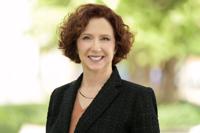
Susan Holtzman, president & CEO, NAMI Miami-Dade County.
(NAMI Miami-Dade County)
“By sharing stories and talking about those things that in the past have not been talked about, we can take away the power that secrecy and shame have,” Holtzman told The Miami Times.
In Liberty City, Overtown and North Miami, Johnson said she is seeing more openness about mental health among older Black residents, including those seeking help for their children and grandchildren. “It’s an awakening, from what I’ve seen,” she said.
But breaking the silence does not necessarily mean getting treatment.
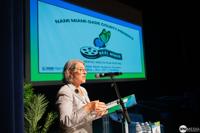
Miami-Dade County Mayor Daniella Levine Cava addresses attendees at the Reel Minds Mental Health Film Festival.
(3PM Media and NAMI Miami-Dade County)
In 2024, 14.7% of Black adults received mental-health treatment, compared with 22.9% of U.S. adults overall, according to the U.S. Department of Health and Human Services. The figures measure treatment use among all adults, rather than access among those who needed care.
In Miami-Dade, Holtzman identified stigma, misconceptions about treatment costs and a shortage of quality mental-health providers in predominantly Black neighborhoods as significant barriers.
Johnson pointed to additional challenges, including transportation, housing and financial pressures, and stressed the importance of involving residents in decisions about services intended for their communities.
NAMI Miami-Dade offers Sharing Hope, an educational program focused on Black communities, and works with faith leaders to connect residents with mental-health resources. Holtzman also called for more Black mental-health professionals serving predominantly Black neighborhoods.
Holtzman said NAMI typically receives more calls to its help line following events such as Reel Minds, although the organization did not provide figures documenting the increase.
For Sarafina, the film is not the end of the conversation.
She is working with five other women to develop a Hard Conversations miniseries exploring other difficult subjects, including family addiction and personal identity. The project remains in development.
Speaking publicly has not erased the effects of her childhood. But Sarafina hopes her story will help others feel less alone and more comfortable seeking support.
“I like people to know that they’re not alone,” she said.