
TAMPA, Fla. – Dr. Bárbara Cruz was surprised to learn she was the first Hispanic of either gender to be hired in the College of Education at the University of South Florida. She has been teaching at the university since 1991.
Cruz said she was immediately welcomed by the university and her colleagues.
“My colleagues really supported me in the mission to try to bring some voice and some contributions of Latino communities to the university and to our community at large,” she said.
Her story begins like millions of others who call Florida home — in search for the American Dream.
“I was born in Cuba, and I came to the United States as part of the Family Reunification Act. And so, my mother and I arrived in 1966,” she said.
Cruz left Cuba shortly after the Castro Revolution, and experienced challenges after arriving in the U.S.
“So, I do remember the struggle of learning English; learning a new culture. Being in a very different place,” she said.
“And at the same time, struggling to keep up with my peers in math and science and social studies and literature when you didn’t know the language. Little did I know that later on, I was going to come full circle back to that.”
Early on in her career as a professor, Cruz found there was limited information on Hispanic studies, and said in some cases, the field was misrepresented.
“The books that we saw in the school districts definitely had an under representation and in some cases a misrepresentation of Hispanic communities throughout Latin America and the Caribbean but also in the United States,” she said.
“And as a result, I started to call out that reality. I started to publish scholarly articles on that, and it got some traction, and at some point folks said, okay that’s wonderful, we understand that there’s a problem now, let’s try to fix it. So we did start to see some positive movement in the case of, like, school textbooks. But then at some point I realized I needed to put up or shut up either, you know; I needed to contribute to that story as well,” she said.
She has written several books, including a biography on Mexican painter Frida Kahlo and social studies textbooks for kids with her same upbringing.
One of Cruz’s pieces of work focuses on the Cuban sandwich: a history in layers.
“We don’t know of any other sandwich. In the history of humankind that has the kind of emotion and strong opinion about what should go in it,” she said. “We looked at old newspaper archives; we looked at old magazines from Cuba from more than a hundred years ago. We interviewed people and we can say with pretty good confidence that the Cuban sandwich originated in Cuba. Surprise.”
In her decades in education, she has also been a pioneer of teaching beyond the pages of a book.
She crafted learning programs involving USF’s Museum of Contemporary Art and teacher and student exchanges.
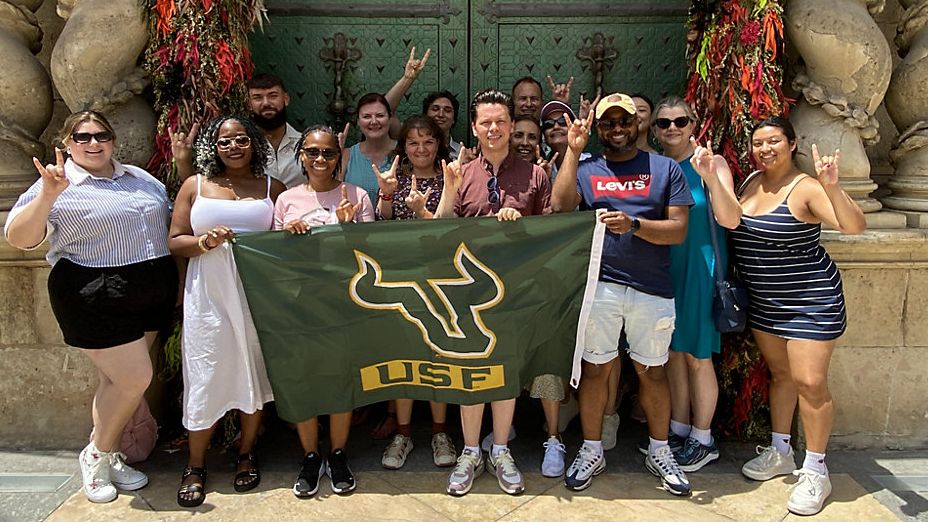
“We brought teachers from 24 different countries to USF, all part of the U.S. Department of State grants. And since then, I’ve taken students elsewhere,” she said. “So, I have led study abroad over the summer, which are a lot of fun. And again, it gets the students outside of the pages of a book. Doing experiential learning, cross-cultural learning, and coming back even more excited about the world and exploring it than they ever were before.”
That concluding chapter of her teaching career is still underway.
“We just started a new initiative at USF. It is called the EDGE Faculty Teaching Development Program, and it is to help professors from across campus learn how to be better teachers,” she said. “So, it’s a quest for teaching excellence, whether, whoever our students are.”
“I fundamentally believe that if every single human being on the face of this planet were to get a high-quality education that enables them to fulfill their potential on this earth, our world would be a completely different place,” Cruz said.