
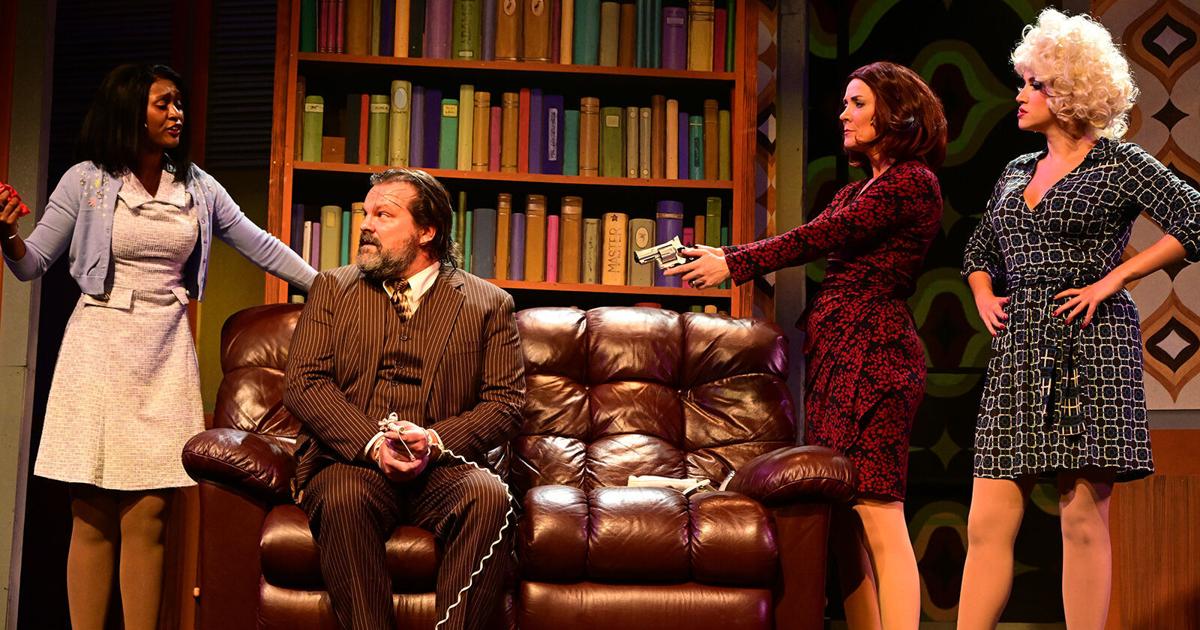

The girls kidnapping Mr.Hart, played by Jacob Medich.
MICHAEL SHAPIRO / COURTESY PHOTOS
More than four decades after the workplace trio featuring Violet, Doralee and Judy first decided they had had enough of their egotistical, sexist boss, the women of “9 to 5” still are fighting battles and using their voices in a revolutionary way in the lively Broadway Palm Dinner Theatre production.
Set in the late 1970s, “9 to 5: The Musical” takes audiences inside a toxic workplace, complete with its themes of women fighting to be heard, respected and valued and yet remains strikingly recognizable. Anchored by three commanding lead female performances, a strong supporting cast on all levels with dynamic performances and an energetic ensemble, the musical delivers plenty of laughs while reminding audiences why these characters have endured.
Today, the story carries an added emotional layer. Dolly Parton, who originated Doralee Rhodes in the 1980 film and wrote the music and lyrics for the stage musical, died in August, leaving a void in humanity and impactful women. Her presence, though, is woven throughout the production, including video appearances projected during portions of the show, adding a bittersweet and timely vignette to such a comedic, high-energy performance.
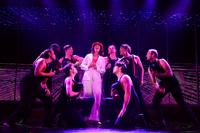
Violet Newstead, played by Sarah Hayes, performs “One of the Boys.”
MICHAEL SHAPIRO / COURTESY PHOTOS
At the center of the production are Violet, Doralee and Judy, three very different women who gradually become an unbreakable team played by Sarah Hayes, Emily Bacino Athaus and Nia Alsop respectively.
“Violet, Judy and Doralee represent the different stages of life for a woman – being seen as a sexual object in our youth, being discounted after marriage and being ignored as we age,” Prather Productions Resident Director/Choreographer Amy Marie McCleary described. “I think women of all ages can connect with these three and their growth through this story.”
The biggest character transformation Judy’s, played by Alsop, growing from a newly single and inexperienced worker into a woman increasingly eager to stand on her own. Her powerhouse number “Get Out and Stay Out” culminates her development into an independent and confident woman who discovers her self-worth.

Director Amy McCleary.
COURTESY PHOTO
While each actor is a standalone character with their own personal identity and story, their chemistry together is what gives the production much of its strength and authenticity. All three bring strong voices and stage presence to their roles, while making the friendship that develops among the women feel genuine rather than simply necessary to move the plot forward.
Each of these women discovers her voice and power to align in an unbreakable friendship with a mutual goal.
“These three women really do go on a journey together! I think Judy highlights Violet’s strengths and Doralee highlights Violet’s weaknesses,” said Hayes. “Violet is willing to give Judy a chance at a fresh start, even though it jeopardizes her own promotion. On the flip side, when we first see Violet and Doralee interact, we see that Violet hasn’t really given Doralee a chance. Throughout the course of the show, Judy teaches Violet that softness isn’t weakness…and sometimes it’s okay to cry. Doralee reminds Violet that you can’t and shouldn’t judge a book by its cover, because you might pass up an incredible story. It really is beautiful how these three women help each other find their voice and take back their power.”
While funny and entertaining, “9 to 5” also deals with workplace sexism, harassment, equal pay for the same job and women fighting to be taken seriously that are still relevant today to some degree.
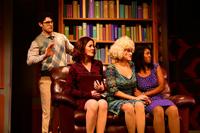
The girls & Joe, played by Cody Howard.
MICHAEL SHAPIRO / COURTESY PHOTOS
“I believe the show itself does a great job of balancing the humor of the film with the added benefit of music to ground the story of the women finding their power,” McCleary reflected. “I identify so much with the women in this show – being taken for granted, viewed as too emotional – I think all women have. By connecting with the characters – my three leading ladies have really been able to create very honest portrayals.”
Doralee, who was played in the movie by the late and legendary Dolly Parton, is the secretary judged by her co-workers due to her appearance and untrue rumors. Throughout the show, Doralee’s dialogue and musical numbers show who she is as a person underneath those assumptions.
“This is probably the aspect of the character that I relate to the most. As a young woman who is blonde, loves pink, makeup, and all things girly, I feel like I often get labeled as the ‘dumb blonde’ before anyone gets to know me,” Althaus recalled.
The “sexist, egotistical, lying, hypocritical bigot” boss is Franklin Hart, Jr., portrayed by actor Jacob Medich. Medich’s versatility and depth to portray characters is inspiring. Now he is a sleezy boss we hope to never encounter – and we love him.
Unlike many flawed characters, there is no redemption arc for Hart. He gets what he deserves after the ladies dig themselves out of a predicament. Medich not only captivates audiences with his rich, smooth crooning, but he also hits every note with objectification and just enough chauvinistic and sleazy style that audiences are fully invested in his destruction.
The supporting cast also offers several standout moments. Roz, an administrative assistant to Hart, portrayed by Reagan Blair, nearly steals every scene she enters, not just with her powerful voice but also with her physical comedy and timing.
Her unwarranted faith in her boss, devotion and secret longing for Hart give the character some of the production’s biggest comic moments. While she is a pawn in Hart’s attempt to use her as a spy, Roz remains blind to his flaws.
Joe, the junior accountant, played by Cody Howard, provides a very different kind of support, bringing warmth and sincerity to his scenes with Violet. He also shines a light on the office culture that not all men are evil and sexist.
The production also benefits from a sizable and talented ensemble that keeps the office bustling and the musical numbers visually active. The fast-paced choreography makes effective use of the larger cast, filling the stage without allowing the movement to become distracting or chaotic.
The physical set itself is relatively simple, making set changes quick, but it incorporates lighting effectively and leverages the stage’s back wall video screen, giving the stage more depth and helping create the feeling of a metropolitan high-rise workplace than the physical scenery alone might suggest.
“Anytime you direct a show that was originally a film, it can be difficult to figure out how to represent all the different locations. That’s the biggest challenge – designing a set that can create multiple locations,” McClary added.
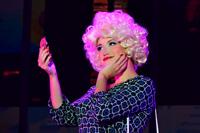
The Backwoods Barbie played by Emily Bacino Althaus.
MICHAEL SHAPIRO / COURTESY PHOTOS
But the screen has the strongest emotional impact when it is used to incorporate Parton into the production. Those appearances were always intended to connect the stage musical to its famous creator, but following her death, they brought tears to audience members as Parton said her parting words.
“9 to 5” continues to resonate decades after its debut. Beneath the big musical numbers, and three distinct, highly stylized revenge fantasies against their tyrannical boss is a story about three working women at different phases of their lives discovering their own power and revealing power of unity and self-worth.
“I think Doralee’s struggles will relate to so many women who see this show, which is still so incredibly timely, moving, and gives encouragement for women to stand up for the right to be treated like an equal human being rather than an object,” Althaus hopes. “I hope that audiences walk away from Doralee’s story remembering to not judge a book by its cover.”
There is a scene in the show where audiences really understand who Violet is and what she wants.
“The moment that stands out to me is when Violet confronts Mr. Hart after he gives the promotion she was hoping for (and has earned) to a man that she trained,” Hayes said. “Up until this moment, Violet has pulled her punches and watered down her reactions to Mr. Hart’s behavior to get the promotion. Now she has no reason to hold back and she unleashes on Hart.”
With Parton’s absence newly felt, the familiar opening notes of “9 to 5” carry something they did not before: a reminder of just how much of her wit, spirit and point of view live on in the show she helped create, and even more so, the path she created for women.
“Dolly Parton was and will always be one of my biggest role models in this world. Stepping into her shoes was something that I was so excited about, and her passing makes it even more special,” Althaus said.
When she sings “Backward Barbie,” it could have just as easily been Parton singing it herself about her own life journey. Althaus’ moving delivery is not just in this number, but honestly, throughout the show, without being characterized, just hit differently considering Parsons’ passing.
“My cast is honored to celebrate Dolly’s music and spirit in this production,” McCleary said. “Dolly was a champion for all humanity and that belief reflects in this show.”
In The KNOW:
WHAT: ‘9 to 5’: The Musical
WHERE: Broadway Palm Dinner Theatre, 1380 Colonial Blvd., Fort Myers
WHEN: Runs through Nov.14, 2026, Matinee 11:30 a.m. lunch, 1 p.m. show, Evening 5:30 p.m. dinner, 7:30 p.m. show, Twilight 5:30 p.m. dinner, 7 p.m. show
SIDEBAR:
Broadway Palm Dinner Theatre partnered with the Children’s Advocacy Center of SWFL to host a “Dolly’s Dream Big Book Drive” in which patrons can donate books targeting youth readers pre-K through 5th grade. Through her own Imagination Library program, Parton has made more than 300 million books available to kids in five countries, according to the program’s website.