
St. Petersburg’s small working port could undergo a major transformation over the next two decades, with expanded marine research facilities, boat repair operations and new infrastructure for small cruise ships.
City Council unanimously approved a new master plan Thursday outlining an estimated $93 million to $163 million in potential improvements to the Port of St. Petersburg over the next 10 to 20 years.
The plan replaces one adopted in 1999 and lays out a future for the roughly four-acre port along the downtown waterfront near the University of South Florida St. Petersburg campus.
The city is not committing to build everything in the plan. The proposals remain conceptual, and each would require additional studies, financing and approval before construction could begin.
David Wirth, who oversees the city’s marina and port facilities, said updating the plan also puts the port in a better position to pursue funding through the Florida Department of Transportation.
“We are not big by any means, we’re only about four acres, but we are still an important economic driver for the state and for the city,” Wirth said.
The city has narrowed its focus to three priorities: expanding the Maritime and Defense Technology Hub, exploring marine maintenance and repair facilities, and improving the port’s small-ship cruise operations.
The technology hub, which opened in 2022, occupies a 32,000-square-foot building where companies and researchers develop and test maritime equipment, including technology used for coastal monitoring and defense.
Alison Barlow, CEO of the St. Petersburg Innovation District, said the facility has attracted interest from the National Oceanic and Atmospheric Administration, United States Coast Guard, Department of Defense and other partners.
The proposed expansion, known as Hub 2, would add approximately 50,000 square feet beside the existing building. Plans call for large workshop spaces with waterfront access on the ground floor and offices on the upper levels.
Barlow pointed to a recent demonstration involving an autonomous device designed to map seagrass beds as an example of the work taking place at the hub. The ability to put equipment directly into the water, she said, gives the facility an advantage over larger commercial ports.
“Our small size is actually an asset,” Barlow said.
The city is also considering marine repair facilities that could serve both researchers and commercial boat operators. Those improvements could include cranes or other equipment capable of lifting vessels from the water.
Wirth said the city would likely seek private partners rather than operate a boatyard itself.
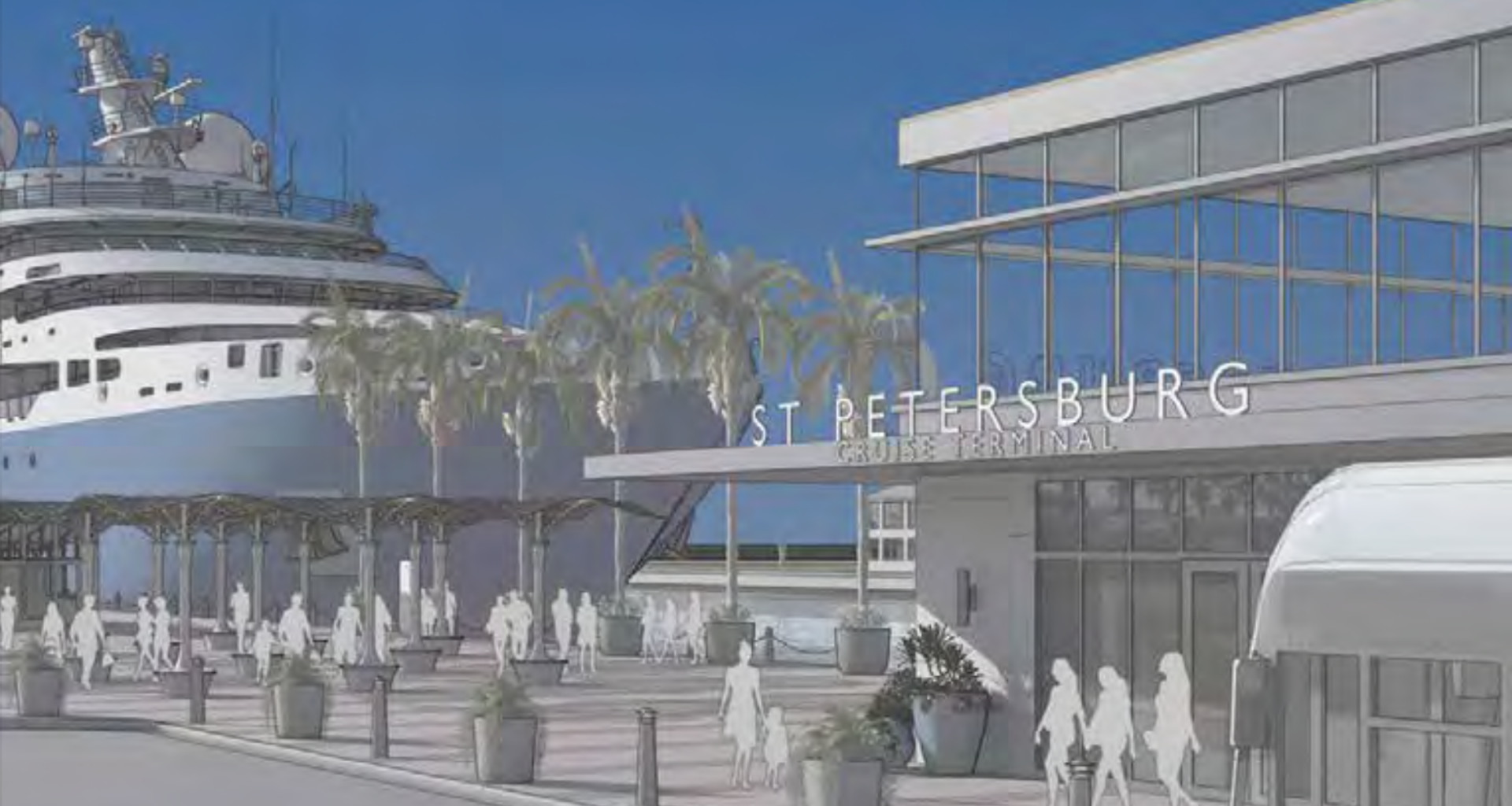
Near the University of South Florida St. Petersburg campus, the master plan envisions improvements for small cruise ships, including a possible 600-foot extension of the existing wharf and a new passenger terminal.
American Cruise Lines already operates seasonal voyages from St. Petersburg. Wirth said the company is expected to return Nov. 3 for its fourth season, with approximately three ships per week operating through April.
The company has expressed interest in partnering with the city on improved passenger facilities and additional docking space. Wirth said the existing port has limited room for buses, rideshare vehicles and arriving passengers, constraints that would need to be addressed as cruise operations expand.
Councilmember Gina Driscoll questioned illustrations showing recreational boating facilities and a superyacht marina near the technology hub, where waterfront access is needed for research and the proposed expansion.
Wirth acknowledged that the illustrations were developed before plans for Hub 2 had advanced. He said the city had considered revising them, but doing so would have exceeded the remaining budget for the planning study, which was partially funded through a state transportation grant.
Driscoll cautioned against treating the port primarily as a recreational destination.
“We are certainly not trying to turn the port into a playground,” she said.
Wirth said the recreational concepts should not be mistaken for city priorities. The focus remains on maritime technology, vessel services and small cruise operations.
The estimated cost of those three priorities, $93 million to $163 million, is lower than the $150 million to $270 million range associated with the broader collection of proposals considered earlier in the planning process.
Even the reduced figure is preliminary. It reflects current construction costs and excludes expenses such as design, permitting and potential utility improvements.
Council Chair Lisset Hanewicz cautioned that costs could rise significantly over the plan’s 10- to 20-year horizon.
Wirth said each project would undergo separate market and financial studies before the city decides whether to proceed. State and federal grants, private investment and partnerships could help cover some of the expense.
Barlow said the proposed technology hub expansion could build on the work already underway and attract additional businesses and researchers to the waterfront.
“We see this as an opportunity to position the Port of St. Pete as nationally recognized for maritime innovation,” Barlow said.