
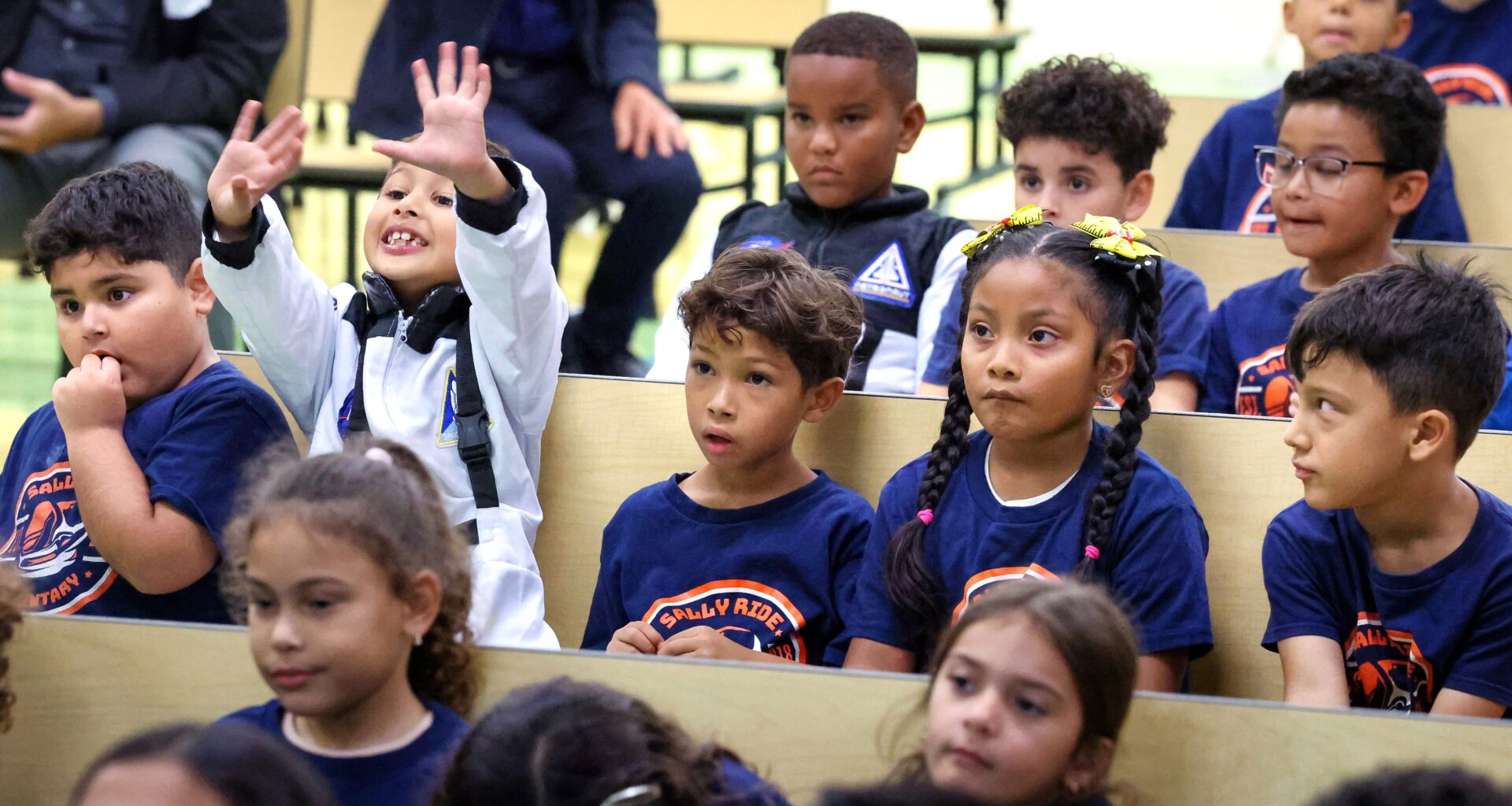
The fidgeting was strong, but so was the excitement among more than 100 kids gathered at Sally Ride Elementary School in Orlando on Friday to hear a pair of NASA astronauts, including one from Central Florida, answer questions from space.
Luke Delaney, who grew up in DeBary and watched space shuttles launch from Enterprise Elementary School in the 1980s, joined fellow NASA astronaut Jessica Watkins as they orbited 250 miles above the Earth, for a call down to the Orange County magnet school.
The pair answered 25 questions over a 20-minute transmission from space while floating in zero gravity.
Delaney, 47, who is on his first spaceflight, was chosen as an astronaut in 2021 after a career as an engineer, naval aviator, test pilot and NASA research pilot.
“For students at an aviation and aerospace magnet school, that sounds like a pretty cool career path,” said fifth-grader Angel Banon, a student chosen to talk about Delaney’s career ahead of the call.
The students, some donning mock flight suits in blue, white, silver and even pink, had prerecorded the questions, so the questioners sat amid the crowd as they were asked. The students were for the most part quiet during the Q&A, but they exploded in enthusiastic shouts when they heard the names of their fellow students as they were introduced.
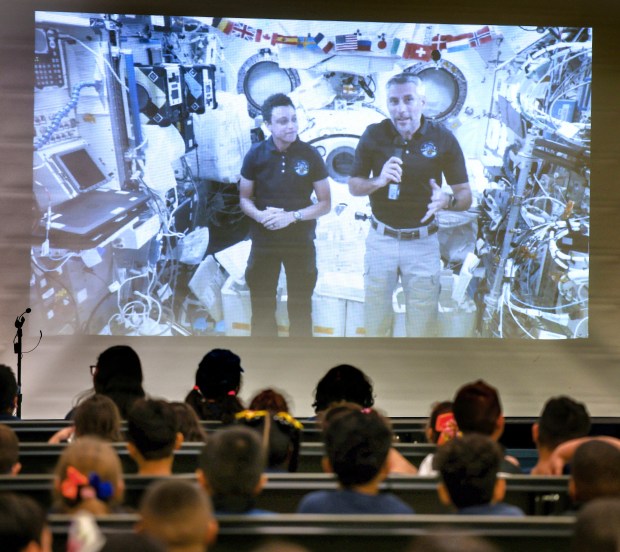 Students in Sally Ride Elementary School’s Aviation and Aerospace Magnet Program listen while NASA astronauts Jessica Watkins and Luke Delaney talk to them live from the International Space Station, Friday, October 16, 2026. 26 students posed questions about living in space as a part of NASA’s In-flight STEM Downlink program. (Joe Burbank/Orlando Sentinel)
One student, Autumn Denison, wanted to know what was the most surprising school subject that could lead to space career.
“You know, Autumn, I think what surprised me is it’s really all kinds of subjects are important for the space career,” Delaney said. “Engineering is what a lot of people think of, but actually when it comes to food services and actual maintenance of things, you need a lot of different career choices and a variety in order to support a space station. So really, all subjects, all aspects are really important. If you like something and you’re interested in it, just stick to it, and I think you can apply it to future space exploration.”
Keitlyn Santos, a Sally Ride alumna who is now in eighth grade, attended the event, too. As a fifth grader at Sally Ride, she had been one of the students able to ask astronauts a question the previous time the school had been chosen to talk with the space station.
“This school was a really great experience for me, and it let me explore and really know what I wanted to do and what I wanted to become,” she said, adding she hopes one day to be flight engineer, in a role similar to the ones Delaney and Watkins have serving as part of Expedition 75 on board the station.

Beatrice Berriz —coordinator for Sally Ride Elementary School’s Aviation and Aerospace Magnet Program— along with fifth-grader Myla Oliveria get ready to connect with NASA astronauts live from the International Space Station, Friday, October 16, 2026. 26 students posed questions about living in space as a part of NASA’s In-flight STEM Downlink program. (Joe Burbank/Orlando Sentinel)

Kindergartner Lennon Hughes and fifth-grader Myla Oliveria, students in Sally Ride Elementary School’s Aviation and Aerospace Magnet Program, cheer as the connection with NASA astronauts is established to interact with the class live from the International Space Station, Friday, October 16, 2026. 26 students posed questions about living in space as a part of NASA’s In-flight STEM Downlink program. (Joe Burbank/Orlando Sentinel)

Students in Sally Ride Elementary School’s Aviation and Aerospace Magnet Program listen while NASA astronauts Jessica Watkins and Luke Delaney talk to them live from the International Space Station, Friday, October 16, 2026. 26 students posed questions about living in space as a part of NASA’s In-flight STEM Downlink program. (Joe Burbank/Orlando Sentinel)

A student in Sally Ride Elementary School’s Aviation and Aerospace Magnet Program waves to visitors while NASA astronauts talk to them live from the International Space Station, Friday, October 16, 2026. 26 students posed questions about living in space as a part of NASA’s In-flight STEM Downlink program. (Joe Burbank/Orlando Sentinel)

A student in Sally Ride Elementary School’s Aviation and Aerospace Magnet Program cheers as NASA astronauts wrap up their remarks to his class live from the International Space Station, Friday, October 16, 2026. 26 students posed questions about living in space as a part of NASA’s In-flight STEM Downlink program. (Joe Burbank/Orlando Sentinel)
Show Caption
1 of 5
Beatrice Berriz —coordinator for Sally Ride Elementary School’s Aviation and Aerospace Magnet Program— along with fifth-grader Myla Oliveria get ready to connect with NASA astronauts live from the International Space Station, Friday, October 16, 2026. 26 students posed questions about living in space as a part of NASA’s In-flight STEM Downlink program. (Joe Burbank/Orlando Sentinel)
Delaney revealed that not everything is easy in space after third grader Aiden Cruz Garcia asked what was harder than expected in microgravity.
“I think a lot of times for me, it’s just the simple task of eating,” Delaney said. “There’s a lot of foods up here that maybe don’t stick together as well as you would want, so they end up breaking apart and floating around. And then it becomes a crew event to try to eat what is moving about the capsule or the compartments here.”
Watkins, who has a backgound in geology, was perhaps the most enthusiastic answering a question from fifth grader Jack Loayza-Ramirez about what rocks on Earth can teach about Mars.
“I absolutely love this question. This is what I studied for a long time before I became an astronaut,” she said, noting that while the two planets are similar, understanding them with different atmospheres and gravity is a challenge. “So it’s a really neat problem to see the same processes and rocks that we see here on Earth and think about how they might act or behave differently on Mars.”
The school’s magnet program coordinator Betty Berriz smiled ear-to-ear as she watched the kids take in the event.
“Teaching them is never boring,” she said. “They come with such questions, and sometimes they teach me.”
The event took a lot of planning but proved worthwhile.
“I still don’t believe what we did. I feel extremely excited,” she said. “The payoff, all the laughter, the good moments. … That is enough for me. I would do it again.”