
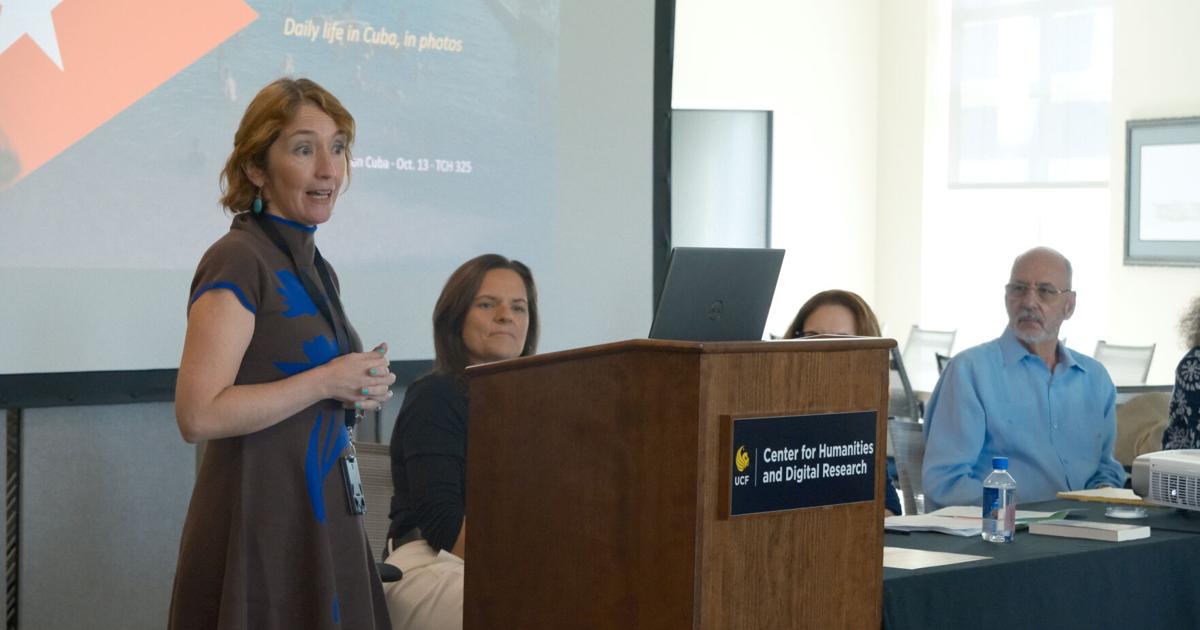

Yamile Silva, chair of the Department of Modern Languages and Literatures, introduces panelists as Kacie Tartt, Cuban-American author Ivonne Lamazares, and Luis Martínez-Ferdnández sit during the opening statement of Conversations on Cuba on Tuesday at Trevor Colbourn Hall.
Asa Carvajal
Empty, trash-strewn streets; children collecting drinking water on a rainy Cuban road; and a woman using a latex glove as a catheter collection bag.
These were among the many images displayed in the opening presentation of the “Conversations on Cuba” roundtable Tuesday at the Trevor Colbourn Hall.
“And this is like at the hospital, right? They don’t even have a collection bag. They ask you to bring your collection bag with you,” Kacie Tartt, panelist and department of modern languages and literature instructor, said. “So then, someone from the United States has to send you a collection bag before you’re going to the hospital, or you have to buy it on the black market.”
Friends of Tartt currently living in Cuba took the pictures, and she asked them to send images of their daily lives for the panel.
Images of elderly women searching for food, methods of cooking without gas and men using wood to power a car’s engine lit up the projector as the slides flipped.
The roundtable took place during the final days of Hispanic Heritage Month, as Cuba continues to face its worst humanitarian crisis in decades, according to The New Humanitarian.
UCF experts on Latin American studies like Tartt discussed the island’s worsening conditions and complex history, encouraging audience input.
“Of course, there’s need in every country; there’s need in our country, there’s need in our communities,” Tartt said. “But I think it’s really hard for people to imagine that they don’t have an ink pen in their house, or that they don’t have any deodorant or that they don’t have one thing to eat.”
Cuba is in the middle of its “worst crisis since the 1959 revolution,” according to USA Today.
Cecilia Milanés, Puerto Rican literature professor and panel organizer, said the island is in a position where they can’t really ask for help.
Following the U.S. oil blockade on Venezuela, which halted the oil shipments Cuba relied on, Milanés said electricity and water pumps fail to run, and garbage doesn’t get cleaned up.
“The Coast Guard just stopped a ship that was coming from Mexico with oil and fuel, and basically turned it back,” Milanés said. “They’re isolated more than ever before.”
Despite Florida’s close proximity and intertwined history with the island, Milanés says she believes many students, including her own, don’t know about the conditions on the island.
“I guess if you watch Spanish language news, you might get some stories about Cuba,” Milanés said. “But the only thing on national American news was when Trump was at the United Nations, and he said Cuba’s a failing nation and it’s failed, and the Cuban delegation walked out. That’s national news.”
Tartt has seen the tragedies in Cuba firsthand. She said most of the things she has seen happen in Cuba, most of her students wouldn’t believe until they saw it themselves.
“When I talk to people about Cuba, when I talk to them about the situations that people find themselves in, I find that number one, they become very overwhelmed, to the point sometimes that they don’t want to talk about it or hear more,” Tartt said.
Kacie Tartt, Department of Modern Languages and Literature instructor, displays an image sent from Cuba of an older woman digging through trash for food at the Conversations on Cuba panel Tuesday in Trevor Colbourn Hall.
Asa Carvajal
Pegasus professor Luis Martínez-Fernández, Latin American specialists Annabelle Conroy and Karina Céspedes and Cuban-American novelist Ivonne Lamazares spoke at the panel as the images continued to loop in the background.
The presentation included images of Cuba’s beautiful beaches, Cubans celebrating birthdays, dancing and celebrating despite the lack of power and resources. Tartt said she wanted to include beautiful images that depict Cubans finding moments of joy even in their lack of basic needs.
Tartt said she believes it’s hardest for people to imagine what schools look like in Cuba today. Schools reopened on Sept. 1, despite reported water and power shortages, according to AP News.
“They didn’t have pencils, they didn’t have paper, they didn’t have notebooks,” Tartt said. “And in a lot of cases, they didn’t have teachers because a lot of the teachers have gone.”
Cuba’s population has declined significantly since 2020, the official estimated decline being 9.7 million, exceeding all Cuban migration waves combined, according to the Council on Foreign Relations. Many teachers, doctors and nurses have left Cuba, leaving gaps in education and healthcare.
“The rate at which Cubans are exiling themselves at this moment is greater than any other moment in history,” Tartt said.
Jesse Rothbard, assistant professor of Spanish and co-organizer of the event, said he asked Tartt if what was happening in Cuba now was worse than the Periodo Especial, the period in the 1990s during the fall of the Soviet Union when the island was left without aid.
Rothbard said he and Tartt had spoken about how this crisis is bad in a way that it has never been in Cuba before.
“They’re wishing for the Periodo Especial right now,” Tartt said.
Tartt included statistics between the images in her presentation, highlighting extreme energy instability, with reports of blackouts lasting up to 60 hours, critical shortages of water, food and basic medicines like acetaminophen, as well as the cost of propane, which is as much as 21 months of Cuba’s minimum wage.
Hannah Carrero, a Puerto Rican junior double majoring in political science and English literature, said much of what goes on in Latin America and the Caribbean is often overlooked in American politics and society. She said open, informative discussions like these can spark change.
“Shedding light on that and really showing the conditions in which these people are living in and what they’re facing in their day-to-day life kind of shifts the narrative, because it allows people to be like, okay, well, what can we do now?” Carrero said. “How can we help these people? How do we get more informed so that we’re not continuing this abusive cycle?”
Rothbard, who teaches Latin American literature, believes that despite all of these hardships, Cuba has one of the richest cultural and literary traditions in the region; Cubans have found ways to live.
“Understanding that in the face of all of this need, that people keep on living, and not only living in terms of surviving, but they find moments of joy and pleasure in spite of all of this,” Rothbard said.
Milanés said she wants the panel to show Cuba’s resilience.
“People are starving. Young people are committing suicide. They’re using wood to burn on their balconies to cook because there’s no gas to cook,” Milanés said. “Some guy I saw on a reel actually fixed his car so that he could burn wood to run the car. It’s like, ‘how do you do that?’ But Cubans have tremendous ingenuity because they’ve learned to make miracles with nothing.”
Rothbard said he hopes panel-goers leave seeing the common humanity rather than being divided by politics or society, especially in a moment where Cuba’s future is uncertain.
“They have a human face, and this is not just happening to some group of people in a different part of the world, but that it’s happening to people just like us in a lot of ways,” Rothbard said.