
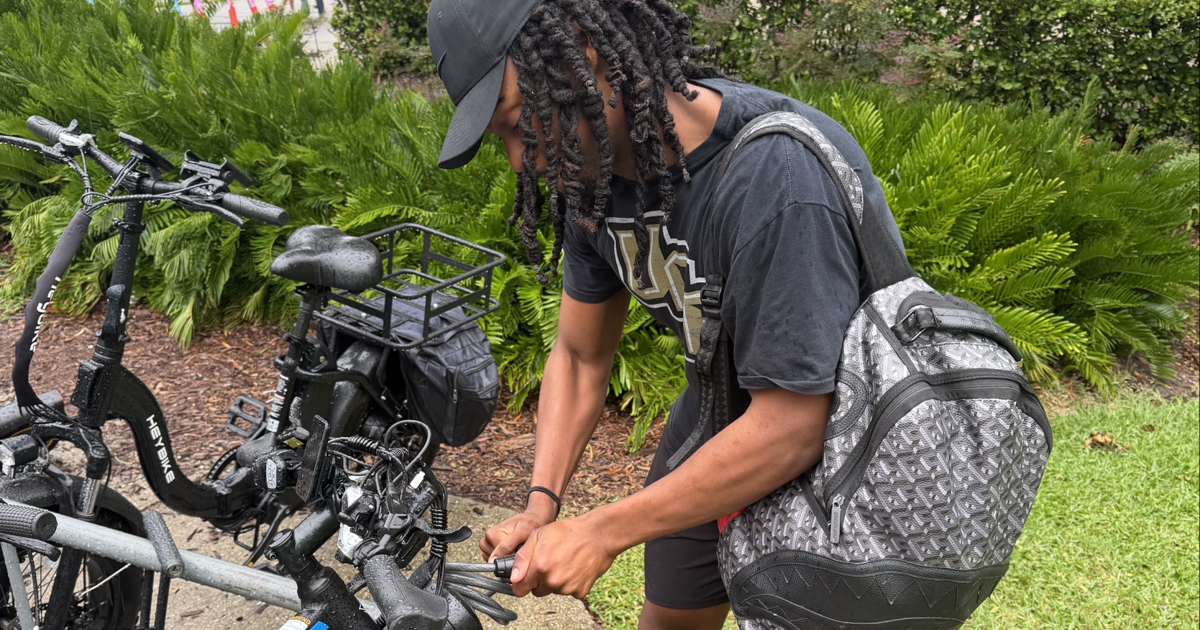

Ezekiel Enaigbe, sophomore electrical engineering major, locks his e-bike on main campus Oct. 7. Enaigbe is one of the many students on campus who rely on e-bikes, e-scooters or various other micromobility devices for transportation around campus.
Gabriella Borriello
The Orange County Board of County Commissioners unanimously approved the micromobility and e-bike safety ordinance on Sept. 29.
The ordinance amends Chapter 35, Articles VII and VIII of the Orange County Code regarding “Electric Bicycles” and “Micromobility Devices.” Under the updated rules, device speeds are capped at 10 mph on sidewalks and multi-use paths, and 20 mph on permitted roads and bike lanes.
In an Oct. 3 Facebook outreach post, Orange County officials summarized the rules with a clear warning: “Know the rules. Ride responsibly. Share the space.”
Under Sec. 35-91 of the ordinance, riders must park devices upright without obstructing foot or vehicle traffic. Public property parking is restricted to designated micromobility staging areas, leaving at least 4 feet of clear sidewalk space for ADA accessibility and building entrances.
The ordinance also grants local authorities the power to enforce minimum age requirements, mandate government-issued photo identification and require safety training. Non-compliance carries a Class 1 civil citation and a $100 fine.
This graphic was posted on the Orange County, Florida Government Facebook account on Oct. 3, showcasing the new rules and regulations for various micromobility devices.
Courtesy of Orange County, Florida Government
For University of Central Florida students navigating campus walkways on motorized scooters and e-bikes, the county rules serve as an added safety reminder.
“We recognize that scooters are a convenient way for students to get around our campuses, and we want riders to arrive where they need to go safely,” Amanda Sellers, Communications Manager for UCF Public Safety, said. “Rental scooters operating on campus have speed limitations in place as a safety measure, and UCFPD officers use discretion when monitoring and enforcing scooter-related rules.”
Ezekiel Enaigbe, sophomore electrical engineering major, uses an e-bike for daily campus transportation.
“I think the new rules will make it safer for everybody,” Enaigbe said.
Andro Fuentes, a junior mechanical engineering major who uses an e-scooter to get to and from class, agreed that clearer rules could improve student safety.
“I think a lot of people are getting e-bikes that are way too fast, and they’re not mature enough to use the proper protection like helmets and stuff,” Fuentes said. “They can get seriously injured, so I think it’s a good idea.”
Sellers noted that while the new county regulations are not expected to cause major disruptions to daily campus operations, rider awareness remains essential.
“We encourage riders to keep safety top of mind by following posted rules, staying alert to pedestrians and vehicles, slowing down in congested areas and avoiding distractions while riding,” Sellers said.