
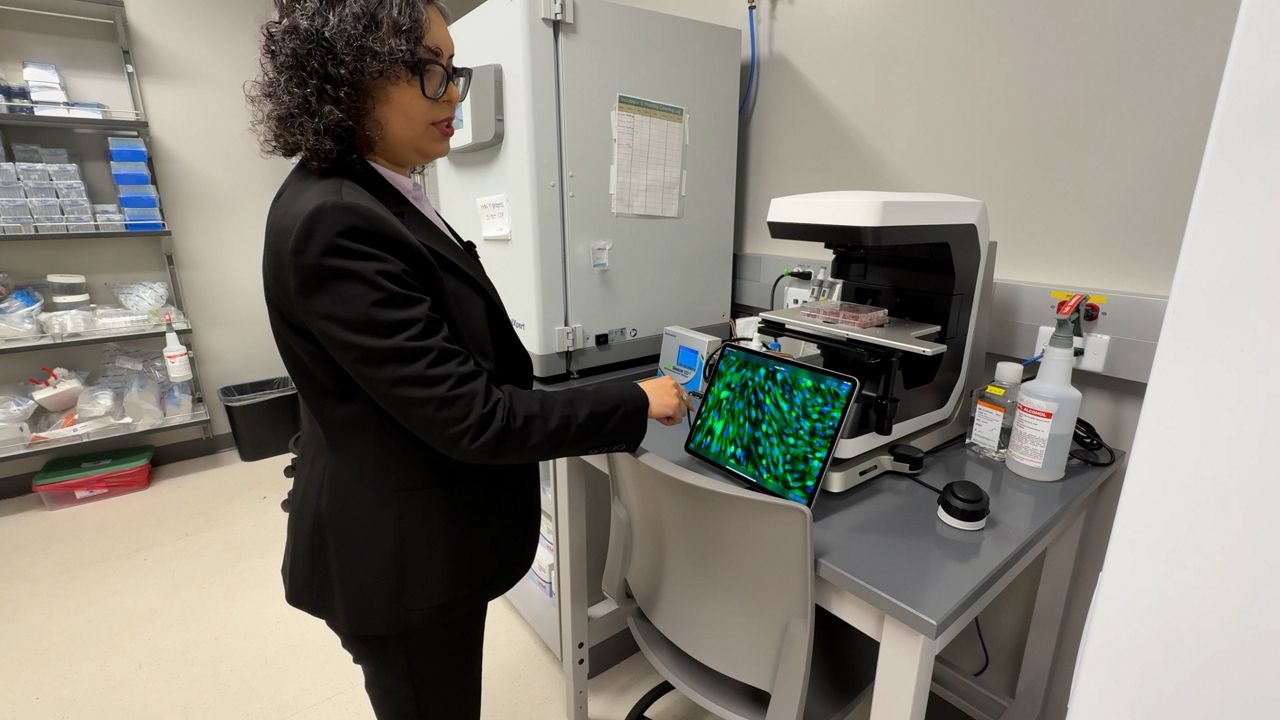
TAMPA, Fla. — Researchers at the University of South Florida are working on a heart valve replacement option they hope could one day reduce the number of open-heart surgeries needed by people born with heart valve defects.
Dr. Neda Latifi, an assistant professor in USF’s medical engineering department, leads a research team that includes undergraduate students through Ph.D. students. The team is focused on congenital heart valve defect solutions, including developing materials that could better adapt as younger patients grow.
Current mechanical and organic replacement options do not grow with children, meaning young patients often need several open-heart surgeries as they get older.
“In my research group, the focus is to bring material cells together and develop something that could adapt with the body, that could hopefully eventually integrate with the body and mimic the key features of heart valves,” Latifi said.
The team’s early findings have researchers hopeful their work could eventually lead to a solution that grows with a patient’s body. Patients like Meadow Boes show why that matters. Meadow, now 4, was born with complex heart defects. Her mother, Sarah Boes, said she learned early that her daughter would need multiple surgeries.
“Now you’re going to have a baby who will have open heart surgery in their first week of life, and they’re going to have another one by the time they’re a year old, and they’re going to continue to have them throughout their life was a massive adjustment,” Boes said.
Boes said Meadow is now thriving between surgeries. “To watch her grow today and ride horses and go to Forest School and get to be a normal kid for a bit has been a beautiful experience for us,” Boes said.
Boes said Latifi’s research makes her cautiously optimistic. “You know, it’s hard in the space because you never want to get too excited and too on the edge of your seat, but at the same time, like this really would rewrite the narrative of Meadow’s future,” Boes said.
Latifi said hearing from families helps guide the lab’s work.
“Sara’s open discussions not only inspires me and my lab and how we are doing our research and what we are contributing, but also helps us get to know better and better what are the challenges, how they are affecting the patient,” Latifi said.
The goal is to eventually make it so patients need only one surgery, but Latifi said any reduction in surgeries would be a win. The research is currently in preclinical stages.
There is no timeline for clinical trials, but Latifi said the lab work is looking promising.