
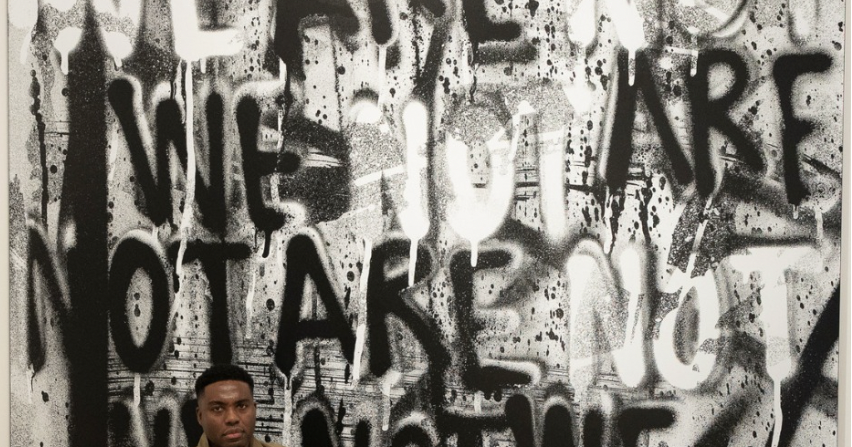
The commutability of artistic talent is, for many artists, a way to represent how they made the leap from one expression of ideas to another. In New York-based painter Adam Pendleton’s case, it’s how he characterizes the connection between the literary arts and the visual.
“Painting has always been related to language for me,” said Pendleton.
The artist was an extremely curious child, a precocious reader and writer whose passions for the written word became an inquisitiveness into the possibilities of geometry as a novel method of emotional communication.


Adam Pendleton’s work is on display on the first floor of the ICA.
(Elisabeth Campbell for The Miami Times)
This year, the Institute of Contemporary Art Miami acquired for its permanent collection a 2023 painting by Pendleton known as Untitled (WE ARE NOT), which is part of a continuing series. The painting, bold and stark, repeats variations of the title phrase in abstraction, breaking the boundaries of conventional grammar to evoke feelings of contemplation.
Pendleton’s method, an experimental form he calls “Black Dada,” is an ever-evolving scrutinization into the relationship between the Black identity and the avant-garde.
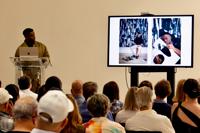
Adam Pendleton presents a series of slides documenting his process in the studio.
(Elisabeth Campbell for The Miami Times)
“Black Dada is about this sense of something being unfixed and not easily defined, but necessary, emergent, and radical, all at the same time,” said Pendleton. “It’s a kind of operating space I’ve created for myself as an artist, a tool that exists outside of time.”
Black Dada was originally inspired by two things: the first, a 1964 poem entitled “Black Dada Nihilismus” by Amiri Baraka, an American writer and poet laureate of New Jersey; and the second, German poet Hugo Ball’s 1916 “Dada Manifesto.” “Black Dada Nihilismus” explores themes of race, violence, and political revolution, while “Dada Manifesto” is equal parts limitless and anarchistic, written in response to World War I.

An attendee takes a photograph during Adam Pendleton’s talk.
(Elisabeth Campbell for The Miami Times)
At his talk at the Institute of Contemporary Art on Nov. 8, which is part of the ICA Speaks programming, Pendleton discussed the contradictions, poetics, and gestures inherent in his approach to painting. He paints as a response to the contemporary experience, exploring the world in fragments. From “Days Paintings,” which he uses to mark the time he spends in the studio, to the “Composition Paintings” that he uses to explore the core elements of his work, Pendleton is intentional in his craft.
“I am tremendously dedicated to an old-fashioned work ethic, to really see what comes out of hard work,” said Pendleton, “not in the sense of toil necessarily, but hard work in the sense of being committed and dedicated. What happens when you bring all of yourself to something?”
For many at the ICA Speaks event, this dedication was clear. Many questions came from the crowd as curious listeners sought to learn more about Pendleton’s work.

Curator Ludlow Bailey asks Adam Pendleton a question about his artistic legacy.
(Elisabeth Campbell for The Miami Times)
“He’s very, very clever about navigating the art world because it’s really not a Black game. He’s done extraordinarily well,” said curator Ludlow Bailey. “For you to be considered seriously as an important artist, the, quote, ‘academy’ has to approve of you, and I think he’s done it.”
Bailey, Managing Director of Contemporary African Diaspora Art, speaks to the difficulty of finding an edge as a Black artist in the visual arts world. Although there have been several genre-defining Black artists, such as the late Jean-Michel Basquiat and contemporary photographer Carrie Mae Weems, the appreciation of Black art is still comparably low.
Bridging this gap is part of the ICA’s ethos as a museum on the cutting edge of contemporary art. The ICA prioritizes the mission of being an international platform for local, emerging, and under-recognized artists, feeding the flow of appreciation of a wide variety of art styles. It offers free, year-round admission to encourage open access to the Miami community and beyond.
“We have an important permanent collection that records global movement in contemporary art and serves as an engine for our exhibitions program,” said Alex Gartenfeld, the Irma and Norman Braman Artistic Director at ICA. “We seek for our collection to represent truly global positions that complicate traditional understandings of modernism and art in the post-war period.”

Adam Pendleton shares a written piece that connects poetry with the visual arts.
(Elisabeth Campbell for The Miami Times)
As Pendleton’s work becomes a part of that permanent collection, Gartenfeld and the ICA seek to expand their reach into underrepresented demographics in the contemporary art world. For Gartenfeld, Pendleton’s work represents a tremendously unique approach to contemporary art, as he includes drawing, photography, silkscreen printing, collage, watercolor, and spray paint into his compositions.
“Adam is such an extraordinary voice in painting because of the incredibly multidisciplinary way that he works,” said Gartenfeld. “His work is deeply engaged with our history, and with language, and with rethinking our understandings of our history.”
Recently, the ICA acquired a second facility on its block that will double its exhibition space. Gartenfeld believes the addition will offer an opportunity to tell a fuller story about the ICA’s permanent collection. Renovations are currently underway, and the new space will be open to the public as soon as late 2025 or early 2026.