
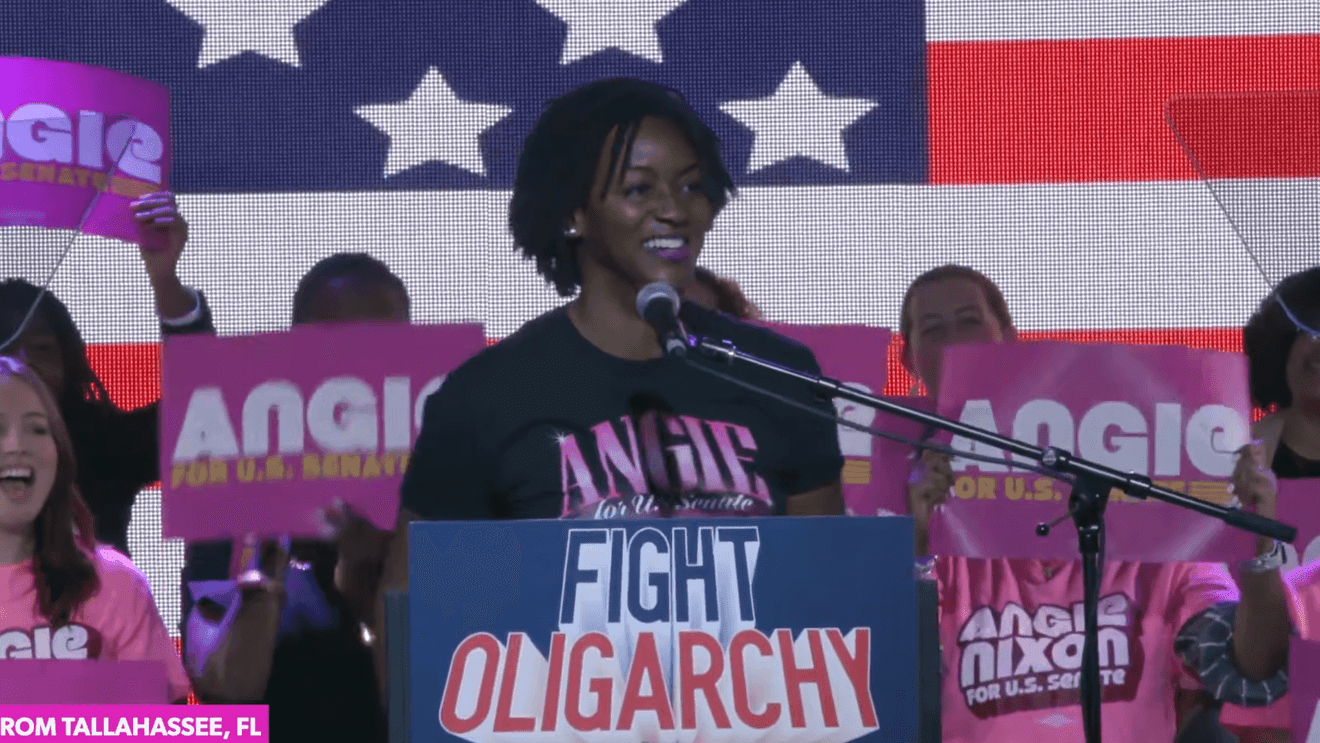
TALLAHASSEE, Fla. — Sen. Bernie Sanders brought his “Fighting Oligarchy” tour to Florida’s capital Sunday night, throwing his national progressive movement behind Democratic U.S. Senate candidate Angie Nixon as she tries to pull off another political upset — this time against Republican Sen. Ashley Moody.
But as Nixon and Sanders railed against money and corruption in American politics before an energized Tallahassee crowd, Nixon was also confronting questions about her own campaign’s financial reporting.
Speaking with reporters after the rally, Nixon acknowledged that her campaign has made mistakes in handling some contributions after the Federal Election Commission raised questions about several of its filings.
“When you have over 300,000 campaign donations, of course you sometimes have some errors, some accidents,” Nixon said. “There’s absolutely nothing nefarious or anything, and so we are going to look at that, and we’re going to correct it.”
Pressed on whether she was describing mistakes by her campaign, Nixon said, “Mistakes get made sometimes.”
She offered an example: “Sometimes people make a donation $25 over, you just refund them.”
The acknowledgment came with just 16 days remaining before the Nov. 3 election, as Nixon attempts to become the first Democrat to win a U.S. Senate election in Florida since Bill Nelson won re-election in 2012.
Recent polls have shown Moody ahead, although the size of her advantage has varied considerably. An Oct. 5-7 St. Pete Polls survey of likely voters found Moody leading Nixon 47 percent to 45 percent, while an MDW Communications survey conducted Oct. 4-10 put Moody ahead 48 percent to 42 percent.
Nixon, however, has already defied expectations once this year.
The Jacksonville state representative stunned the Democratic establishment in August by defeating retired Army Lt. Col. Alexander Vindman in the party’s Senate primary despite being dramatically outspent. Her campaign relied heavily on grassroots organizing and support from labor, Black voters and progressive activists.
Sunday night, two of the most recognizable figures in the progressive wing of American politics came to Tallahassee to argue that the same model could work statewide.
“This election is not only important for the people of Florida,” Sen. Bernie Sanders told the crowd. “After Angie wins, this is going to be a spark that is going to ignite the entire country.”
Sanders, a Vermont independent who caucuses with Democrats and twice sought the Democratic presidential nomination, has spent years making economic inequality, universal health care and the influence of wealthy donors central to his political movement. Nixon has deep ties to that movement: She worked on Sanders’ 2016 presidential campaign as a deputy field director focused on Black outreach.
At Sunday’s rally, Sanders portrayed Nixon’s campaign as part of a broader fight over economic and political power, arguing that wealthy donors and corporations exercise too much influence over elections and government.
“We have to end this corrupt campaign finance system,” Sanders said, calling for an end to super PACs and for public financing of elections.
That message also framed Nixon’s speech.
A mother of five, former union organizer and small-business owner who has served in the Florida House since 2020, Nixon cast herself as a working-class alternative to Moody and repeatedly returned to the cost of housing, groceries, insurance and health care.
“I know what it means to work hard and still struggle to have to pay your bills,” Nixon told the crowd. “I know what it means to look at your child and wonder how you’re going to give them every single thing that they deserve.”
Nixon reiterated her support for Medicare for All, stronger unions and higher wages, while rejecting Republican efforts to portray those positions as radical. She has joined the Democratic Socialists of America, an affiliation Republicans have made a central part of their attacks against her.
Nixon has resisted defining herself by the socialist label, instead arguing that her positions reflect the economic concerns of working-class Floridians. The distinction could prove particularly important in Florida, where Republicans have for years used socialism as an attack against Democrats, particularly in heavily Hispanic South Florida.
Moody, meanwhile, entered the Senate through a much different path.
Gov. Ron DeSantis appointed her to the seat in January 2025 after Marco Rubio resigned to become President Donald Trump’s secretary of state. Before joining the Senate, Moody served six years as Florida’s attorney general and previously worked as a federal prosecutor and Hillsborough County circuit judge.
The November special election will determine who serves the remainder of Rubio’s term, which runs through 2028.
Republicans have won every U.S. Senate election in Florida since Nelson’s 2012 victory, and the state has moved sharply toward the Republican Party in recent election cycles. Nixon must now assemble a statewide version of the coalition that propelled her through the Democratic primary.
Rep. Maxwell Frost, D-Orlando, who became the first member of Generation Z elected to Congress in 2022, argued Sunday that Democrats have misunderstood Florida’s political trajectory.
“We’re not a red state. We’re an under-resourced state,” Frost said. “We’re not a red state. We’re an under-organized state.”
Frost’s presence reinforced the organizing theme running through the evening. Before his election to Congress, he was the national organizing director for March for Our Lives, the gun-violence prevention organization that grew out of the 2018 shooting at Marjory Stoneman Douglas High School.
Nixon, Sanders and Frost repeatedly urged supporters Sunday to turn the enthusiasm inside the venue into door knocking, phone banking and votes.
But Nixon’s campaign must simultaneously answer questions about its financial reports.
The FEC has sent Nixon’s principal campaign committee, Angie for Florida, requests for additional information concerning its filings. The questions include apparent contribution-limit or designation problems and discrepancies in reported receipts.
An FEC request for additional information is not a finding that a campaign violated federal law. Such notices give committees an opportunity to clarify information or amend their reports.
The Florida Republican Party has seized on the notices to accuse Nixon of campaign-finance violations. Nixon rejected suggestions Sunday that anything improper had occurred and characterized the issues as routine errors arising from a large volume of contributions.
Asked whether her campaign would meet an Oct. 22 deadline to respond to the FEC, Nixon said it would.
“We’re going to make it,” she said.
Asked what she would tell voters concerned about the way her campaign is handling its money, Nixon said, “My campaign is definitely handling the money correctly.”
Nixon repeatedly accused Moody of corruption Sunday, focusing in particular on the controversy surrounding $10 million from a Medicaid settlement connected to the Hope Florida Foundation. Nixon has called for further investigation and used considerably sharper language against Moody during the rally and afterward.
The rhetoric underscored how bitter the race has become as Election Day approaches.
Nixon described Moody from the stage as “lying, cheating, thieving” and “scamming,” while arguing that Moody and her allies were using ideological labels to distract voters from economic issues.
Republicans, in turn, have emphasized Nixon’s progressive record and affiliation with the Democratic Socialists of America as they seek to define her as outside Florida’s political mainstream.
For Sanders, those attacks are familiar.
His visit to Tallahassee capped a four-stop Florida swing that also took him and Nixon to Tampa, Melbourne and Gainesville. In Tallahassee, Sanders argued that a Nixon victory would reverberate well beyond the state.
“What you do in the next 16 days can change the course not only of American history but of world history,” Sanders told supporters.
Nixon offered a more immediate test of her campaign’s momentum when reporters asked why she believes she can win a statewide race Democrats have repeatedly lost.
She pointed to turnout at recent rallies, her fundraising and her willingness to face questions from reporters.
“We don’t run away from tough questions,” Nixon said. “I’m sitting here answering them from you.”
For at least one of those questions, Nixon now has a deadline of her own.
Her campaign says it will answer the FEC by Thursday.