
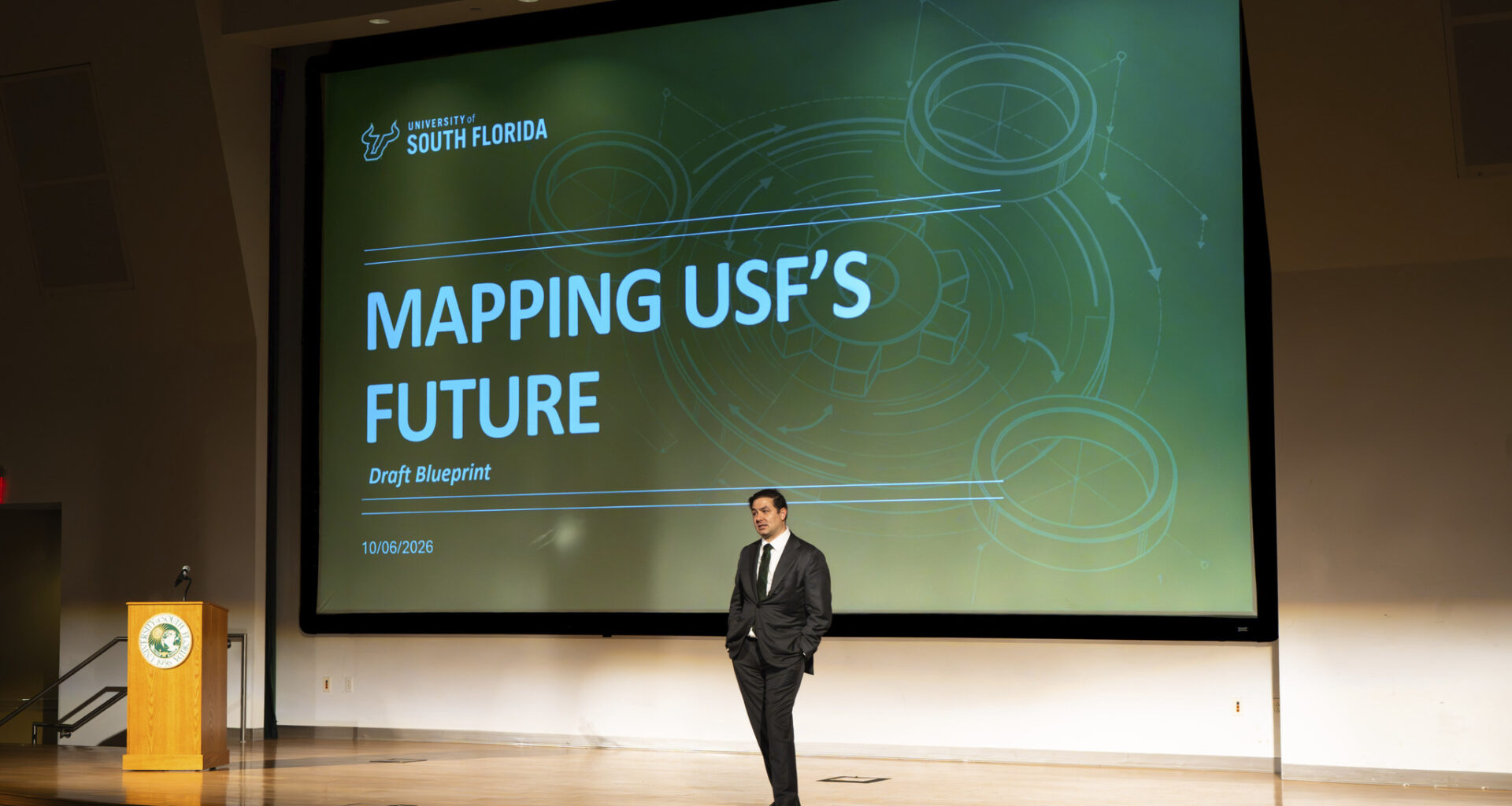
 Dr. David S. Simmons, co-chair of the Mapping USF’s Future Committee, presented the “Draft Blueprint” for USF’s next five-year strategic plan to faculty, staff and students at a town hall Oct. 6 in the Marshall Student Center’s Oval Theatre. ORACLE PHOTO/AYRON ESPINO-NARDI
USF’s proposed five-year strategic plan puts artificial intelligence at the center of its vision for the university, drawing mixed reactions from students and faculty at an Oct. 6 town hall.
The Mapping USF’s Future Committee — a group of 21 influential members of USF’s leadership tasked with envisioning the university’s future — presented its “Draft Blueprint,” an outline of the university’s goals for the next five years.
USF President Moez Limayem and the Florida Board of Governors formed the committee in May 2026. Some members of the committee include Muma College of Business Dean David Blackwell, USF Tampa General Physicians President Mark Moseley and USF Athletics CEO Rob Higgins, according to Mapping USF’s Future’s official website.
Dr. David S. Simmons, the committee’s co-chair, USF Faculty Senate president and a professor of chemical, biological and materials engineering, introduced the plan and explained why AI features across its five pillars.
“We have an area of expertise in applied AI,” Simmons said. “But it was clear to us as we went through this, [AI] cuts across every single research area, every single pillar as we’ve already seen, and so it makes sense as the cross-cutting angle.”
The university also recently announced updated plans for the building for the Bellini College of Artificial Intelligence, Cybersecurity and Computing.
The committee identified creating a national model for education in an AI-driven world as one of the plan’s five pillars. Simmons said AI’s potential applications across research areas informed the decision to make it a central theme.
The other pillars include improving livelihoods, providing national security, improving resilience for coastal communities, and creating new technologies at a molecular level.
Simmons said USF is the fifth-largest educational innovation enterprise among the top 100 public universities, according to the National Science Foundation’s Higher Education Research and Development survey.
Related: Bellini College students, faculty say new building will unite scattered college
Vivienne Spotswood, a sophomore geographic information systems major, said she noticed the heavy focus on AI but was surprised by the nuance.
“I had seen that a lot of it was going to be AI-focused,” she said. “I really liked that the person who presented it isn’t fully obsessed with it. There’s definitely skepticism of it, and he wants to prioritize critical learning first before integrating AI. That was something I was surprised [about], but definitely happy to see.”
Dr. Andrew Hargrove, an associate professor of instruction at the Judy Genshaft Honors College, said they were concerned about the draft’s emphasis on AI and metrics.
“The things that kind of rubbed me the wrong way are the focus on metrics and the focus on AI,” Hargrove said. “I think that those things can be important, but I don’t like when they’re front and center, because what it does is it hijacks our ability to decide why we should care about those things.”
Related: USF breaks ground on $500 million Uptown Landing, formerly Fletcher District
Simmons said that every pillar supports the “flywheel,” a proposed diagram showing how talent, impact, perception and partnerships work together to lift the university.
 CUT: Simmons presenting the flywheel diagram during the town hall. ORACLE PHOTO/AYRON ESPINO-NARDI
“This is the fundamental strategy of how we both grow our impact, and grow our resources to enable us to do that,” Simmons said.
The town hall was the ninth of 13 feedback sessions held as part of the planning process. Others include a St. Petersburg town hall, a Student Government consultation and a Council of Deans consultation, according to Mapping USF’s Future’s official website.
The committee is expected to use feedback from the sessions to finalize its blueprint draft ahead of approval by both the USF Board of Trustees in November and the Florida Board of Governors in early 2027.
Simmons said expanding opportunities for students is what motivates him most about USF’s future.
“What really motivates me is making this an even better university in terms of the opportunities we give our students to excel,” he said after the event in an interview with The Oracle. “Making sure that everybody who comes here has the opportunity and is supported and succeeding.”