
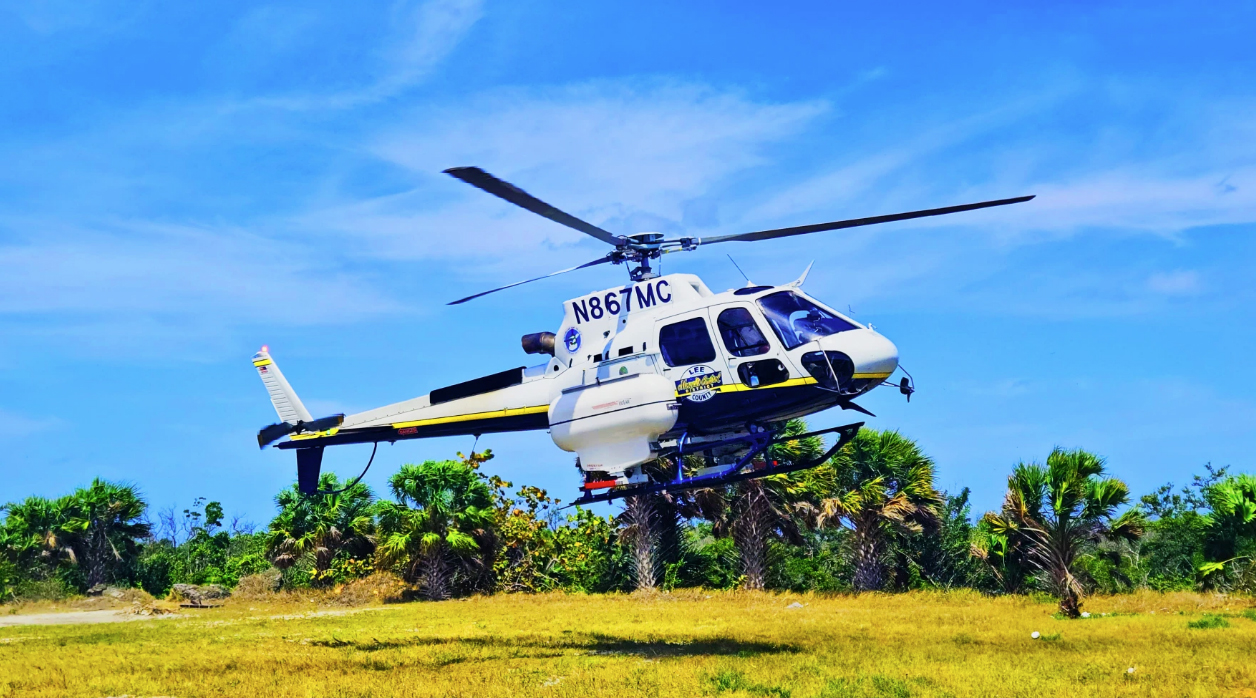
Pinellas County is taking its fight against dengue to the skies, partnering with Lee County Mosquito Control to conduct aerial treatments in parts of St. Petersburg and Clearwater as cases of the mosquito-borne virus continue to rise across Tampa Bay.
The treatments could begin as early as Friday, according to Pinellas County Public Information Manager Tony Fabrizio, who said Lee County could deploy up to four helicopters to spray a fine mist of Bacillus thuringiensis israelensis (Bti), a naturally occurring bacterium that kills mosquito larvae.
“The treatment is very expensive,” said Fabrizio. “They will be using up to four helicopters.”:
Official will continue doing rotational treatments each Wednesday.
The helicopters will fly at low altitudes between 9 a.m. and 3 p.m., allowing the Bti to reach standing water in tight spaces where mosquito larvae breed. Though the low-flying aircraft will be noisy, the bacterium is not harmful to humans, pets or pollinators.
Pinellas County’s own helicopters are not equipped to conduct this type of treatment, prompting the partnership with Lee County.
As of the Florida Department of Health’s Oct. 15 report, Pinellas County had recorded 37 confirmed dengue cases since August, while the Tampa Bay region had seen 351 cases across Pinellas, Hillsborough and Pasco counties. The numbers are updated weekly on Thursdays.
“It’s a regional problem,” Fabrizio said, noting that mosquitoes generally don’t travel far, but infected people can carry the virus into other communities.
Dengue isn’t transmitted directly from person to person. Instead, a mosquito that bites an infected individual can acquire the virus and, after an incubation period, transmit it to another person through a subsequent bite.
As for where the helicopters will fly, the exact treatment boundaries remain up in the air.
“Department of Health (DOH) doesn’t release specific areas,” Fabrizio said, citing HIPAA concerns. “They will draw polygon boundaries and treat within those boundaries. It will include downtown St. Pete. But the polygons have not been finalized.”
Preliminary treatment areas in both St. Petersburg and Clearwater are still being determined.
Unlike traditional truck-based treatments, which struggle to reach certain breeding grounds, aerial applications can cover larger areas in less time. The county will monitor reported dengue cases to help evaluate whether the expanded treatments are working.
Pinellas County has remained under a local state of emergency since September, allowing officials to expedite mosquito control expenditures and potentially seek reimbursement if state funding becomes available.
Alongside the aerial operation, mosquito control crews continue daily truck treatments, weather permitting, while additional trucks contracted through Clarke Mosquito Services assist with overnight spraying.
County workers are also going door to door in at-risk neighborhoods to help residents identify and eliminate standing water where mosquitoes breed.
“In terms of the numbers, we can’t get into the public health part of it, but we’ve had a strong response to dengue,” Fabrizio said, pointing to the county’s outreach efforts and dedicated information website.
Residents can register for neighborhood treatment notifications through Alert Pinellas, while additional information about dengue prevention and mosquito control operations is available at Pinellas.gov/dengue.