
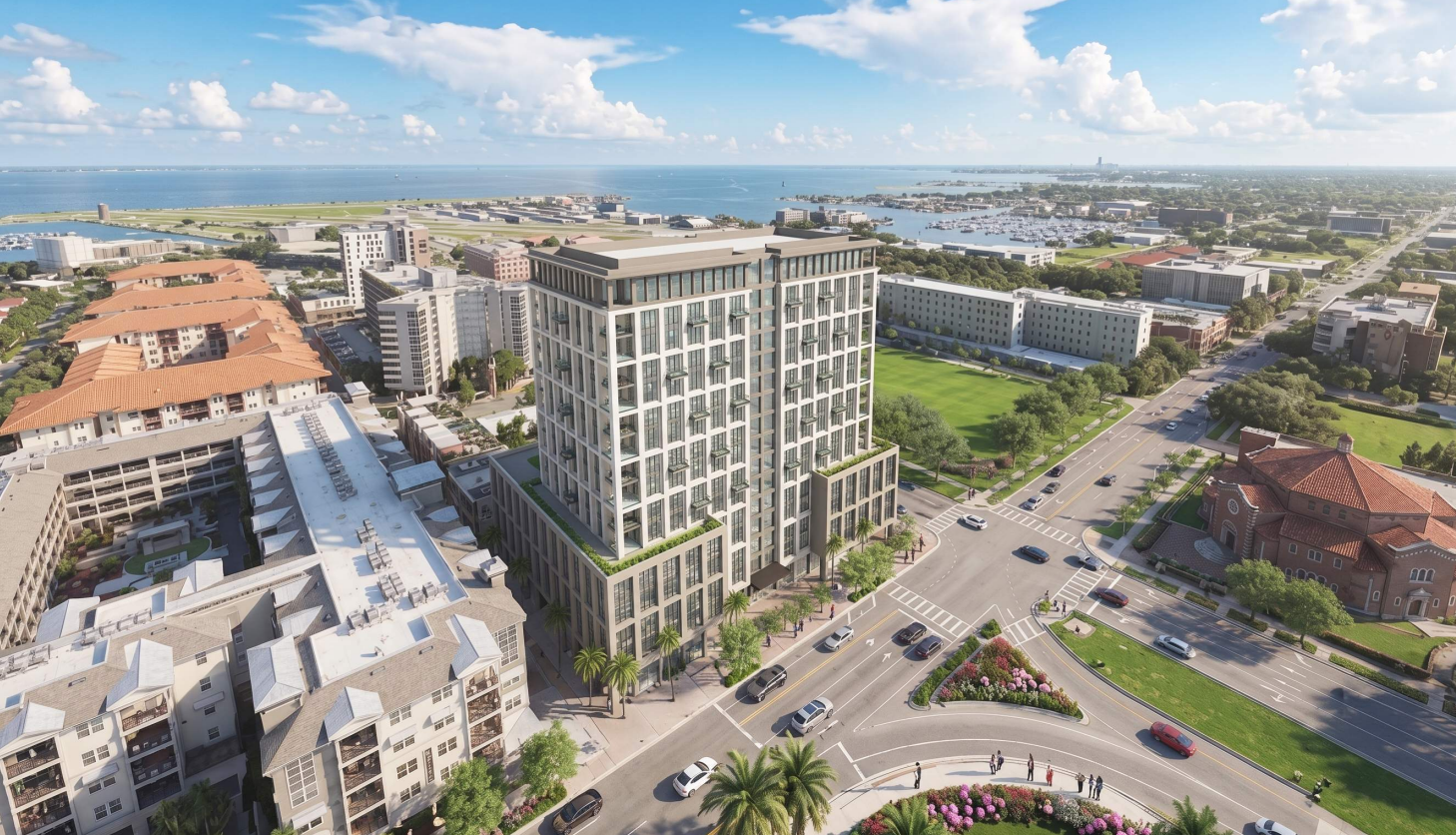
Two developers have pursued apartment towers on the same downtown St. Petersburg property in less than two years. Neither project has moved forward, leaving an older commercial building and parking lot across from the University of South Florida St. Petersburg campus without a clear future.
The latest proposal, a 16-story building with 165 apartments, was withdrawn in September by Charleston, South Carolina-based The Beach Company. It followed a 21-story development from Stadler Development that received city approval in February 2025 but never broke ground.
The setbacks at 446 Fourth Street S. come as developers across the region contend with high interest rates, rising insurance expenses and construction costs that have made new projects increasingly difficult to finance.
Jon Wittner, a St. Petersburg commercial real estate broker who worked with prospective buyers interested in the property, said developers are shelving projects that would have been financially workable under different market conditions.
Wittner said his firm was involved in potential transactions at the site but never represented the owner. He was not involved in the transaction that followed Stadler’s departure and could not explain The Beach Company’s withdrawal.
The slowdown is visible in the city’s skyline, he said. Wittner estimated that downtown St. Petersburg had roughly a dozen active construction cranes a year ago, compared with just one today, operating at The Cade Residences, a seven-story condominium development overlooking Mirror Lake.
The broader numbers show a similar retreat. According to Marcus & Millichap’s second-quarter 2026 multifamily market report, the number of apartments under construction across the Tampa-St. Petersburg market fell to its lowest level since early 2021 during the first quarter of this year.
Wittner also cited uncertainty surrounding oil prices, which can affect fuel, transportation and the cost of construction materials. Those fluctuations make it harder for developers to estimate expenses on projects that may take years to complete.
For developers without substantial cash reserves, Wittner said, that uncertainty makes an already difficult investment even riskier.
The property at Fourth Street and Fifth Avenue South offers one example of the challenges.
In January 2025, the Catalyst reported on Stadler Development’s plans for a $67 million, 21-story tower with 213 apartments, 2,250 square feet of commercial space and a 230-space parking garage.
The project was intended to bring housing near the university, hospitals and the city’s Innovation District. City Council, acting as the Community Redevelopment Agency board, approved the proposal the following month.
Stadler Development ultimately decided against building it.
John Stadler later told the Tampa Bay Business Journal that the company had not completed its feasibility analysis before seeking approval because of a short due diligence period. The roughly 0.7-acre parcel proved too small to accommodate the city’s requirements and the developer’s ground-floor needs in a financially workable arrangement.
The Beach Company subsequently proposed a smaller tower on the property.
Its plans called for a 16-story building standing approximately 195 feet tall, with 165 apartments, about 3,200 square feet of ground-floor commercial space and a parking garage with 176 spaces. Earlier concept drawings showed 150 apartments before the later city review identified 165.
The plans went through departmental review in August and September ahead of a scheduled hearing before the city’s Development Review Commission.
Most city departments raised no objections, but the Engineering and Capital Improvements Department identified restrictions that could affect the building’s design.
Fourth Street South and Fifth Avenue South are controlled by the Florida Department of Transportation. Engineers warned that building foundations and other structural elements could not extend into the state-controlled rights-of-way.
Similar restrictions applied along Delmar Terrace, the narrow alley on the property’s northern edge. An eight-inch sanitary sewer line runs beneath the alley, limiting where construction could extend.
City engineers warned that the restrictions could require changes to the building’s footprint. The documents do not establish whether those issues influenced The Beach Company’s decision.
The proposal was initially scheduled for a September hearing, which was postponed until October. On Sept. 21, development manager Morgan Bentivegna emailed city zoning official Corey Malyszka requesting that the application be withdrawn from the Oct. 7 Development Review Commission meeting.
The email offered no explanation.
City spokesperson Samantha Bequer confirmed that no replacement application has been submitted and officials do not know whether another proposal is forthcoming.
For now, the property remains without an approved project moving toward construction.
Despite the difficult market, Wittner sees some signs of relief. With fewer projects to bid on, contractors are becoming more competitive, and some construction prices have begun to fall.