
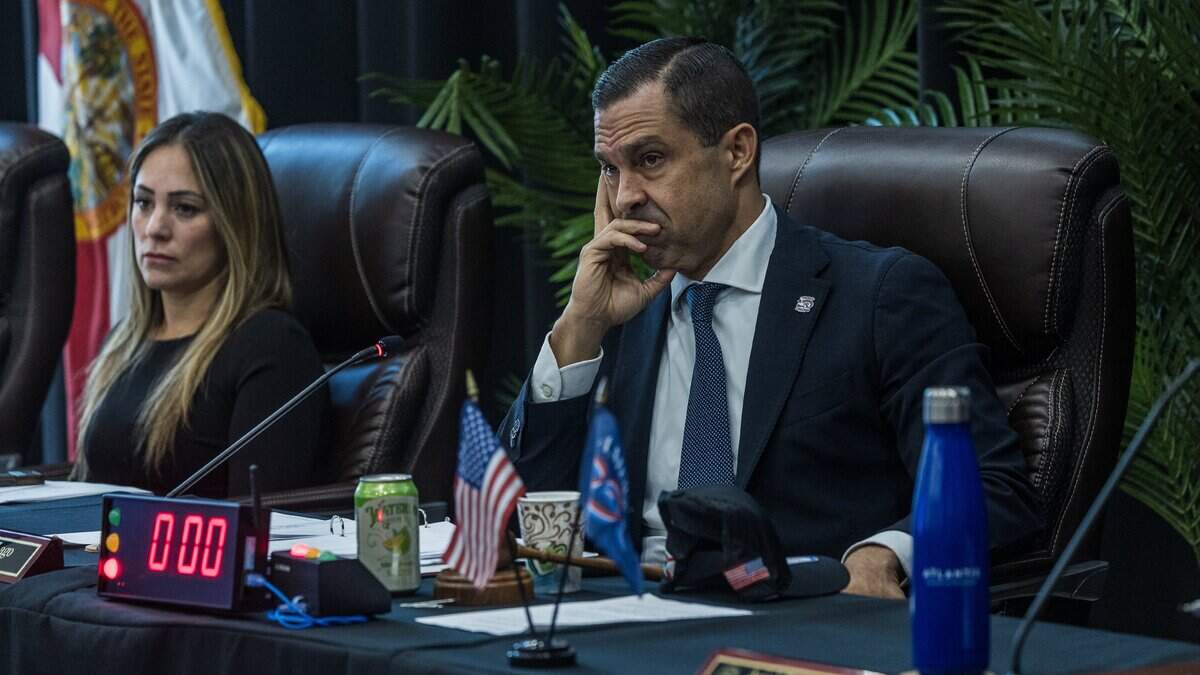
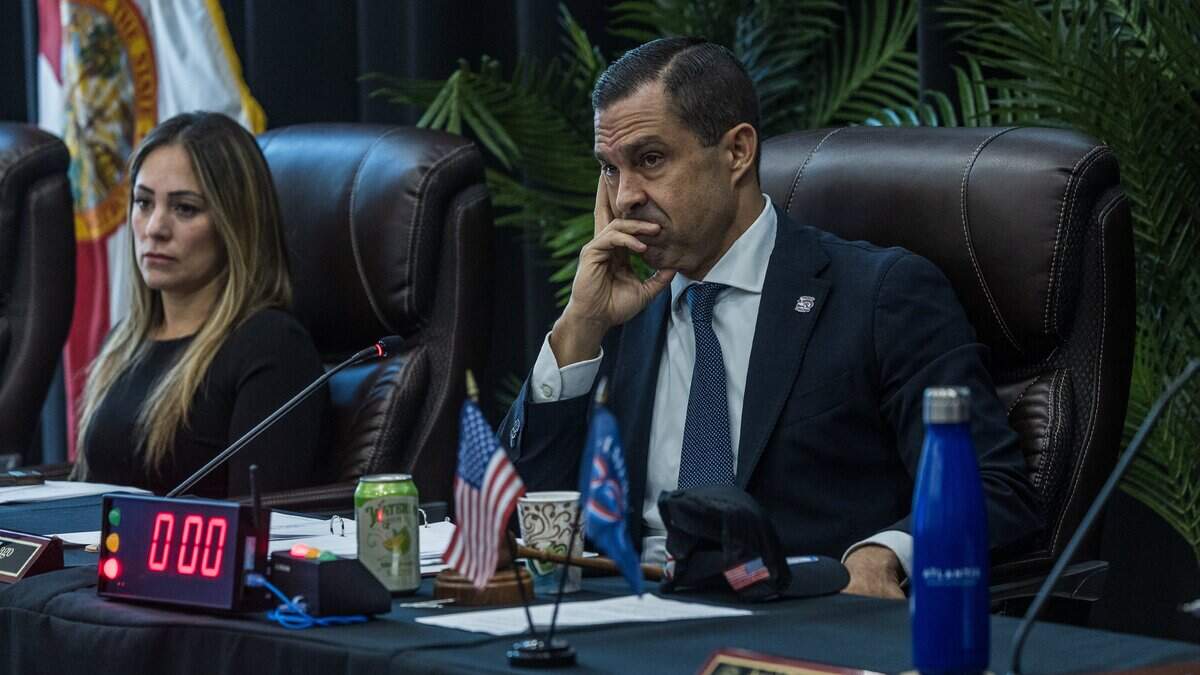
Coral Gables Commissioner Melissa Castro and Mayor Vince Lago are both running for reelection in November.
Pedro Portal
pportal@miamiherald.com
While they may not be competing in the same race, the political rivalry between Coral Gables Mayor Vince Lago and Commissioner Melissa Castro is center stage in this November’s election.
Castro, who’s hoping to be reelected for her second term, has positioned herself as the voice of dissent against Lago, who is running for his fourth and final term as mayor. She’s facing off against Nestor Menendez, an attorney supported by Lago who says he will bring compromise to the dais.
Lago, for his part, says he’s campaigning on his track record, not just as mayor, but from his decade-plus of experience in the city, where he previously served as vice mayor and commissioner. He’s being challenged by longtime Gables residents and previous candidates Laureano Cancio, an attorney, and Jackson Rip Holmes, a self-described “perennially losing candidate” who owns property on Miracle Mile.
Lago is encouraging voters to kick out Castro, saying residents “need a serious elected official in that commission seat.”
It’s not uncommon to see telenovela-worthy disputes and accusations fly during commission meetings, mainly between Lago and Castro, who sit right next to each other. Both blame each other for the fiery fights, with Lago saying that disagreements between commissioners used to be more civil before Castro and Commissioner Ariel Fernandez were elected in 2023. Castro says she’s “not resentful” and “can move forward,” but “I think there’s others that are not.”
Snippets of those disputes frequently make their way onto Castro’s Instagram, which Lago says the commissioner is using to create “political theater.” Castro, meanwhile, is often criticized in posts and ads by Lago’s political committee, Coral Gables First, which has created a website that lists what it describes as a “record” of her “concerning behavior.”
How the majority has shifted
Castro was first elected in April 2023, along with Fernandez, who decided not to run for reelection this November. The two newcomers shook up the dynamic on the five-member City Commission. Starting in mid-2023, former Commissioner Kirk Menendez — who had historically been an ally to Lago — joined Castro and Fernandez in a handful of significant votes that created a new majority on the commission, sidelining Lago and Vice Mayor Rhonda Anderson. (There is no relation between candidate Nestor Menendez and former Commissioner Kirk Menendez.)
That majority changed again after the April 2025 election, when Kirk Menendez lost the mayoral race to Lago and voters elected Commissioner Richard Lara as a new face on the commission. Since then, most of the 3-2 split votes have had Lago, Anderson and Lara on one side, with Castro and Fernandez dissenting.
November’s election is voters’ latest opportunity to shake up the dynamic on the commission, with three seats up for grabs — Lago’s, Castro’s and the seat being vacated by Fernandez.
Looking to November
Castro, Cancio and Holmes criticize Lago for what they see as an attempt at “stacking the commission” by supporting Nestor Menendez in the race against Castro and endorsing Dominique “Nikki” Whiting in the race for Fernandez’s open seat. Lago said he’s just supporting the candidates he thinks will do the best job for the city.
Both Menendez and Whiting told the Miami Herald they would be independent voices on the commission. For their part, Anderson and Lara have also said at meetings that they vote based on what they think is best, not who is sponsoring the legislation.
Holmes, who said he expects to lose to Lago, used most of his interview with the Miami Herald to critique the mayor, particularly for his involvement in a recently approved 30-year development agreement between the city and the University of Miami, as well as for voting in support of a since-dismissed investigation into Fernandez in regard to anonymous political surveys sent to residents in 2023 and 2024.
Holmes said he’s running to spread awareness about the “kind of tsunami of radical revolutionary development” he believes will happen in the city if Lago is reelected.
Cancio, Lago’s other opponent, said he’s running because he and others are upset with the new buildings that have risen in the past several years.
“You have to strike a middle ground,” he said, explaining that the city was built with beauty in mind, but the new Gables seems focused on building “boxes.”
He doesn’t agree with the city’s recent strategy, often touted by Lago, of giving certain zoning code variances in return for new land to create parks, which Cancio argues are often small and lack parking, making them difficult for people to use.
The accusations frustrate Lago, who said the city looks at variance requests on a case-by-case basis and that the city needs “more green space, so there has to be a give and take.” Development projects have to get approval from various city boards first to make sure they align with the city’s requirements before going to the City Commission for a vote.
“We do follow zoning code, but we also try to find public benefits that leave a lasting legacy, that leave a lasting imprint on our quality of life in a positive fashion,” Lago said.
Political clashes
While Castro has been Lago’s main adversary on the commission, he’s been involved in other public feuds and clashes in recent years. In 2024, the Florida Department of Law Enforcement investigated a reported skirmish between Lago and then-City Manager Amos Rojas, who accused Lago of assaulting him during a meeting at City Hall. The FDLE determined Lago did not assault Rojas, stating that “the facts did not meet the elements of an assault.”
Lago has also been at odds with the owner of Gables bierhouse Fritz & Franz, most recently over whether the restaurant could host outdoor watch parties during this year’s FIFA World Cup games.
And he’s made various accusations of impropriety against the Coral Gables War Memorial Youth Center Association, a self-described nonprofit watchdog affiliated with the city-owned youth center. The civic organization has questioned whether his scrutiny over its finances and a reverter clause in the youth center’s deed is politically motivated, a notion Lago denies. Former commissioner and mayoral candidate Kirk Menendez ran the association as president from 2010 until this past January.
READ MORE: New leader tapped for civic group tied to Gables youth center. What to know
But Lago’s primary rivalry has been with Castro, who has weathered her own controversies in recent months. She’s currently under investigation by the Florida Commission on Ethics, which is looking into whether she violated state ethics laws and used her city position to benefit her permit-expediting business. The commission determined in January that there was probable cause to move forward with its investigation, which is ongoing. Castro has denied wrongdoing and said she believes she’ll be cleared.
The commissioner is also facing questions from Lago, Anderson and Lara about whether she improperly used city funds to cover a recent trip to Tallahassee where she appeared for a hearing in her ethics case days before representing the city at a conference there. Castro said she did not charge the city for personal expenses and called those allegations an attempt to hurt her reelection campaign.
At meetings, she’s frequently at odds with Lago, Anderson and Lara and is known to vote against many development projects that come before the commission.
Most recently, she voted against the controversial Crystal Residences project that Lago, Anderson and Lara approved, and she continues to ask Police Chief Ed Hudak for updates on the investigation Lago called for into whether there was a coordinated effort to make it appear as if residents supported the project. A big selling point of the project to Lago and the others was that it would give Crystal Academy, a nonprofit school for children with autism, a new and larger rent-free school as part of the apartment complex. Castro sided with a group of residents who wanted to save a garden that was on the property and argued that the complex did not align with the neighborhood.
To Castro, her dissent is an example of how she’s fighting for residents, arguing that without her voice, the city will have a commission that nearly always agrees with Lago and see “buildings go up like if it’s Brickell 2.0.”
“I’m not anti-development. I’m smart development, healthy development, if it makes sense and it’s in the best interest of the city, not just because either we’re being threatened or because they’re funding your campaign, basically, or they’re your friends,” she said.
She’s also not a fan of the city’s current negotiation strategy of approving variances in return for parks or other perks.
“You know what you’re buying. You know the zoning and what you’re buying,” Castro said, adding that she believes the city is more stringent with residents than with developers when it comes to variances.
Lago similarly says he’s fighting for the best interests of the city but that “life is about negotiation,” especially as the city tries to navigate county and state regulations that reduce local authority over new developments. He points to The Mark, a new UM student housing complex on U.S. 1, as an example of a development the city would have lost all oversight over, as well as millions in impact and permitting fees, if he and City Manager Peter Iglesias hadn’t reached a last-minute compromise with developers.
Sometimes, the political disputes hit a breaking point.
Castro was “censured,” or publicly reprimanded, in a meeting last year by Lago, Anderson and Lara for contacting Florida Attorney General James Uthmeier, without discussing it with them, to seek a formal legal opinion on their vote to move city elections to November. Commissioners, after seeing the courts weigh in on a similar election date change in the city of Miami, later agreed to let voters weigh in on whether to move elections. Voters approved that measure in April 2026, which moved the planned April 2027 election to this November.
Critics also continue to bring up Castro’s 2023 vote to raise commissioner salaries and her 2024 vote to hire Rojas as city manager without a national search, two decisions that have since been overturned by the current commission.
“I still don’t think there was anything wrong. People — residents — had the chance to opinionate on it” before she, Fernandez and Menendez voted to raise salaries, Castro said, explaining that it had been discussed in several public meetings.
“I didn’t need the money, I didn’t need the scandal. I thought it was the right thing to do” and would make it easier for a more diverse group of residents to run for office, she told the Herald.
She similarly defends her vote to hire Rojas, characterizing it as a decision that had to be made quickly due to not having an acting city manager at the time.
Besides Lago, one of her most vocal critics has been an anonymous blog that Lago and other commissioners read. Among other topics, the Aesop’s Gables blog has written about the state ethics investigation she is facing surrounding her permit-expediting business and the questions about her taxpayer-funded trip to Tallahassee.
Castro is awaiting a hearing before a judge in the ethics matter and has denied the allegations, stating that she stopped doing business in the Gables after seeking and receiving guidance from the county’s own ethics commission.
Campaign promises
Castro says residents continue to be concerned about development, corruption and public safety. If reelected, Castro said she plans to “continue putting money back into taxpayers’ pockets” and make good on her promise to “follow the money” and announce during commission meetings if any commissioner received a campaign contribution from developers ahead of a project vote. Under Florida law, elected officials are not required to recuse themselves from a vote just because they received a campaign contribution. It’s up to commissioners to decide whether they can vote impartially on a project.
Although developers are permitted to contribute to political campaigns, Castro hopes that more public notice of the donations will push developers to stop contributing to commissioners and create an environment where “these developments are voted on merit because they’re in the best interest of the city.”
Lago said he counts many of his initiatives in office as successes, including creating over two dozen new parks and “pocket parks” across the city, bringing back historic “White Way” lights to the city, and delivering Fire Station Number Four, which he says was one of George Merrick’s unfinished projects.
He touts the referendums he backed in April’s vote-by-mail election that were approved by voters, including a referendum that calls for inspector general services to weed out corruption, as signs that he’s doing what residents elected him to do.
Lago’s priorities, if reelected, are to see through some upcoming and extensive projects, including the restoration of the city’s “crown jewels” — the Gondola Building that sits on the Biltmore golf course, the historic Alhambra Water Tower and the ongoing restoration of City Hall. He also wants to focus on beautifying the city’s downtown, which he believes will help attract more diners and shoppers at a time when the city is preparing for a future with less revenue if Amendment 3, the statewide property tax cut, goes into effect.
Lago has raised just over $26,000 to his campaign account, while his political committee has raised more than $267,000 this year.
Castro, whose campaign has raised just over $15,000, has received endorsements by Miami Realtors, the city’s police and fire unions, and Coral Gables Democrats. While the roles of Coral Gables mayor and commissioner are nonpartisan, Castro is registered with no party affiliation, while Lago is a registered Republican.
If she’s reelected, Castro said she might consider running for mayor in 2028. But first, she’ll have to defeat Nestor Menendez, her sole opponent in the race.
Menendez said he decided to run against Castro because he didn’t “agree with a lot of the decisions” that she was making. Like Whiting, who is running for the open Fernandez seat, Menendez takes issue with people questioning whether he’ll be an independent voice.
“Shouldn’t we all be independent voices up there? … We should be five independent voices bringing in our own experiences, our own work, our own point of view, our own research, our own experiences from talking with residents,” he said, noting that while it’s natural to see disagreements, the goal of a commission should be to work together and compromise to create solutions for residents.
He praised many of the city’s current efforts to improve quality of life during his interview with the Herald, including Lago’s work to bring more parks to downtown and Lara’s same-day residential permit program. He said he wants to help steer the commission into “really boring commission meetings,” with spirited debates instead of the drama-filled marathons residents have become accustomed to. He also wants to focus on solving residents’ everyday problems, including fixing and updating city infrastructure.
“I want to build bridges. I want to build coalitions. I want compromise. I want to bridge those gaps between my colleagues and, most importantly, the residents and the commission,” he said.
Menendez said he hasn’t accepted any endorsements because he wants to earn the vote from residents through his doorknocking. He’s raised over $124,000 in campaign donations, the most of any Gables candidate in any race for the 2026 election for a campaign account, followed by Whiting, who has raised over $107,000.
Miami Herald
Michelle Marchante covers the pulse of healthcare in South Florida and also the City of Coral Gables. Before that, she covered the COVID-19 pandemic, hurricanes, crime, education, entertainment and other topics in South Florida for the Herald as a breaking news reporter. She recently won first place in the health reporting category in the 2025 Sunshine State Awards for her coverage of Steward Health’s bankruptcy. An investigative series about the abrupt closure of a Miami heart transplant program led Michelle and her colleagues to be recognized as finalists in two 2024 Florida Sunshine State Award categories. She also won second place in the 73rd annual Green Eyeshade Awards for her consumer-focused healthcare stories and was part of the team of reporters who won a 2022 Pulitzer Prize for the Miami Herald’s breaking news coverage of the Surfside building collapse. Michelle graduated with honors from Florida International University and was a 2025 National Press Foundation Covering Workplace Mental Health fellow and a 2020-2021 Poynter-Koch Media & Journalism fellow.
Support my work with a digital subscription