
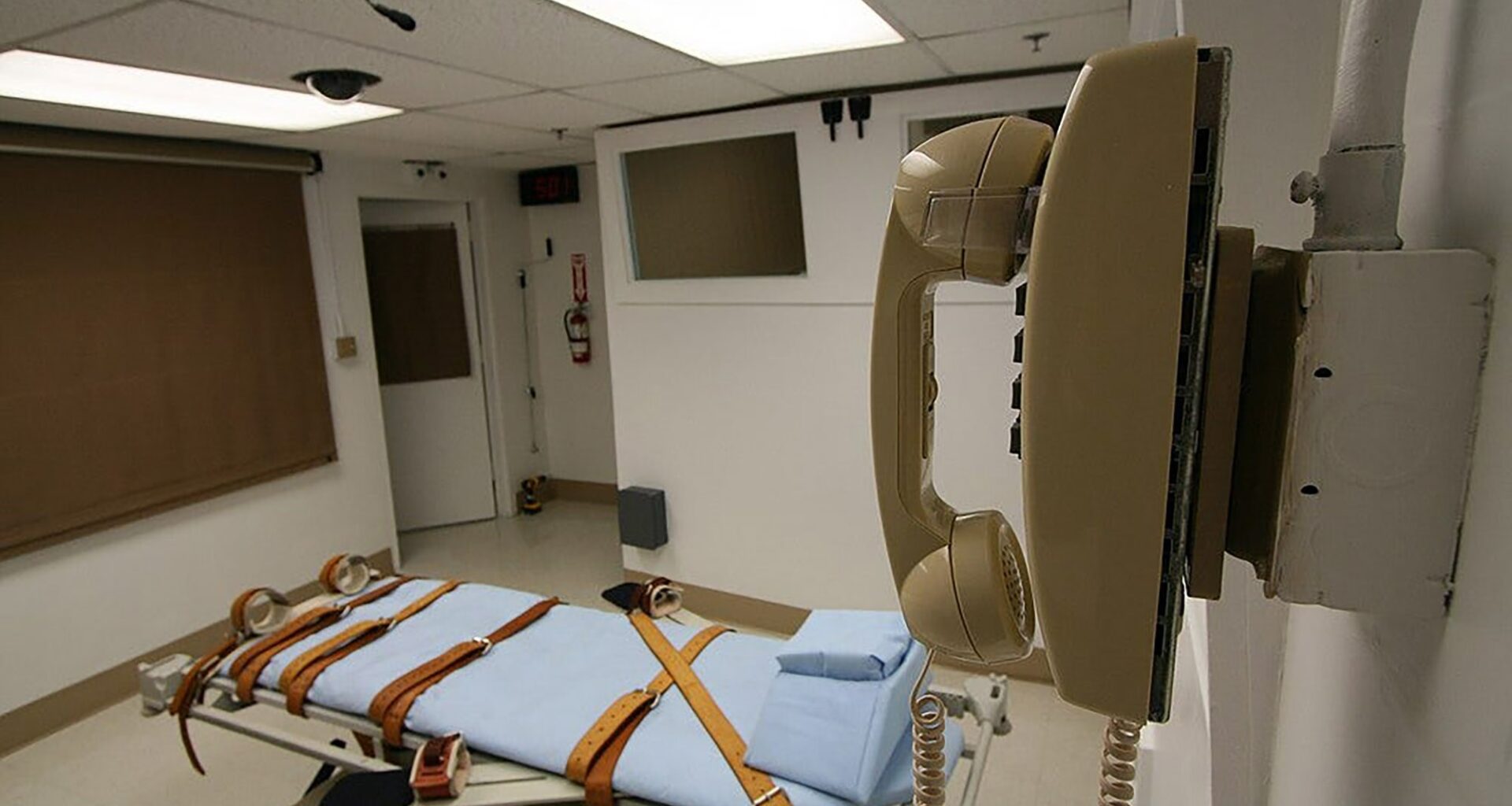
The next governor of Florida will inherit the nation’s second-largest death row population — and with it, a legacy of profound questions about the remorseless and deeply flawed system that put so many people there.
In a recent statement, Republican Byron Donalds said he “firmly supports” the death penalty.
Democrat David Jolly has said “with absolute clarity” that he would never sign a death warrant not recommended by a unanimous jury, and would impose a moratorium on executions pending a full review of the system.
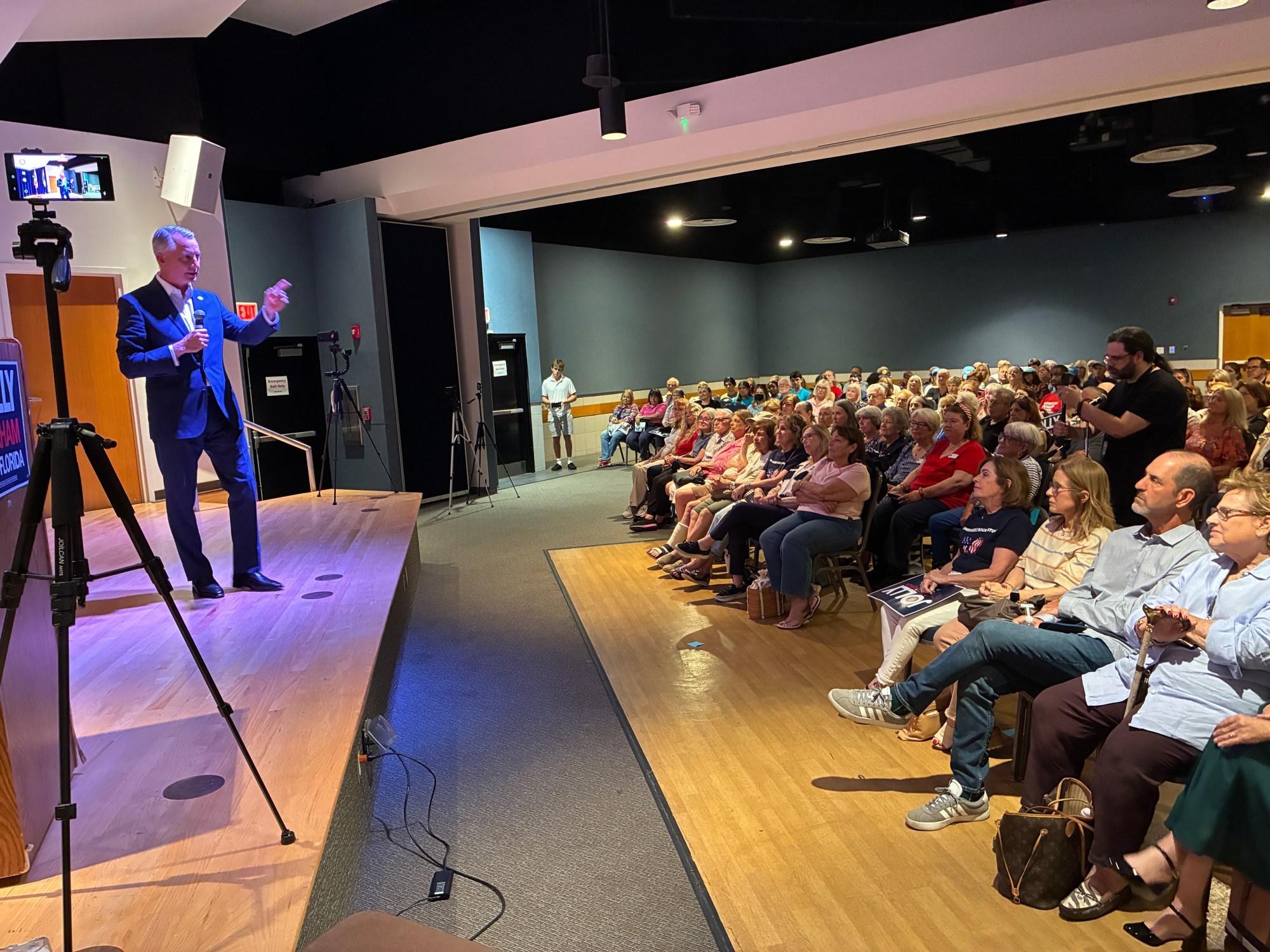 David Jolly on stage in July near Delray Beach (Steve Bousquet/Sun Sentinel)
Speaking to hundreds of supporters in Delray Beach in July, Jolly, a man of deep faith, answered “I don’t know” when asked if he would sign a death warrant as governor.
His answer was imprecise. It also resonated with candor. The crowd broke into applause.
To be clear: Jolly’s response wasn’t about a belief in death as an appropriate means of punishment. It was about doubt in Florida’s broken process. Just one recent example comes to mind: In July, the state executed James Duckett despite the fact that there was evidence that could have been tested for DNA using modern methods, which might have proved the former Mascotte police officer was innocent of the killing of Teresa Mae McAbee in 1987.
Not every case deserves that kind of last-minute intervention, but in Duckett’s case nearly every shred of evidence presented at his original trial has been disproven or debunked.
“I have grave reservations about the fidelity of the criminal justice system to produce results that provide sufficient confidence to sign a death warrant,” Jolly said that night. Cases like Duckett’s demonstrate why that uncertainty is justified.
Florida ranks No. 2
In California, Gov. Gavin Newsom has said he might spare the lives of all 563 death-sentenced prisoners before he leaves office in January. He declared a moratorium long ago and dismantled the state’s death chamber. California has not held an execution in 20 years.
That would never happen in Florida if Donalds wins, he has said. “Florida is not California,” he told Florida Trib.
Florida has the nation’s second-largest death row population, with 233. Gov. Ron DeSantis, persisting in a recent pace of two executions a month, has scheduled two more in November.
It is too easy for headline-hunting prosecutors to secure death sentences. By allowing as few as eight of 12 jurors to recommend it in Florida, the Legislature created the nation’s easiest path to execution.
No governor has commuted a death sentence since Gov. Bob Graham in 1983. A pending appeal claims that DeSantis’ refusal to grant clemency in any murder case means that the entire clemency process, as mandated by both the Florida Constitution and by law, “is just a facade.”
One hundred prisoners have been on death row for 30 years or more, including 24 for more than 40 years and three for more than 50.
Eight are at least 80 years old, including the longest-serving death row inmate from South Florida, James Franklin Rose, 80, from Pompano Beach.
Rose has been awaiting death since 1977 for the kidnap and murder of Lisa Berry, the 8-year-old daughter of his former girlfriend.
Florida judges, lawmakers and governors perpetuate the patently unreliable assumption that jurors never make mistakes.
The exonerations of 30 formerly death-sentenced Florida inmates, the most of any state, clearly refutes that. The late Justice Gerald Kogan said he believed the Supreme Court allowed three innocent people to be executed; he refused to identify them.
An enthusiastic executioner
DeSantis is Florida’s most enthusiastic executioner, having put 46 men to death.
State archives show that Gov. Albert Gilchrist ordered 43 executions from 1909 to 1912. Spessard Holland, who served from 1941 to 1945, holds the modern record of 35.
But Holland also commuted death sentences to life in prison, as did seven of his successors. For clemency to fall into permanent disuse, as it has, wipes out the last fail-safe.
Sentencing judges must explain at length how they decide between life or death, and governors should have to as well.
Whether it’s Jolly or Donalds, the next governor will face an issue that death row lawyers raise in every last-ditch Florida appeal: Is lethal injection really swift and merciful? Tennessee’s recently botched execution, where Christa Pike survived two doses of poison, is just one example of the physical and mental torture that modern “scientific” means of execution involve. It was the second time this year that prison officials mangled a prisoner trying to find a suitable vein. Gov. Bill Lee has put a hold on executions for now.
Putting people to death, however efficiently it is done, is not something a modern civilization should do. No one pretends any longer that it is a deterrent or anything other than an outlet for vengeance. It also is far costlier throughout the process than life in prison, and it is vulnerable to fatal mistakes that cannot be undone.
Alabama is the only other state that allows an execution without a unanimous jury vote, and it requires at least 10 of 12 jurors to concur. Gov. Kay Ivey recently issued her third commutation, citing “not enough direct evidence to carry out the most serious punishment.”
The man whose life she spared had been condemned on the questionable testimony of one informant who claimed she had heard him confess, and who earned a $5,000 reward.
The Orlando Sentinel Editorial Board includes Executive Editor Roger Simmons, Opinion Editor Krys Fluker and Viewpoints Editor Jay Reddick. The Sun Sentinel Editorial Board consists of Executive Editor Gretchen Day-Bryant, Editorial Page Editor Steve Bousquet, Deputy Editorial Page Editor Dan Sweeney and editorial writers Pat Beall and Martin Dyckman. Send letters to insight@orlandosentinel.com.