
Terra Group developer David Martin unveiled some eye-opening illustrations and his updated plans to revitalize the area of the former Miami Seaquarium, clearing up a lot of earlier misconceptions, yet raising other concerns during the week.
Joined by a couple of his seven University of Miami-affiliated partners on the project and Miami-Dade Commissioner Raquel Regalado at last week’s joint webinar, there were 63 slides shown during the hour-long presentation which touched on various aspects of the “science-led” design.

An aerial view of the renovated Miami Seaquarium proposal.
“It’s about a new day,” said Regalado, who led the charge to evict the previous lease operators at the “nostalgic” Seaquarium after concerns arose about the welfare of the animals there. “This (new project) reflects our values in Miami-Dade County.”
Martin spoke “as a father and someone rooted in the community” as to why he wants to make things better at the site while “preserving history,” such as the iconic Buckminster Fuller (golden) Dome and the Flipper House.
Additions include a dynamic aquarium; a wave pool; an educational center; a scenic walkway with views of Biscayne Bay open free to the public; restaurants and shops in a “Fisherman’s Village”; and hundreds of boat slips and dry docks, the latter which has raised concerns from the public and, especially, environmental advocates regarding potential seagrass damage and the like.
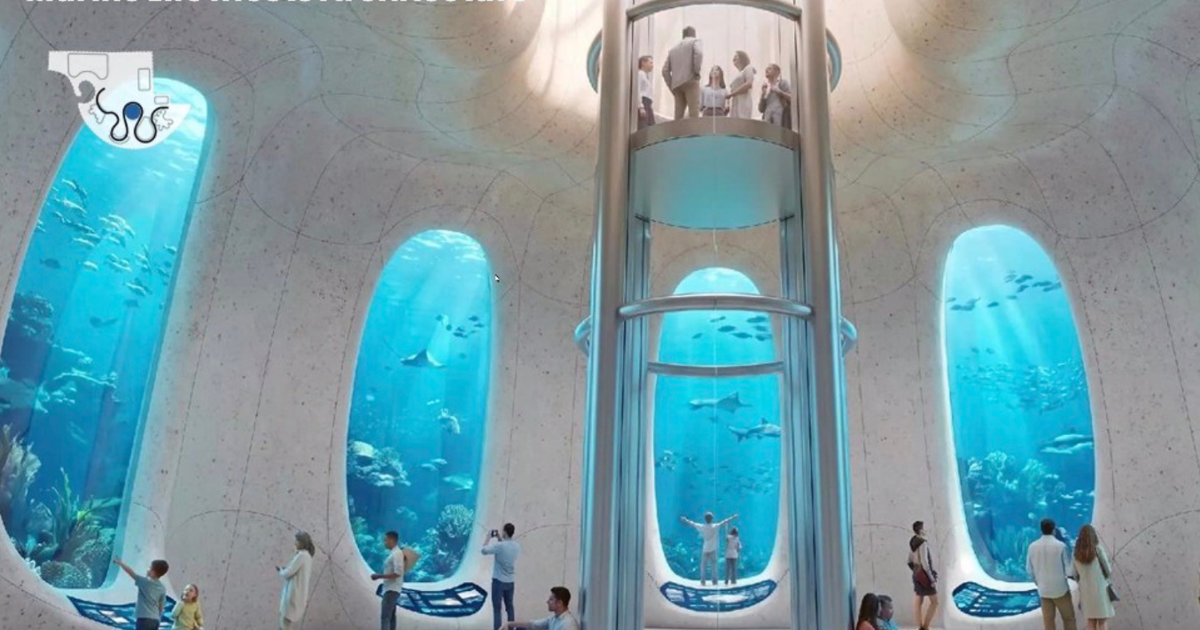
A render of the Underwater Classroom as part of the Seaquarium renovation plan.
He also spoke about potential scientific breakthroughs, with a system of oyster beds and sponges “polishing” the water in Biscayne Bay, something that could lead to a global advantage.
“We will not be dredging,” Martin said. “There is some silt removal (which is favorable to some environmental groups) … the wet slips sit within the historically dredged basin. I wanted to make sure we are clear with that.
“I know there’s been some serious questions about the bay and they deserve answers,” added Martin, who said his team plans to make all environmental reporting “public” throughout the 99-year lease.
Martin’s group is investing some $200 million into infrastructure improvement.
As far as the overall view of what the former Seaquarium could look like, he wanted to let viewers’ imaginations take over.
“Imagine walking the shore without buying an admission ticket,” said Martin, who is also spearheading two major projects on Key Biscayne, a luxury condo on the Silver Sands site, and a padel sports complex and business office at the “entry block” to the Village, with his Terra Group development team. “A family can come to the aquarium, kids can come for an education and (everyone) can come for a walk. This is a project that should be engaged with the community, with science and with industry and the government.”
Martin added that when thinking about the future of the Seaquarium site, he could only imagine a child standing on the edge of the shore and looking out at the bay and “seeing something they’ve never seen before.”
So, what did we learn from last Wednesday’s webinar?
• There will be no whales or dolphins.
• Landscape architect Walter Meyer, one of seven experts Martin has employed and affiliated with UM, is the lead design director.
• The number of wet slips has dropped to 295, while the solar-powered dry-dock capacity is now 546.
• The 300-foot yachts people have spoken about “is not true,” Martin said. He showed where 85% of the fleet is under 60 feet.
• The modern marina is designed to meet public demand. There are more than 75,000 boat owners in Miami-Dade with only 1,000-plus public boat slips available in the county.
• The Master Plan brings the connectivity into one shoreline setting with Regalado’s separate project proposal, “The Shoreline.”
• A three-quarter of a mile public ocean walkway stretches from Hobie Beach to the UM’s Rosenstiel School.
• An Immersive Education Center will be built, with a “living classroom,” allowing visitors to see sea life in their natural habitat.
• A public kayak launch and two boat ramps are part of the plan.
• The Seaquarium Trail is a high-rise walkway that weaves through the site with shady areas and stopping places.
• The spacious aquarium is actually a “living ocean, with living exhibits.” That, apparently, will come with a cost to the public.
• Coral restoration (transplantation) and the “superpower polishing” of water by sponges and oyster beds not only could make Biscayne Bay cleaner, but also could inspire future careers.
• Restoring the golden dome and making it flexible for year-round events while still recognizing Miami’s history.
A view of the Golden Dome & Events Lawn as part of the Seaquarium renovation.
• The “Miami Wave” saltwater pool is not just for surf culture, but will be used as a training ground for lifeguards, since the surge machine can mimic any type of wave conditions. It also will be used to study wave force, which would contribute to long-term resiliency in South Florida.
• A main waterfront restaurant will serve “responsible” seafood, while smaller eateries and shops make up the Fisherman’s Village.
• There will be a Harbor House to safely contain marine patrols (including Key Biscayne’s) and a substation for the Sheriff’s Department.
• There will be “real-time” water quality monitoring in that area, a boon to environmentalists and the public.
• Seagrass management and native habitat restoration and using a “cistern strategy” to provide cleaner runoff water.
Martin’s team also learned that evening peak-time vehicles in that Seaquarium area would actually be reduced (from 677 to 627) and said there would be ride-share areas and “better bicycle and pedestrian connections.”
He also wants to maintain “a working channel” with Key Biscayne and other entities along the Rickenbacker.
However, it was a week of objections to the plan, starting with some speakers at the Miami-Dade Board of County Commission meeting on Tuesday, when they unanimously advanced an ordinance on first reading to allow for a formal vote, possibly in November.
The next day, a lawsuit was filed by two Miami-based attorneys and environmental advocates who claim that a referendum is needed, according to the County Charter, in order to redevelop land on Virginia Key, and especially projects over submerged public land.
On Friday, Friends of Biscayne Bay representative Laura Reynolds told the Rotary Club of Key Biscayne about some of the “half-truths” that were delivered during the Regalado webinar and addressed numerous concerns why a “pause” is needed at this time.
Martin and his team did not take questions during the webinar, but vowed he or County officials would answer all written questions (email district7@miamidade.gov with your questions).