
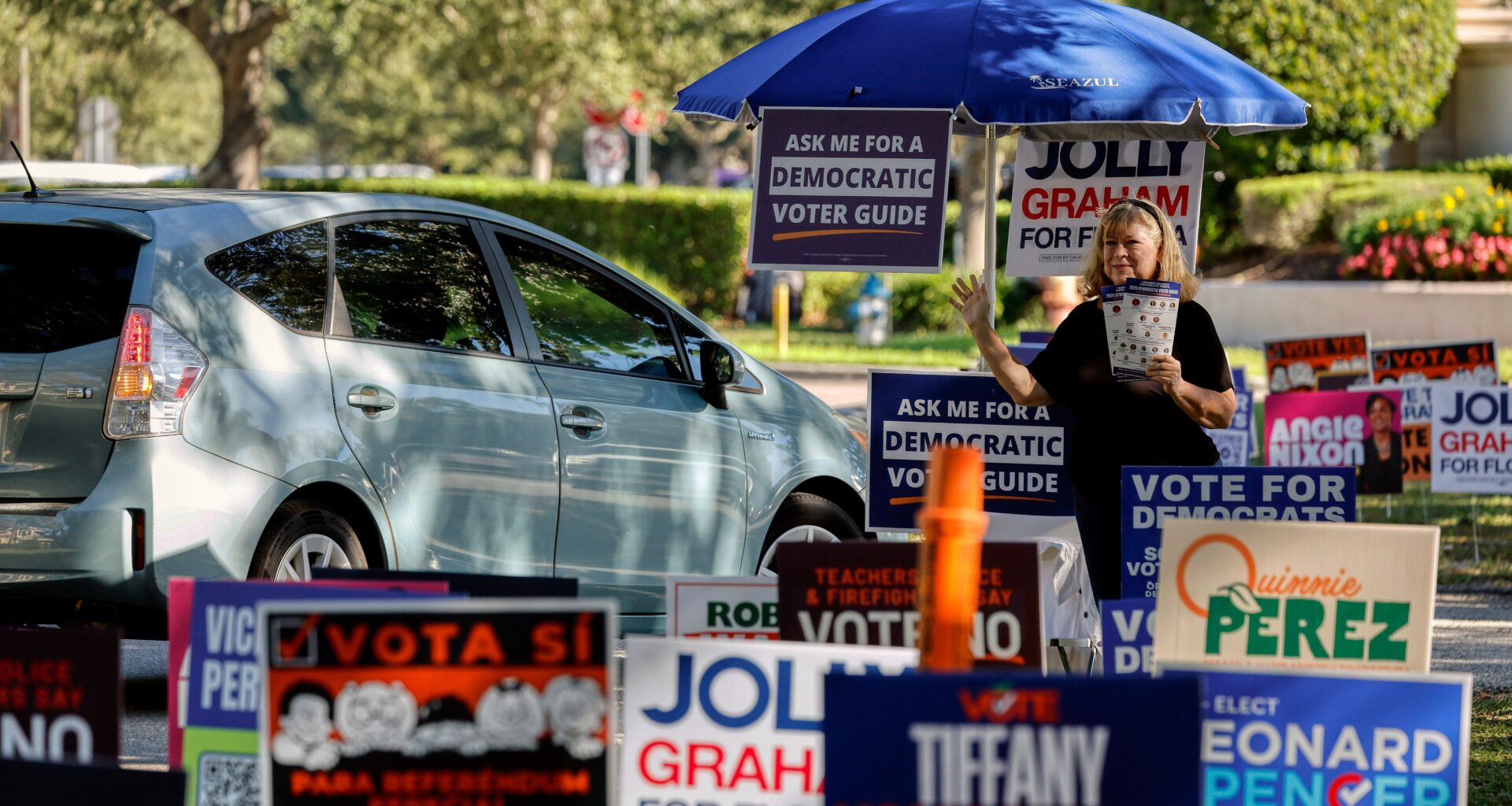
Florida Democrats are turning out in droves to vote this month, but will that be enough to pull off upset victories in a state where Republicans enjoy vast advantages?
In high-profile contests for governor and U.S. Senate and down-ballot battlegrounds for congressional seats, Democrats feel buoyed by how many of their supporters have already cast ballots in races that have drawn national attention and millions of dollars in last-minute advertising.
While polls show the GOP candidates holding slight leads, the early voting tabulations suggest Democratic voters here, like counterparts across the country, are enthusiastic about their candidates and angry about the direction President Donald Trump has taken the nation.
So far in Orange County, one of the Florida’s few blue bastions, Democrats account for roughly half of the ballots cast. The party has doubled the number of early and mail ballots cast in 2022, and this year’s totals could rival the numbers of those ballots cast during the 2024 presidential election.
Democrats are also seeing a good showing in Osceola and Seminole counties. And in deep red Lake County, which has nearly twice as many registered Republicans as Democrats, by Thursday afternoon Democrats had turned out about 37.5% of their voters compared to Republicans at 25.7%.
Statewide, Republicans held less than a 2-percentage-point lead in turnout by Thursday evening.
Roughly 21% of ballots cast so far are by no-party-affiliated voters, a group polls show as likely to break in favor of Democrats this year. A University of North Florida poll shows a 17-point edge for David Jolly for governor among that group, and a 15-point advantage for Angie Nixon.
But experts warn more Republican voters are sure to turn out, and they could very well swamp hopeful Democrats.
“You’re starting to see more infrequent Democrats voting, which is good,” said Democratic strategist Steve Schale about his party’s chances next week. “The flip side to that is there is a boatload of highly likely … Republicans left to vote.”
And, Schale notes, in most of these contests, district lines have been redrawn to benefit Republicans. And statewide, the GOP enjoys a strong advantage of 1.5 million more registered voters and more financial resources.
“Everywhere you’re trying to win is a little bit uphill,” said Schale, a veteran of two Obama presidential campaigns who ran a pro-Joe Biden Super PAC in 2020.
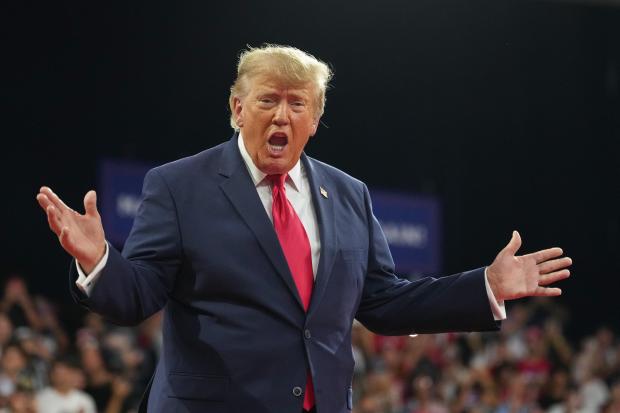 President Donald Trump arrives at a campaign rally at Alico Arena on the campus of Florida Gulf Coast University, Friday, Oct. 23, 2026, in Fort Myers, Fla. (AP Photo/Mark Schiefelbein)
Jasmine Burney-Clark, who co-founded the Black-led voter rights group Equal Ground, credited Democrats David Jolly and Angie Nixon for giving Democrats candidates they’re excited about at the top of the ticket. Florida Democrats are not just relying on people wanting to vote against Trump.
“Turnout is high. It’s enthusiastic. It isn’t just online fodder,” she said. “These are two candidates that are giving Democrats something to vote for. Voting against Trump has been the moniker for the Democratic Party in years past. Trump isn’t on the ballot, but the impact of his policies are being felt.”
Key Republican leaders have also indicated at least some concern about turnout. Gov. Ron DeSantis said this week that he thinks “Republicans have work to do” and noted that enthusiasm was lower than when he was last on the ballot in 2022.
DeSantis, a popular figure among Republican voters, has made appearances this week with GOP gubernatorial candidate Byron Donalds and U.S. Sen. Ashley Moody, who is running for election after DeSantis appointed her to Congress.
A University of North Florida poll released last week shows Donalds with a two-point edge over Jolly and Moody with a four-point lead on Nixon.
“For Republicans, I don’t necessarily want to be the bearer of bad news, but I don’t think the turnout has been as strong as we want to see,” he said Wednesday. “I think we need to do a better job of early voting. I caution people about waiting until Election Day.”
U.S. Rep. Randy Fine, in a radio interview he posted to social media, warned his party’s members they could suffer losses if they don’t vote.
“While we have a lot more Republicans in this state than we do Democrats, if our people stay home, it will not be good,” he said.
Despite Democratic optimism, Florida Republicans have had strong Election Day showings in recent years, which has helped them continue a three-decade dominance of the governor’s office.
Trump, whose attacks on mail voting have largely spurred the GOP shift to showing up in-person on election day, is expected in Daytona Beach Friday evening. He’ll likely rally Republicans behind their slate of candidates and urge supporters to vote on Tuesday.
“We don’t know for sure what’s going to happen because Republicans may yet have a huge surge on election day,” said Aubrey Jewett, a University of Central Florida political science professor. “That’s one of the reasons President Trump has done multiple events around the country.”
But some historical trends are also working against Republicans.
Most midterm elections see the incumbent president’s party lose congressional seats and Trump is historically unpopular, with approval ratings in the 30-percent range. Trump’s local appearances might present an awkward situation for some candidates who have sought to distance themselves from the president.
A few GOP candidates have welcomed Trump’s support, such as Fine, whose district includes much of Daytona Beach. “Let’s show up strong and remind Democrats that Volusia County will always be Trump Country!” Fine wrote on social media.
But the reception from other candidates has been less enthusiastic.
Ryan Elijah, a Republican who is running to represent congressional District 7, which includes all of Seminole County and the southern half of Volusia, did not respond to a question from the Orlando Sentinel this week about whether he planned to attend Trump’s Daytona event.
Elijah, a political newcomer and former TV news anchor, is in a tough race in a district that leans red but where 28% of registered voters have no party affiliation. While Republicans there have a modest registration advantage, Democrats are posting strong numbers in early and mail-in voting.
His opponent, Democrat Bale Dalton, is running as a moderate, highlighting his experience as a veteran and former chief of staff for NASA.
Earlier this week, national Democrats appeared to have written off the race, as House Majority PAC, a Super PAC focused on electing Democrats to the House, pulled funding for TV ads supporting Dalton’s candidacy. But the group reversed course on Wednesday, saying it planned to spend $1.7 million on ads slamming Elijah for supporting data centers.
The group also announced it would pour nearly $2.9 million into ads attacking Republican Dan Green, who is challenging incumbent Democrat U.S. Rep. Darren Soto to represent a district that was one of the key targets of Florida Republicans’ redistricting efforts earlier this year.
 The Democratic House Majority PAC put nearly $2.9 million into ads attacking Republican Dan Green, who is challenging incumbent Democrat Darren Soto in District 9. (YouTube screenshot)
Before this year, Democrats had the advantage in that district, which was centered in Osceola County and was heavily Hispanic. But now Republicans hold a 12-percentage-point advantage in the district, redrawn to stretch to Vero Beach in deep-red Indian River County and as far south as Lake Okeechobee, spanning parts of seven counties.
A Soto victory will be a challenge, said Matthew Isbell, a Democratic analyst, who described the redistricting as “the most egregious part of the 2026 gerrymander” on his MCIMAPS site.
To win, the Democrats need to focus on turning out voters, particularly those in the areas of Orange and Osceola counties that remain in the district who are likely to vote for Soto.
Isbell said he thought District 7 also is tough turf for Democrats, despite the party getting out its voters in Seminole and likely winning independent voters.
“Dalton could win the county, too,” Isbell said. “But if you only win the county 51-49 and you’re losing the Volusia portion by a lot, that’s the big problem.”
Election day is Tuesday. Sunday is the last day of early voting in Orange, Seminole and Osceola counties and Saturday is the last day in Lake.