
Let there be lights – again!
The northern lights were expected to illuminate the night skies in nearly two dozen states across the U.S., as a powerful solar storm approached Earth starting Tuesday, Nov. 11.
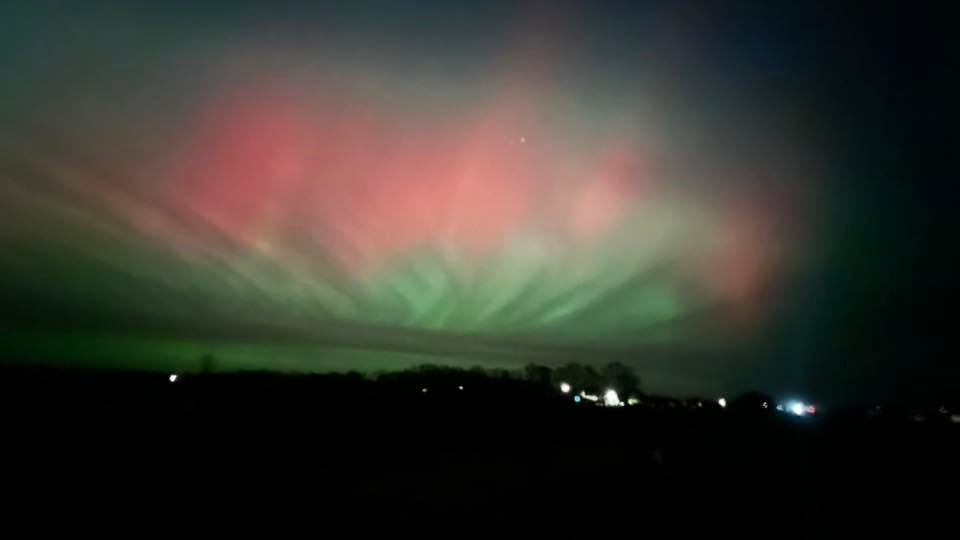
But it looks like the aurora borealis overperformed as photos of a chilly Florida night sky bathed in pink ricochet around social media. It was the Sunshine State’s third look at the lights since 2024.
“Uh did not expect to see the aurora from northern Tallahassee this evening,” National Weather Service forecaster Wright Dobbs wrote on X. “Faintly visible to the naked eye as an extremely dim red glow. Long 25s exposure here and edit to bring out the color captured by the camera.”
Reports of the stellar light show were coming in from the Emerald Coast to the Nature Coast with photos showing pink skylines in Marianna, Tallahassee, Crawfordville, Bryceville, Titusville and as far south as Orlando.
Twice in 2024, Florida residents experienced the rare display of the aurora borealis in the Deep South, once in October and once in May. The October sky show came just hours after an earthbound monster storm, Hurricane Milton, devastated central Florida. The May northern lights came hours after another national disaster, the great Tallahassee tornado outbreak.
This time around the lights were more subdued and Florida had to only contend with an early cold snap and freeze warning before getting the latest light show.
The most recent National Oceanic and Atmospheric Administration aurora forecast map showed that at least 21 states could see the aurora, and the view could last into through Wednesday, Nov. 12. According to NOAA, the northern lights are usually most visible from 6 p.m.-6 a.m. Central Time.
If you missed it Tuesday you may have another shot Wednesday. A coronal mass ejection of plasma clouds and charged particles driving the storm prompted NOAA’s Space Prediction Center to issue a rare G4 geomagnetic storm watch that continues into the evening of Nov. 12.
Formally known as the aurora borealis, the colorful night skies are caused by the interaction between Earth’s magnetic field and the sun’s plasma, according to the National Weather Service.
Tips for catching a glimpse of the northern lights
Find dark skies: Get far away from city lights. Rural roads, state parks, or wide-open farmland work best.
Look low on the northern horizon: The aurora won’t be overhead; it’ll appear low in the sky, if visible at all.
Stay up late: Peak viewing could be anytime, from 10 p.m. to 2 a.m., but earlier or later bursts are possible. Remember, these are just their best predictions.
You might not spot the aurora with the naked eye, but that doesn’t mean it’s not there. Cameras can capture more light than your eyes can, especially with long exposures.
How to take a picture of the northern lights — even with a phone
Here’s how to capture a photo of the Aurora Borealis to make all your friends jealous.
If you have a DSLR or mirrorless camera:
Use a tripod to keep your camera steady.
Set your camera to manual mode.
Start with a 10–15 second exposure, a wide aperture (like f/2.8), and a higher ISO (around 1600–3200).
Focus manually, ideally on a distant light or star.
If you’re using a smartphone:
Use Night Mode or a dedicated low-light app.
Hold your phone as still as humanly possible, or rest it on a solid surface.
Some newer iPhones and Androids allow you to manually set longer exposures — use it.
And turn off your flash — the aurora doesn’t like to be photobombed.
▶SHOW US YOUR BEST SHOT: If you snap a good photo of the northern lights share them with us at news@tallahassee.com and we’ll share them with the community. Please include your name and where you took the photo in the email.
USA TODAY Network reports contributed to this story.
This article originally appeared on Tallahassee Democrat: Northern lights spotted in Florida, Tallahassee