
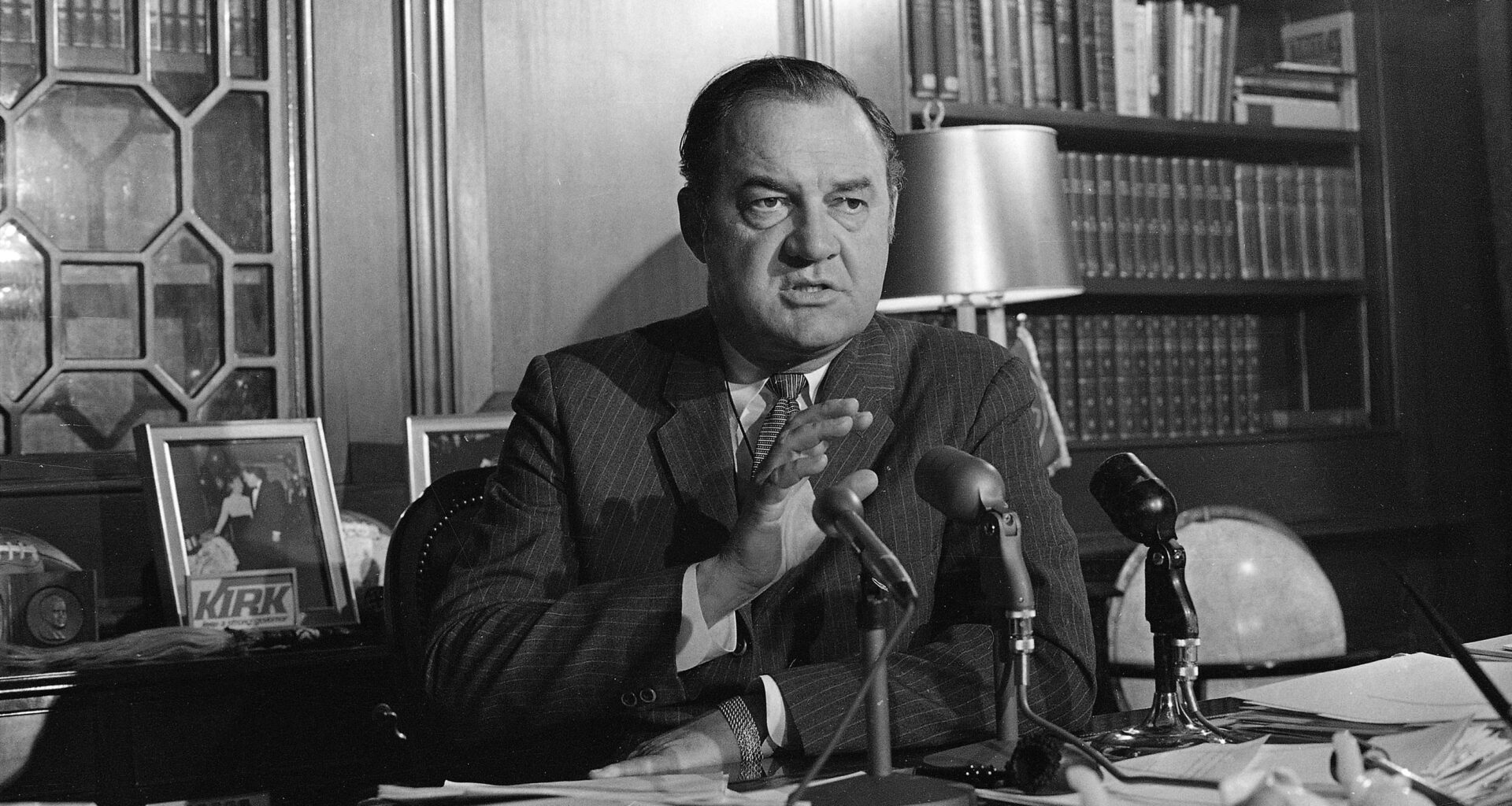
It was one of the biggest political upsets in the 1966 midterm elections. Claude R. Kirk Jr. was elected Florida’s governor, becoming the first Republican win the office in nearly 100 years.
Florida had not elected a Republican governor since since post-Civil War Reconstruction in 1872. Kirk defeated his Democratic opponent, Miami mayor Robert King High. But he had some important help.
Democratic incumbent Gov. Haydon Burns lost his party’s primary to High, and he ended up working with Kirk’s campaign to help elect the GOP candidate. And Kirk hired a professional campaign manager, something that was unusual at the time.
While Kirk made history with his win, his tenue was short-lived. He was defeated for re-election by Democrat Rubin Askew in 1970, and Florida would not elect another Republican governor until 1988 when Orlando’s Bob Martinez won.
Here’s the November 1996 election story about Kirk’s history victory by D. G. Lawrence of the Sentinel staff:
Claude Kirk dealt a stunning defeat to Mayor Bob High in Tuesday’s gubernatorial election to become Florida’s first Republican governor since 1872.
With 240 precincts missing out of the state’s total of 2,561, the Republican candidate had 752,992 votes to the Democrat’s 607,569 or a plurality of 145,423. High carried or was leading in only 11 of the 67 counties.
There was no geographical pattern to the voting, Kirk doing well in every section. He ran far ahead of High in every one of Central Florida’s counties and in Orange it was better than two to one for the Republican standard bearer.
At 9:33 p.m. High and his wife, Faith, appeared before the television cameras and although the situation looked hopeless then, he refused to concede.
At 11:12 p.m. he was back, this time with both his wife and father, Lester.
“I lost the election,” he said, “but my defeat is swallowed up in victory,” referring to his family background of poverty in Tennessee and his subsequent nomination as a “candidate for governor of this great state.”
“I wish Mr. Kirk Godspeed and all good success as governor, he said. “He will be my governor. I am a Floridian. I love my state more than I care for my political fortunes.”
The defeated Democrat then called on all the people of the state to support Kirk’s administration as governor.
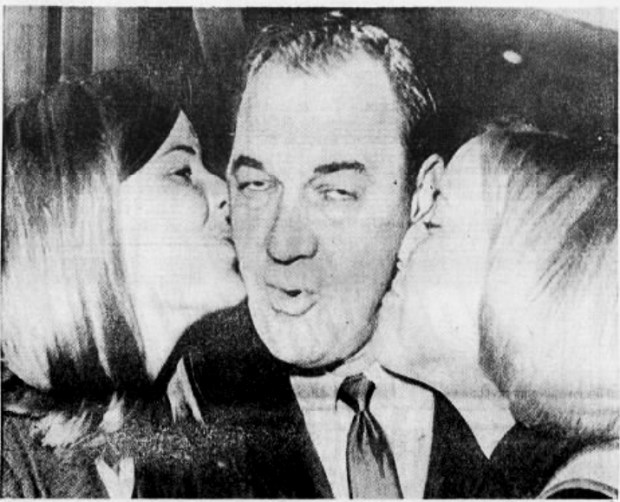 Claude Kirk Jr. gets kisses from daughters Sarah, left, and Kitty on election night in 1966 after becoming the first Republican in nearly 100 years to be elected Florida’s governor. (Orlando Sentinel file)
A few minutes later Kirk, speaking from his victory headquarters at the Diplomat Hotel in Hollywood, thanked “everyone all over Florida.”
*This was a total bipartisan fight of all of Florida, that government must be a servant of all the people,” the governor-elect said. “Florida will have a government in Tallahassee that will be the servant of the people. We will have a businesslike government.”
Counties which earlier had seemed certain to turn in big majorities for High went for Kirk and showed only small High margins.
The Democratic candidate’s home county, Dade, the largest concentration of voters in the state, gave High a margin which appeared would not go much above 50,000 votes, a droplet against the big Kirk margins in Orange, Pinellas, Duval (Haydon Burns’ home county), Pinellas and Polk, the latter Scott Kelly’s headquarters which High had hoped to take.
Voter dissatisfaction with the administration in Washington, Kirk’s emphasis on the crime incidence in the Democratic candidate’s home city, the help given Kirk by Haydon Burns, and Kirk’s strong state-wide organization — all these were reasons given for the Kirk overturn of a tradition of Democratic governors which has stood for 94 years.
Kelly, who lost to High in the primaries and later worked full time for him, attributed the defeat to general discontent with the Democratic party.
“They just blamed all the Democratic officeholders,” said Kelly.
Fears that Kirk would not work well with the Democratic cabinet were dispelled by Broward Williams, celebrating his retention of the state treasurer’s office at his home at Tallahassee.
“We’ll be able to work with the new governor,” he said. “For the benefit of the people, we must work together.”
Kirk’s victory Tuesday was in marked contrast to his defeat at the hands of U.S. Sen. Spessard Holland two years ago, when Kirk lost by more than 400,000 votes.
But that campaign gave him state-wide exposure, and he entered this campaign as well-known in many sections as was the Miami mayor.
Kirk is 40 years old and former president of American Heritage Life Insurance Co., of Jacksonville, and later a director of the stock brokerage firm of Hayden Stone & Co. He retired from active business to make the race for the Senate. In the intervening two years, he conducted an investment banker’s business on a part time basis in Jacksonville.
His campaign was unique for this state in that he brought in a professional campaign manager, Robert E. Lee of Denver, Colo. Throughout the campaign, it was a Kirk-Lee effort and the candidate did not attempt to mix it with local Republican hopefuls.
More stories and features from the Orlando Sentinel’s 150 years of covering Central Florida can be found at OrlandoSentinel.com/150. Sign up for our free history newsletter at OrlandoSentinel.com/newsletters. Want more Orlando history? Buy a copy of the Orlando Sentinel’s 150th anniversary book with 150 front pages from our 150 years. Get it OrlandoSentinel.com/150yearsbook and see more anniversary merchandise at OrlandoSentinel.com/150yearsmerch