
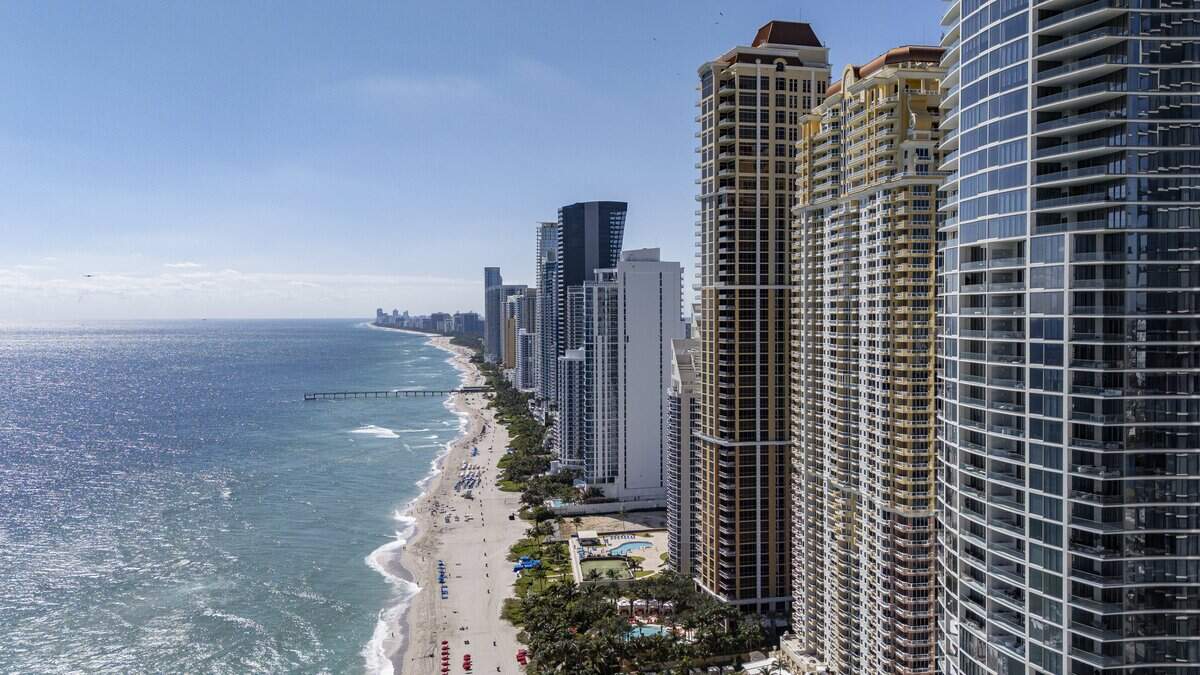
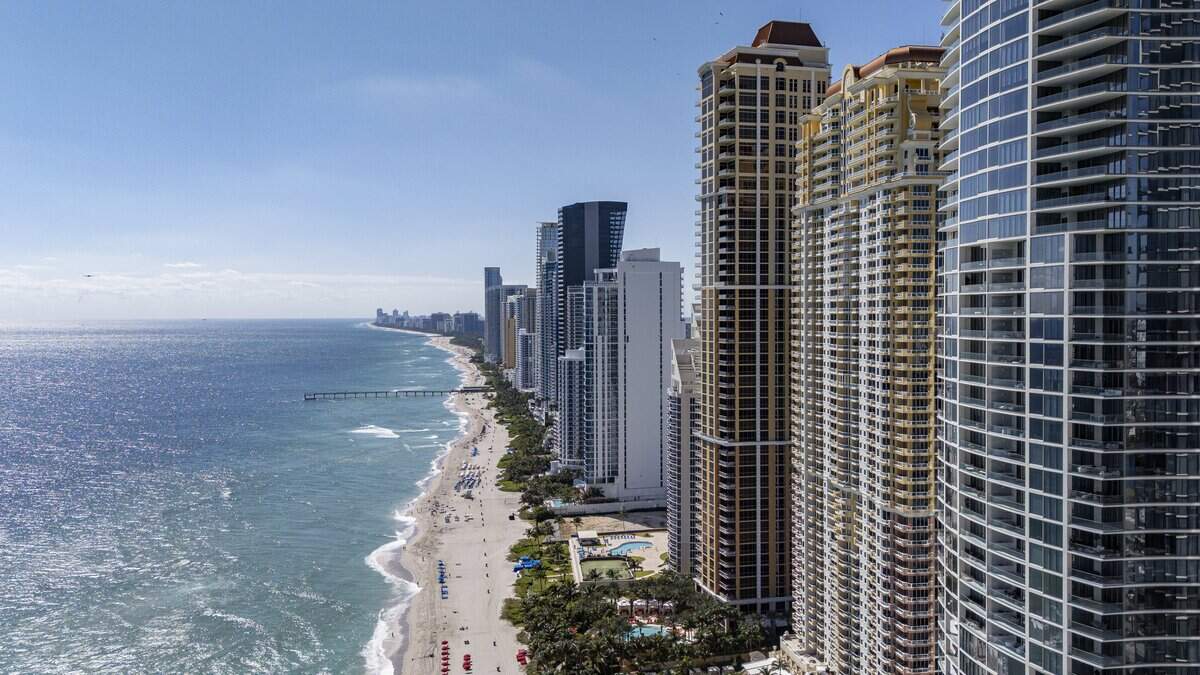
For wealthy people looking to live in luxury condos in Miami-Dade, like the Acqualina towers in Sunny Isles Beach pictured here, sometimes renting a unit costs significantly less than buying.
Photo by Matias J. Ocner
mocner@miamiherald.com
Darren Metz was sure he wanted to buy a luxury condo when he moved to South Florida from Nashville.
The retired business executive could afford a multimillion-dollar unit at The Estates at Acqualina in Sunny Isles Beach, and he said he assumed it would be better to buy a condo and build home equity.
“I’ve always hewed to the traditional financial wisdom that it’s better to own versus rent,” Metz told the Miami Herald. “That’s like the gospel.”
But Metz’s financial planner had a different recommendation: He might be better off renting.
Still, Metz decided to go with the conventional wisdom. He bought the unit for $5.5 million in 2022, according to Miami-Dade property records.
There are obvious benefits to homeownership. Owning your own place can help grow your net worth, and it protects you from uncertainties that can come with renting, like unexpected rent hikes or landlords deciding they no longer want to rent out a unit.
Owning a home also allows you to modify and renovate your space to make it your own. And it can offer emotional benefits, like a feeling of security or ownership.
But a recently published report from apartment search website RentCafe found that a growing number of wealthy Miami residents are choosing to rent instead of buy.
Millionaire renters reflect Miami wealth trend
Doug Ressler, a researcher with the real estate analytics firm Yardi Matrix, owned by the same parent company as RentCafe, said the growth in millionaire renter households in the Miami metro area reflects the larger trend of high-income people moving to South Florida.
“Florida isn’t just gaining renters,” Ressler said. “It’s gaining wealth.”
RentCafe defines millionaire households as having a total annual income of $1 million or more. That total can come from the incomes of multiple people in the household.
The number of millionaire households renting in Miami, 538, is still relatively small compared to cities like New York, where there are more than 7,000, or San Francisco, where there are more than 1,800.
But it’s a number that’s exploded since the pandemic. In 2020, there were just 51 millionaire renter households in the Miami metro area, which includes Broward and Palm Beach counties. RentCafe used data from the U.S. Census Bureau’s American Community Survey in this report.
Only Houston and Naples on Florida’s Gulf Coast have seen more rapid growth in the demographic during that time.
New York, San Francisco, Los Angeles and San Jose, California, were the only cities with more millionaire renters than Miami, according to RentCafe.
Cost and flexibility among reasons to rent
For many wealthy newcomers, especially white collar workers, a luxury rental is the “first stop after relocation,” Ressler said. Some may choose to rent long term for the flexibility, he added.
Some are finding it cheaper to lease a unit than to pay the high carrying costs of a mortgage, condo association fees, property taxes and insurance in addition to a down payment that can tie up millions of dollars. Owning a unit in a building going through a special assessment can also come with unexpected costs for condo owners.
A report published by the Swiss bank UBS in September showed that Miami was one of the global cities where renting is significantly cheaper than buying.
Even as the real estate market has cooled in South Florida, single-family home prices have remained stronger than condo prices. The UBS report showed that while condo prices fell 3% year-over-year, single-family home prices had only fallen 1.6%.
Savvy renters may choose to invest the money they save in an index fund, which could see better returns than real estate. Some prefer to use the money they save for their own businesses, said Mendel Fellig, a luxury Miami Beach real estate agent who said he’s seeing an uptick in luxury rentals. These affluent households may not want to “tie up their wealth in real estate,” Ressler said.
Renting and investing, a strategy once mainly favored by financial experts, is becoming a “more mainstream” wealth management strategy, said Albert Bell, a Miami real estate adviser with the brokerage SERHANT.
SERHANT is marketing and leasing units in FIVESIXTY Waterfront Residences + Club, a recently launched luxury rental building in Edgewater. Apartments will rent for between $15,000 and $25,000 a month, Bell said.
These high-end rentals are geared toward newcomers to Miami looking to test out a neighborhood before buying, retirees looking to downsize from larger single-family homes or people who would rather save the money and invest it, Bell said.
He estimated that buying a comparable unit in an Edgewater condo building would cost between $27,000 and $35,000 a month.
Rent vs. own still a complicated question
In Metz’s building, a unit comparable to his own is available to rent for $55,000 a month.
With condo association fees of around $15,000 a month, plus property taxes, insurance costs, maintenance and financing, it can easily become more expensive to own than rent. On top of that, a down payment on a luxury condo can tie up millions of dollars.
Of course, the tradeoff is more complicated than simply looking at whether renting or owning comes at a higher monthly cost.
One key difference between renting and buying is that once Metz’s mortgage is paid off, he’ll no longer be paying to finance his condo, and he’ll own the unit with no debt. That wouldn’t be the case if he rented a unit over the same period.
The growing number of millionaire renters in Miami reflects a variety of factors, some national and some unique to Miami. Most obviously, cities with many millionaire renters are typically cities where real estate is expensive. Someone who makes $1 million a year will likely have a harder time affording a home in an expensive city than in a lower cost-of-living city.
The high cost of borrowing could also be pushing house hunters across the country to rent instead of buy right now, said Benjamin Wright, a Miami real estate broker. Although mortgage rates have begun to come down in recent weeks, they’re still relatively high, which makes financing a home more expensive. The national average for a 30-year fixed-rate mortgage is 7.26%.
For buyers taking out a mortgage, a higher rate would lock them into a higher monthly payment and could make renting look more attractive. But, Wright added, when the market is cool because of high interest rates, it can be a good time for homebuyers to score better deals.
How Miami-Dade’s condo market could favor renters
Miami-Dade’s condo market offers another benefit to luxury renters. Because a significant number of condo buyers are foreign investors looking to store money in a stable asset, many condos are purchased by owners who don’t plan to live in them.
These owners are more likely to rent out the condo for just enough to cover their costs, which is sometimes below market rent or below the cost of ownership. According to a report from the Miami Association of Realtors, foreign buyers accounted for half of South Florida’s new construction condo purchases during an 18-month period that ended in July 2025.
Metz said he thinks this is especially common where he lives in Sunny Isles Beach, a barrier island town known for its luxe oceanfront condo towers. Sunny Isles Beach is also known as a place where foreign nationals like to invest in American real estate.
Fellig, the Miami Beach luxury real estate agent, said he has seen growing interest in rentals. But more often, he’s helping clients rent condos, not single-family homes. The supply of high-end single-family homes for rent is relatively small, and the demand is high, he said.
Fellig recently helped a client rent out their home on Flamingo Drive in Miami Beach. His client was initially offered $85,000 a month and ended up negotiating the rent up to $100,000.
In the luxury condo rental market, it’s often the opposite phenomenon. Owners looking to lease their condos sometimes offer discounts to potential renters. A glut of new and soon-to-be-built condo supply in Miami-Dade is part of the reason, Fellig said.
That oversupply has made Metz worry about the future value of his condo, although he said it has appreciated significantly in the years since he bought it. But that doesn’t guarantee its value will continue to climb, he said. Miami’s condo market has cooled significantly since the boom years of the pandemic, meaning his unit’s best days of growth may be over.
“Since the COVID days, it’s really leveled off in Miami,” Metz said. “If anything, the condo market has taken a downturn.”
Because the value of Metz’s unit has grown in the years since he bought it, and he locked in a low mortgage rate during the pandemic, he said he isn’t exactly worse off because he bought his condo. But if he were house hunting today, he said he would probably make a different choice.
“In today’s world with today’s interest rates, I would’ve reached a different conclusion,” Metz said.
He added that in addition to high interest rates there are “several things moving at once.” Association fees, property taxes and special assessments are driving the cost of ownership up, while a condo oversupply is keeping rents relatively low.
“All of that,” Metz said, “has upended traditional received wisdom.”

Miami Herald
Catherine Odom covers real estate for the Miami Herald. She previously interned on the Herald’s government team and has worked as a journalist in Germany and Armenia. She is a graduate of Northwestern University.