

Two words are striking fear and loathing into some neighborhoods across South Florida: Live Local.
The state law that aims to boost affordable housing takes away local control over where high-rise projects can be built, forever altering the quality of life for the surrounding neighborhoods, opponents say.
But fans of the Live Local Act argue it addresses skyrocketing rents and a severe shortage of affordable housing throughout the state — even though some local officials and residents say some of those residential towers are going up in places they don’t belong.
Fort Lauderdale Vice Mayor Ben Sorensen argues the city needs to join with other municipalities to help change or repeal the Live Local Act in an effort to safeguard their communities.
“The impacts on our infrastructure, roads, sewage, water are massive,” Sorensen said during a recent City Hall meeting. “And this is being forced down our throat.”
But supporters of Live Local argue it’s providing desperately needed housing.
The law took effect on July 1, 2023, and is set to expire on Oct. 1, 2033.
So far, 26 projects with a total of 10,000 housing units are under construction and another 238 projects with a total of 70,000 units are in the pipeline, said Keith Poliakoff, a land-use attorney who has represented several Live Local developers.
Without Live Local, those projects would have never been talked about or even shown up on a blueprint, Poliakoff said.
“Absolutely, this is a win for Florida,” Poliakoff told the South Florida Sun Sentinel. “We need to recognize that projects of this magnitude don’t happen overnight. Financing, permitting and construction take time. The real measure of success will be how many of these units are ultimately built and made affordable to working families. But without the Live Local Act, many of these projects might never have gotten off the drawing board. This is meaningful progress toward addressing one of the greatest challenges facing Broward County and the entire state.”
Developers like Live Local because it bypasses restrictive zoning and allows them to skip the normally required public hearings where elected officials can request tweaks to projects or block them altogether, Poliakoff said.
In addition, the law provides developers with financial incentives via property tax exemptions and sales tax savings.
Based on recent studies, Broward County is short 147,042 affordable housing units, Poliakoff noted.
“Without the Live Local Act, Broward County risks becoming a place where people can afford to work but cannot afford to live,” he said. “Teachers, firefighters, police officers, nurses and young families are increasingly being priced out of our communities.”
The county cannot expect to sustain a strong local economy if the very people who keep it running are forced to live elsewhere, he added.
“The Live Local Act provides critical incentives for private investment to create much-needed housing that might otherwise never be built,” Poliakoff said. “This isn’t simply a housing issue — it’s about Broward County’s economic future, the strength of our workforce, and preserving the opportunity for future generations to live here.”
Still, the angst over Live Local has been on the rise as more people come to understand its impact.
A chorus of angry critics packed a town hall meeting last year to tell Fort Lauderdale officials what they think of the plan to remake Galleria mall into a site with eight towers, all 30 stories high.
Mayor Dean Trantalis called the town hall meeting to educate the neighbors about the state’s Live Local law. Many vented, demanding the city do something to stop the project.
“That project is a nuclear bomb,” one angry resident told the mayor before a packed crowd.
“I will be honest with you,” Trantalis said at the time. “I have nightmares thinking about this project. We do not need another 3,200 units plopped right there in the middle of our community. We have directed city staff to find any opportunity to downsize this project and make it compatible with the neighborhood. That’s their mandate.”
But the city’s hands were tied, the mayor explained at the time.
And to a great extent, they still are, he admits today.
The law allows developers to bypass the normally required public hearings and zoning approvals as long as at least 40% of the residential units qualify as workforce housing.
Under Live Local, it’s not commissioners or planning boards that greenlight projects, but city staff. That means controversial projects can avoid the sometimes marathon meetings that come when opponents show up at public meetings to speak against a proposed high-rise tower.
The controversial Galleria project was recently approved by city staff.
Staff approval is not automatic.
Developers are required to meet all technical requirements and local regulations, including setbacks, building codes, environmental impacts and stormwater management reviews.
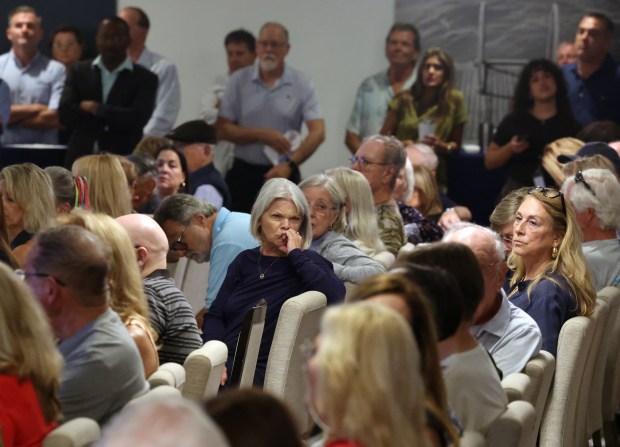 Residents listen to Fort Lauderdale Mayor Dean Trantalis during a town hall meeting at the Coral Ridge Yacht Club on Oct. 28, 2025. The topic: A proposed redesign of the Galleria mall. (Mike Stocker/South Florida Sun Sentinel)
Poliakoff, who does not represent the Galleria developer, says he understands why some folks don’t like Live Local.
“Residents don’t like the state Legislature usurping local government control over its land use and zoning,” he said. “They like to be able to have more input into whether or not certain developments will go into their community. And since the state has taken away that control, residents don’t like it.”
Parts of Fort Lauderdale with commercial zoning are now fair game for developers who want to build Live Local projects on land where it wouldn’t have been allowed before, Poliakoff said.
“Residents don’t feel like they have a say in height or density,” he said. “That power has been taken away from them — and the commissioners too. That’s a scary proposition for a commissioner to realize all these units are being built without their oversight.”
As a state representative, Chip LaMarca says he backed Live Local for good reason: It jolted private developers into building affordable housing.
“The legislation is not perfect and nothing is,” said LaMarca, whose term ended on Nov. 3. “I get it. But at the end of the day, the private sector is going to be the most efficient at building affordable housing. And this gave them that tool.”
Like other cities, Fort Lauderdale has a master plan that dictates where high-rise towers can go. But with Live Local, that plan is somewhat upended, Trantalis and Sorensen say.
In general, Fort Lauderdale commissioners are not opposed to density — they are opposed to density in the wrong places, Trantalis says.
Under Live Local, there are now several high-rise projects planned on or near Southeast 17th Street, Sorensen noted.
“17th Street is an F-rated road,” he said. “There are five Live Local projects proposed in proximity to 17th Street. It is already a traffic nightmare.”
If those five projects get built, Sorensen predicts a host of problems, including longer emergency response times along with a strain on the city’s sewer and water infrastructure.
The other problem: A lack of neighborhood compatibility, he argues.
“We have a fantastic master plan for our city,” Sorensen said. “And we ask that the Legislature respect local authority and neighborhood input on where they think density is best and allow us to grow in those areas. That has served us as a city very well. You see density downtown. You see more density coming up north on some of our main corridors.”
Sorensen also took aim at the allowed income for eligible renters of Live Local projects, saying it’s way too high.
“Right now it’s at 120% of area median income, (well over) $110,000,” he said. “That is not workforce and affordable housing.”
Under the Live Local Act, developers can bypass height and density rules if they reserve at least 40% of their residential units for workforce housing for a minimum of 30 years.
Households qualify if they make between 80% and 120% of the county’s area median income.
Based on the county’s current median income of $102,500, renters eligible for the workforce housing apartments can earn anywhere from $82,000 to $123,000 a year.
“Make it real affordable housing,” Sorensen said. “Not 120% of AMI.”
Sorensen argued the maximum cap should be at 60% or 70% of the county’s area median income. That would make the workforce housing apartments available to renters making up to $61,500 or $71,750.
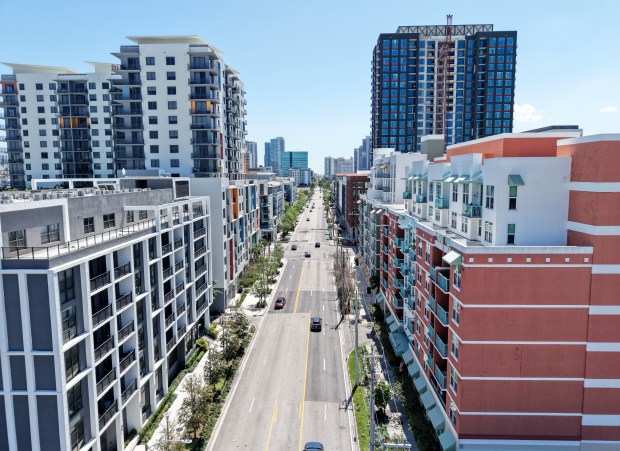 An aerial view of downtown Fort Lauderdale on March 23, 2026, looking south on Andrews Avenue toward Broward Boulevard. The city needs another large sewage lift station to accommodate a growing downtown. (Carline Jean/South Florida Sun Sentinel)
Daphnee Sainvil, Fort Lauderdale’s intergovernmental affairs division manager, told the commission the city had come up with a plan to seek changes to the Live Local Act that would allow for building heights to be stepped down next to low-rise neighborhoods.
Under the current Live Local Act, a large development can sit right next to low-rise neighborhoods, she noted.
“We are asking that building heights step down and that local design measures apply,” Sainvil said.
Sorensen interjected.
“This is not enough, city manager,” he said. “We need to go much harder, much stronger against Live Local.”
Barbra Stern, an attorney and future mayoral candidate, praised Sorensen for speaking up about the problems with Live Local.
“Ben, to your credit, I think it’s really important to get a grip on this,” Stern said. “This is not going to be just a Broward County issue. If we’re going to look at a coalition, I think we need to look at a coalition of the tri-county area to get up there (to Tallahassee). Strength in numbers.”
The consequences of Live Local need to be addressed on a regional scale, Stern argued.
Under the state’s Live Local Act, developers can match the currently allowed height of a commercial or residential building up to a mile away in an effort to boost affordable housing.
“If your tallest building is eight stories, that’s one thing,” Stern said. “If your tallest building is 47 stories or 50 stories, it’s a completely different ballgame. One size does not fit all for Live Local. The coastal communities are going to be dealing with it the worst because we have the tallest buildings.”
Stern said she also had grave concerns about what the future holds as the county’s area median income rises.
In 2019, before the coronavirus pandemic, the county’s area median income was $68,600, she noted.
“Well during COVID everybody moved to Florida and our home values went up,” Stern said. “Our area median income this year is about $102,000. What do we think it’s going to be three years down the road from now when these projects are built? Probably $120,000 and $130,000. It’s not just going to level out at $102,000.”
Stern pointed to the abundance of luxury towers that have cropped up in downtown Fort Lauderdale over the past several years, with more in the pipeline.
“We’re building luxury condos and apartments left and right in downtown Fort Lauderdale,” she said. “Who can afford to live there? People making higher salaries. It’s going to be driving the AMI up.”
Like Sorensen, Stern suggested the salary cap for Live Local’s eligible renters be somewhere between $60,000 to $80,000.
“I think we need to look at what actual income levels are and not AMI,” Stern said.
The Council of Fort Lauderdale Civic Associations sent an Oct. 19 letter to the commission urging the city to push for needed changes to the Live Local Act.
“The Live Local Act is an example of legislation with good intentions but unintended consequences,” wrote William Brown, president of the organization, which represents more than 40 neighborhood associations throughout Fort Lauderdale.
“The new units being developed as ‘affordable’ may command rents of roughly $2,800 per month for a two-bedroom apartment, which is comparable to market-rate housing in many areas of Fort Lauderdale,” Brown wrote. “In some cases, similar two-bedroom apartments in existing buildings are available for less.”
A one-size-fits-all law fails to recognize significant geographic and local differences, Brown added.
Brown’s letter urged Live Local’s shortcomings be addressed in the following ways:
— Limiting eligible projects to locations closer to established high-density areas.
— Prohibiting Live Local developments in areas where infrastructure capacity is inadequate.
— Reducing the maximum tenant income eligibility threshold to 100% of AMI.
— Requiring municipalities to administer and monitor affordable housing units developed under the Act.
— Restoring stronger local government oversight of development approvals.
In signing off, Brown made one last plea: “Communities such as ours should have the flexibility to rely on proven local programs and, ideally, should be exempt from the provisions of the Live Local Act altogether.”
Sorensen told the Sun Sentinel he has already reached out to local legislators about “fixing” Live Local.
“I told them we need to change this,” he said. “And they are saying they’re open to discussion. They understand the pain it’s causing.”
Susannah Bryan can be reached at sbryan@sunsentinel.com. Follow me on X @Susannah_Bryan