
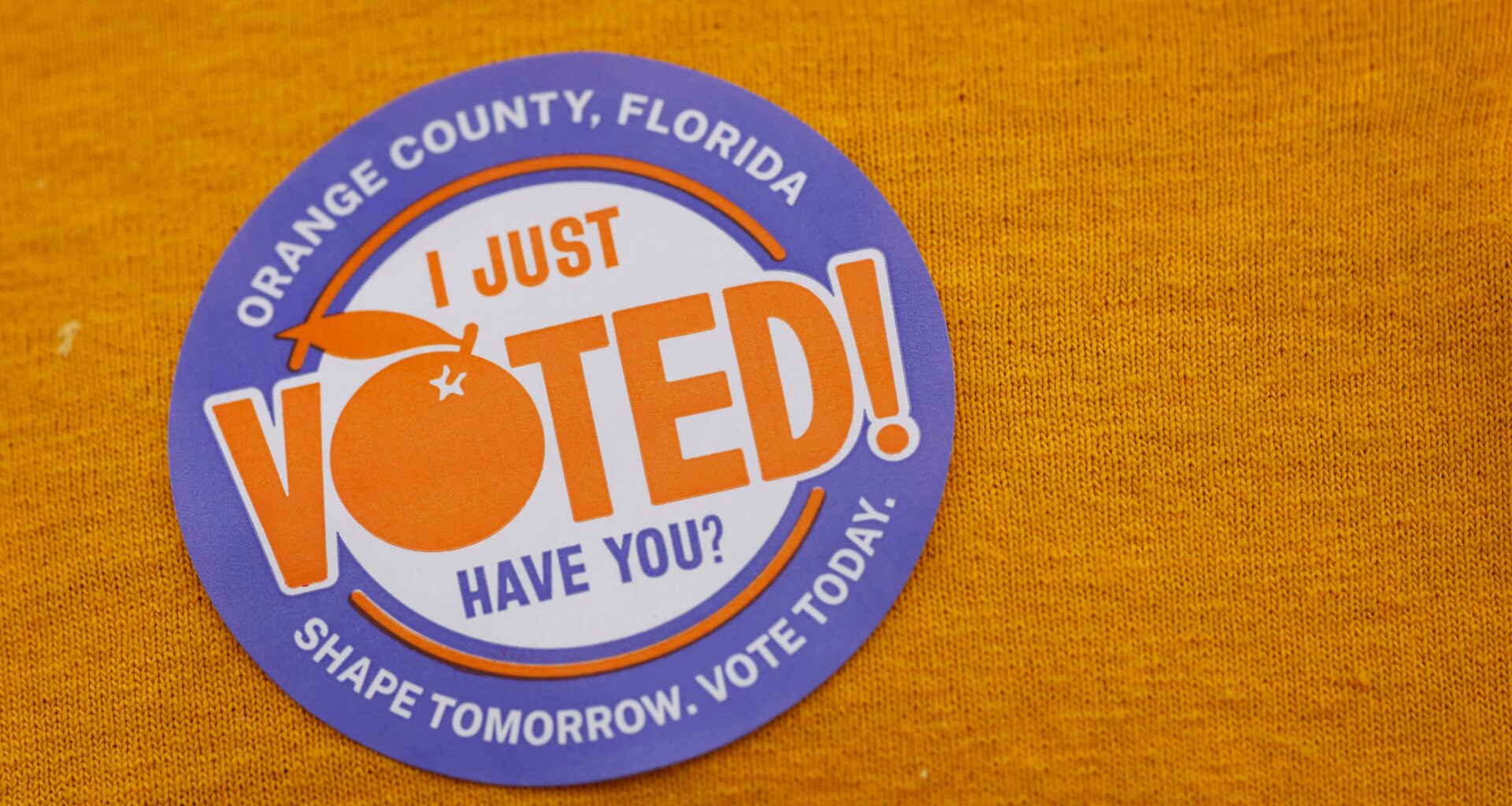
These are posts from early Tuesday on Election Day in Florida. For latest updates, follow our live blog here.
UCF student took Trump’s advice and pretended he was on the ballot | 1:28 p.m.
First-time voter and psychology major Laila Hills, 18, came to the UCF polling place to cast her first-ever ballot to support Democratic U.S. Senate candidate Angie Nixon.
“I definitely feel like my top issues were more against the current administration, I’m not too happy with it,” said Hills. “I’d rather vote against it.”
In a rally yesterday in Dubuque, Iowa, Trump did urge voters to “Pretend I’m on the ballot.’’
Hills also noted the atmosphere provided by the Nonpartisan Voter Assistance group present at the polling site.
“They definitely made me a lot less nervous, because going there in the first place was like ‘Oh, I’ve never done this before,” she said. “Coming out, it was a great experience.”
Sofia Gonzalez, University of Central Florida student journalist
Two friends at UCF show up together to vote | 1:23 p.m.
Whitney Souffrant, 22, and Kari Claude, 20, came to cast their ballot at the UCF on-campus polling site after numerous forms of voter outreach, including television commercials and text messages, had sparked their interest.
“You see all the ads, and of course after that, I did my research. I wasn’t too pleased with how everything was distributed. One side had more funds and opportunities to get their outreach than the other,” Souffrant said.
For Claude, the automated messages from politicians pushed him to vote and conduct his own research.
“For me, I think it would be more so the constant text messages. I think that further pushed me to look into it. I feel like Florida is in desperate need of change,” he said.
Souffrant, a Miami native, was initially going to vote in her hometown and said she requested her mail ballot on time. But she was later notified that the request was denied.
“Even though I sent it correctly, and within the time, they got back to me a week later and said the deadline passed. So I kind of had to go here,” she said. “After that, I was frustrated and more determined to vote.”
Both friends said they cast their ballot in support of former commissioner and Orange County Clerk of Courts Tiffany Russell in the Orange mayoral race.
Sofia Gonzalez, UCF student journalist
First-time UCF voter hopes to make a difference | 12:32 p.m.
UCF first-time voter Savannah LaViolette, 18, was excited to finally have the opportunity to cast her ballot. She showed up to the Live Oak Center on the UCF main campus to do so.
“Some things are not going so right with our government, and I would like to make a difference,” LaViolette said.
While lots of students are voting for the first time, some students are voting in their second major election.
Edward Martinez, 20, says he used to lean conservative but noticed his views aligned more with the Democratic Party. “I agree with more so the policies that Democrats have at the moment and honestly I would like to see Florida become more of a blue state,” Martinez said.
Jessica Scura, University of Central Florida journalism student
Oviedo mom goes to the polls for the future of her children | 12:55 p.m.
Marissa Phillips and Kaitlyn Thompson both waited 45 minutes with infants in their arms to cast their votes at a precint in Oviedo.
Phillips, 34, is a systems engineer and a mother of three. She was motivated to cast a ballot, she said, by “my black ancestors fighting for my right to vote. They only were considered two-thirds of a person.”
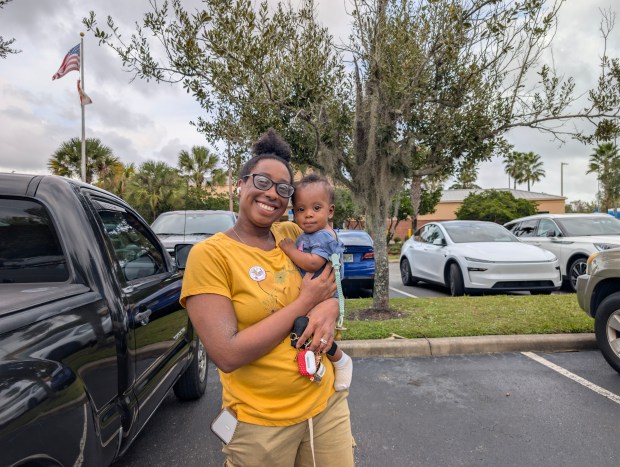 Marissa Phillips, 34, of Oviedo waited 45 minutes with her baby in her arms to cast her ballot Tuesday, Nov. 3, 2026. She said she was thinking of her ancestors and her children as she voted. (Micah Johnson/UCF journalism student)
Thompson is a stay-at-home mom. Her sole reason for voting was her children. “I care about the future for my kids,” Thompson said.
“I want to make sure they have green spaces when they grow up,” Thompson said. She also expressed concern about protecting state parks and the rural Seminole boundary.
Despite the wait, she was pleased with her voting experience.
“They were very accommodating. I had a stroller and everything, they just were very kind people,” Thompson said
While Phillips and Thompson disagree on some issues, they both had one thing to say to the world: “Just go out and vote!”
Micah Johnson, UCF journalism student
Support for OCPS tax renewal by daughter of teacher | 1:44 p.m.
Amy Griffith voted in Orlando’s Conway area, first stopping outside her precinct to accept a voter guide from Laura Smith, a volunteer with Orange County Democrats.
Griffith’s mother is an Orange County Public School teacher, so she said she was keen to vote in favor of continuing the one-mill one-mill school property tax in place since 2010 and re-approved by voters every four years since.
Griffith said she is dissatisfied with Florida’s current political leaders and that was also motivation for her to vote.
She supports the Democratic Socialist movement and cast her ballot for Angie Nixon in the race for U.S. Senate.
“I wouldn’t say there’s any major, specific issues,” she said. “It’s more that I want to see an upheaval of sorts of the entire current system of government in Florida.”
Smith, the volunteer, said there had been a steady stream of voters coming to the polls all morning. Smith, who works for Robert Walton Johnson’s campaign for Orange County clerk of courts, held a sign and wore a bright orange Johnson t-shirt as she waved at arrivals.
“A lot of cars coming in, I mean a lot of cars,” she said. “There’s been a lot of traffic and it’s not even lunchtime yet.”
Michael Cuglietta
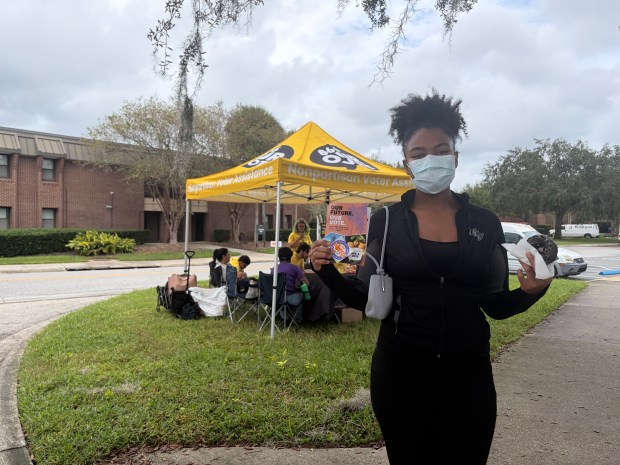 UCF psychology student Mya Fairbanks said she voted Tuesday, Nov. 3, 2026, because her forebears fought hard for the right. “I’m a Black, young, Hispanic woman, and I find that the people who came before me didn’t have the opportunity to vote and they fought for my right to vote. So, I vote like my life depends on it because it does.” (Sofia Gonzalez/UCF journalism student)
UCF voter feels the weight of history as she casts her ballot | 12:32 p.m.
A sense of honor and heritage brought UCF student Mya Fairbanks, 21, to the Live Oak Center polling place Tuesday. The senior psychology student said it was important to cast her vote to honor those who came before her.
“I’m a Black, young Hispanic woman, and I find that the people who came before me didn’t have the opportunity to vote and they fought for my right to vote. So I vote like my life depends on it because it does.” Fairbanks said, adding she voted for Democrats Angie Nixon for U.S. Senate and David Jolly for governor.
She added it was important to show up because others don’t see it as important.
“I know there’s not a lot of Black voter turnout and I just want to change that narrative and just be a good steward of what I believe in,” Fairbanks said.
Another UCF student, Annabelle DuBose, an 18-year-old political science major, voted for the first time.
“I wanted to vote obviously to give my opinion and help the country.” DuBose said. “But also just for the people who don’t get to vote, people who are working or who are unable to for some reason not vote today. … It made me feel really proud, just to be able to partake in something that is nationwide and so important.”
Both students remarked that their voting experiences went smoothly and quickly.
Gracon Ladd, University of Central Florida journalism student
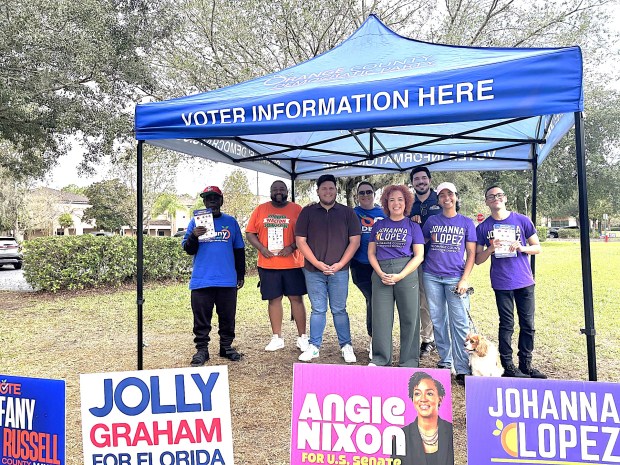 Johanna López, fourth from right, showed up to Orange Precinct 431 at the Renaissance Senior Center on Tuesday, Nov. 3, 2026, to encourage supporters. The Democrat is running for the Orange County Board of County Commissioners to represent District 4. (Aaliyah Cardenas/UCF journalism student)
López speaks up for education at east Orange senior center | 12:19 p.m.
Orange County Commission District 4 candidate Johanna López is outside the Renaissance Senior Center in Orange County speaking to voters – and speaking up for education.
“I think that is it’s extremely important to have volunteers and to have, us, the candidates that are running for those seats, being outside,” López said.
She spoke in favor of the proposed Orange County sales tax increase on the ballot to fund education.
“I’m completely in favor, yes. Because now that we are having all of these cuts for education and now that we don’t have the same population in our schools, it is extremely important to support these amendments,” López said.
As a former teacher and 2017 Teacher of the Year she said students need more support programs to succeed.
“We don’t have Boys and Girls Club, we don’t have a YMCA, we don’t have a cultural center. So having a very high Hispanic population and not having certain opportunities is just not allowing our community to grow and to grow and thrive economically,” López said.
Aaliyah Cardenas, University of Central Florida journalism student
Education, affordability drive Oviedo voters to the polls | 12:17 p.m.
Oviedo voter Austin Gregory, 26, an education manager, said support for education brought him to the polls at Seminole Precinct 70 at the Oviedo Gym and Aquatic Facility on Tuesday.
“One of the biggest problems in America is the education system,” Gregory said. “Many people cast their votes because their parents said they are the right candidate, but they aren’t thinking about their choices.”
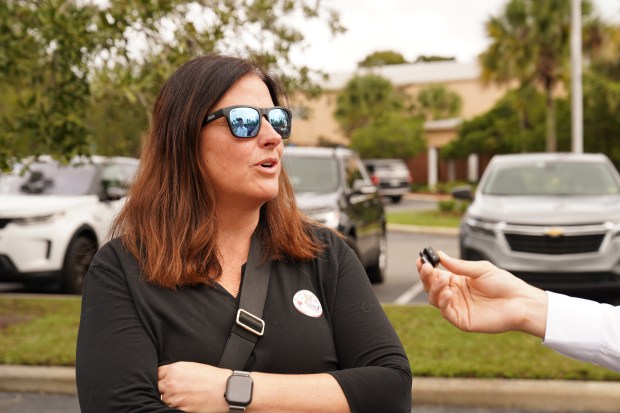 Vanessa Ross, 48, of Oviedo says she voted Tuesday, Nov. 3, 2026 with lower housing costs in mind, especially for recent graduates like her son. (Micah Johnson/UCF journalism student)
Vanessa Ross, 48, a marketing executive in Oviedo, voted with lower housing costs in mind, especially for recent graduates like her son.
“My son is in his 20s, and many people like him have to have multiple jobs just to make ends meet,” Ross said. “If you work a minimum-wage job, you can’t pay rent.”
Ross said many graduates also face the cost of paying for their degrees on top of their housing costs, which add up over time.
“If you’re a college graduate, it really just depends on what major is,” Ross said. “With that, it makes it too hard to get a normal apartment and with a normal paying job.”
Michael Gonzalez, University of Central Florida journalism student
Vilchez Santiago shows up to greet voters at polls in east Orlando | 12:11 p.m.
Democratic state House candidate Samuel Vilchez Santiago greeted voters arriving at Orange Precinct 431 at Renaissance Senior Center Tuesday morning.
“It feels like I am greeting my neighbors,” said Vilchez Santiago, running in District 43. “These are the people I went to school with, my former teachers and people from the community, and it has been humbling to see them come out and express their support for me.”
Vilchez Santiago grew up in east Orlando as the son of two political refugees from Venezuela who came to Florida seeking opportunity and safety. Although he faced financial hardships and relied on public assistance and school resources early in life, the community provided him an opportunity to succeed, he said.
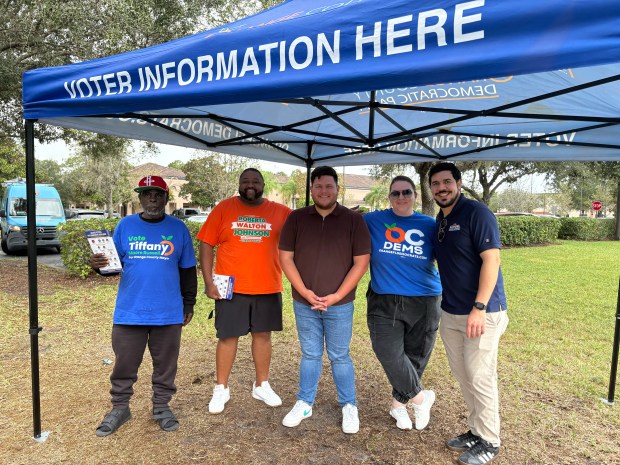 Democratic congressional candidate Samuel Vilchez Santiago greets supporters at Orange Precinct 431 at Renaissance Senior Center Tuesday, Nov. 3, 2026. He’s running for Florida House of Representatives District 43. (Andrew Newlin/UCF journalism student)
“As a kid, I escaped political persecution from Venezuela, and I want to make sure that we are defending our democracy here in the United States,” Vilchez Santiago said. “Today, I am here to make sure voters feel welcome and valued to exercise their right.”
Andrew Newlin, University of Central Florida journalism student
Exercising the right to vote paired with exercise in Winter Park
The parking lot of the Winter Park Family YMCA on North Lakemont Avenue was busy with folks there to vote, exercise or do both.
That was the case for William Berzak, who came to work out and cast his ballot. He said he tends to vote more for Democrats, was especially interested in the gubernatorial race and planned to vote for Jolly.
“He has liberal or moderate stances on different issues,” Berzak said. Donalds, he added, “is almost a stooge” for President Donald Trump and Gov. Ron DeSantis.
On another statewide issue, Amendment 3, Berzak said he planned to vote no.
If approved by 60% of voters, it would create a $150,000 tax exemption on primary homes in 2027 and a $250,000 exemption in 2028. Such new rules would lead to thousands of dollars in annual savings for taxpayers but could decimate local government budgets and also lead to increases in fees or other taxes, as cities and counties look for ways to fill budget holes.
“If they had done an exemption less drastic than that I’d probably vote for it,” Berzak said. “And it’s shifting all the tax burdens onto renters and commercial property owners.”
Anne Kelly also stopped by the YMCA to vote and said she considered herself a moderate, but in this election was pretty much voting for Republicans across the board. Although Donalds would be Florida’s first Black governor, she said that didn’t impact her vote.
“I don’t really vote based on color, or minority, or anything other than just really what the issues are and what the state is facing,” Kelly said. “And I just feel that a Republican governor is what we need to continue to have in the state.”
She also planned to vote for Amendment 3. She works in banking and believes higher homestead exemptions will help make buying homes more affordable for those with moderate-to-low incomes.
Kelly said she has two grown sons — one who already owns a home — and this would certainly help the other.
“The other one is 27 and would like to buy a home, and I just think this gives them a leg up on being able to afford very pricey homes right now, relative to their income,” she said.
Brian Bell
UCF student casts vote against what he sees as political corruption of Trump administration | 12:09 p.m.
UCF student Sean Scherker, 19, voted on campus, motivated by his worries about political corruption.
“The current administration has seen more corruption than any political administration in the past as far as I can remember for sure,’’ Scherker said. “If Trump did the Watergate scandal, it would seem like normal everyday news.”
Scherker said he voted for Democrat Angie Nixon for the U.S. Senate because he wants the Senate to start setting up guard rails on Trump.
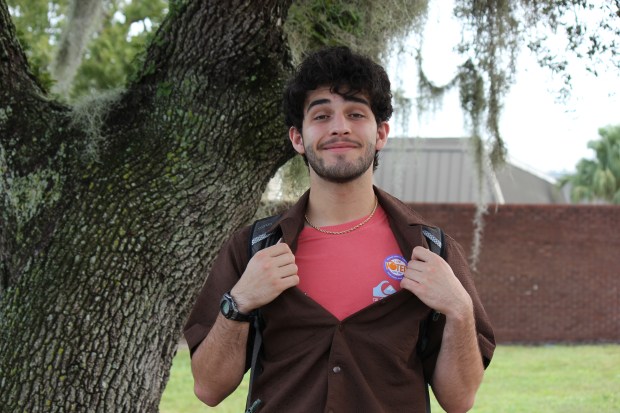 UCF student Sean Scherker opens his jacket to reveal an “I Voted” sticker outside the Live Oak Center at Precinct 511 on UCF’s main campus on Tuesday, Nov. 3, 2026. Scherker said he showed up to vote against political corruption. (Jessica Scura/UCF journalism student)
Sean Brogan, another UCF student, said the candidates on the ballot didn’t inspire him but he still went to the polls.
“This morning I woke up and I thought that I should go vote, even though before I wasn’t as motivated to,” Brogan said.
Jose Aponte, University of Central Florida journalism student
First-time Florida voter casts his ballot in Maitland
Jerry Cuevas came to the Asbury United Methodist Church in Maitland to vote for the first time in Florida since moving here from Connecticut a little over a month ago — just ahead of the cutoff for registering to vote.
Cuevas called himself a progressive and said he was supporting Jolly for governor along with other Democrats on the ballot.
“I’m a little more left than probably most of my options here, to be perfectly honest,” he said. “I wouldn’t call myself a socialist, for instance, but I would rather vote for socialists than a lot of the Republicans right now.”
As a recent arrival, Cuevas said during the last month he did a lot of research on the Florida candidates and issues that would be on the ballot. He said he looked for people whose politics were closely aligned to his.
Cuevas said he moved south because so many family members have migrated to Florida over the years.
“I just wanted to be closer to family. I don’t think we’re living in the best of times,” he said. “I just get more comfort being close to my family — despite having told them for years I would never move here.”
Brian Bell
Confused voters at UCF campus precinct sent to other polling places | 10:53 a.m.
Election day confusion sent some University of Central Florida students who showed up at the campus precinct to other polling places due to misunderstandings about address changes and assigned precincts.
Gen Gonzalez-Nunez, 21, a UCF senior, and 19-year-old Jeremiah Leverity, a junior, were both sent to other polling sites off campus since they are not on-campus residents. Gonzalez-Nunez said she was told her polling address was near her parents’ house and worried about making the 30-minute drive to that site but planned to try.
“I do want to vote. I do want to make my voice heard,” she said.
Leverity said he was excited to cast a ballot since he’s a first-time voter. “I’m trying to help the world. It’s a vote, it could change something,” he said.
Jose Aponte, University of Central Florida journalism student
‘Content of your character … really matters’ | Eatonville, 10 a.m.
Kevin Brown, a 58-year-old Eatonville resident voted early on Saturday. On election day,
he sat in a barber shop near the polling station at Eatonville Town Hall, where a
slow but steady crowd of people was coming to vote.
A regular voter, Brown said this election is especially important because of how
dissatisfied he is with the state of the country. “Basically everything that’s going on with the economy: gas prices, food prices, health care coverage, the whole nine yards,” he said.
Brown, who is Black, said the fact that Republican Byron Donalds could becom Florida’s first Black
governor was not enough to win his vote.
“In a way, it probably should have. But at the end of the day, it’s about what are you going to do for the people,” he said. “The color of your skin matters but like Dr. King said, it’s the content of your character that really matters.”
Michael Cuglietta
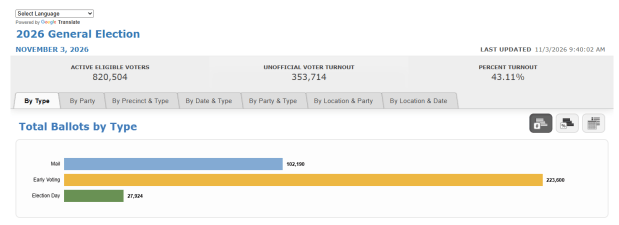
Orange County already showing 43% turnout | 9:49 a.m.
The Orange County Supervisor of Elections reported early Tuesday that the county had already exceeded 43% turnout for the election.
In an update at 9:40 a.m., the office showed that of 820,504 eligible voters, 353,714 had already cast ballots. The breakdown: 102,190 came from mail, 225,600 came from early voting, and 27,924 were from election day in-person voting.
Roger Simmons
Heavy rain, flooding impacting some Florida polling locations | 9:32 a.m.
Flooding caused by this week’s heavy rains prompted Florida to change some polling locations in eight counties, the Florida Division of Elections says.
Brevard and St. Lucie counties are the most impacted, with a half dozen or more polling locations shifted in each county to make sure residents can still vote.
The other counties are Broward, Highlands, Indian River, Martin, Okeechobee and Palm Beach.
Leslie Postal
More on Florida flooding and its impact on the vote | 9:00 a.m.
TALLAHASSEE – Torrential rain along Florida’s central eastern coastline and in some inland counties has flooded roads and led to the shutdown of schools in some counties, and election officials are attempting to find alternative polling places in affected areas.
Gov. Ron DeSantis on Monday afternoon issued an executive order declaring a state of emergency in Brevard, DeSoto, Hardee, Highlands, Indian River, Martin and St. Lucie counties.
Included in the order is a provision allowing local supervisors of elections in affected areas to designate new polling places for sites that are unsafe or where voters can’t get to them because the roads are blocked due to flooding. State law requires election officials to “designate a new polling place which shall be accessible to the public on election day” when under a state of emergency, and post notice at the old polling place telling voters about the alternative precinct.
“The Division of Elections is in contact with the counties impacted and will respond pursuant to state law, as necessary,” Department of State director of communications Gretl Plessinger stated in an email.
Brevard County canceled schools Monday and Tuesday, and several roads were closed for part of the day as heavy rains inundated large swathes of the county.
Brevard Supervisor of Elections Tim Bobanic was hopeful the waters would recede by Tuesday but was still looking for alternative polling places if the original sites weren’t accessible.
“Yes, we are conducting an election tomorrow,” Bobanic told the News Service of Florida. “Actually, a majority of my sites are already set up and ready to go. We’re still evaluating – I’m having conversations with city and town management with the (emergency operations center).”
Some of Bobanic’s offices in Titusville, Melbourne and Palm Bay were closed Monday due to the weather conditions, but its Viera site was open, according to the Brevard elections website. A canvassing board meeting originally set for Monday afternoon, however, was cancelled.
Hurricane-prone Florida has dealt with storm-related disruptions to its elections before. In 2018, when Hurricane Michael swept through the Panhandle as a Category 5, then-Gov. Rick Scott issued an order setting up alternative polling sites in the affected areas.
But Michael made landfall on Oct. 10, leaving more time for residents to know where the new polling sites would be. The sudden nature of the latest weather disruption means officials will be scrambling to tell voters where to cast their ballots on Tuesday if new polling places are deemed necessary.
“We will get the word out the best we can,” Bobanic said.
Gray Rohrer, News Service of Florida
 Desiree Espinosa, foreground, sits next to her mother, Becky Collazo, shortly before doors opened for voting at the Apopka Community Center on South Central Avenue. They said they had been there since 5:30 a.m. and wanted to be first “So we can go back home early and sleep.” (Brian Bell/Orlando Sentinel)
Apopka voters arrive early at the polls | 8:50 a.m.
At the Apopka Community Center on South Central Avenue voters started lining up long before the sun had risen.
Becky Collazo and her daughter, Desiree Espinosa, were sitting at the front of the line waiting for the doors of Precinct 216 to open at 6:45 a.m. They said they’d been sitting there since 5:30 a.m.
Both had the same reason for wanting to be first: “So we can go back home early and sleep,” Espinosa said as they both laughed.
The mother and daughter said they are regular voters and believe doing so is important.
“It’s our duty to make a difference,” Collazo said.
As Republicans, they said they planned to cast their ballots for Byron Donalds in the gubernatorial race. Donalds would be the state’s first Black governor.
“To give everybody an opportunity, yes, I think that’s important,” Collazo said. But her daughter said race is irrelevant as long as he does a good job.
Bryson Reed, who arrived right before doors opened, said he didn’t align with either major party and said he’s only been a regular voter for the last couple of years.
“I think it’s important to vote because our rights are important and our wishes need to be heard,” the 33-year-old said.
He said he’d done research on the issues and candidates but remained undecided heading into the precinct. He did say he liked David Jolly — the Democratic candidate for governor — where he comes from, the way he speaks and his professionalism.
But with the information overload that leads to Election Day, Reed said he’s been looking at both sides to sort through it all.
“I’m just trying to understand and kind of go with my gut when I get there,” he said.
Brian Bell
Amendment 3, Nixon brings these voters to the polls | 8:39 a.m.
Jess and Michael D’Amico walked over to their Colonialtown precinct with their young daughter early Tuesday morning. The Orlando couple said they vote in every election but this one is particularly important, in part because of Amendment 3, the property tax cutting proposal, which they oppose.
“Things that are really important to us are community infrastructure and being able to have community resources and amenities, and that comes from all of us contributing,” Jess D’Amico said, pointing to a nearby public swimming pool. “We’re worried this pool’s going to close if Amendment 3 passes. We moved here because of this pool.”
They were also enthusiastic about voting for Democrat Angie Nixon for U.S. Senate.
“I had a friend in Indiana that just texted men, she’s like ‘how excited are you to vote for Angie Nixon?’ And I can tell you, very, very excited,” Jess D’Amico said. “We’re down and things feel dark right now with leadership. We feel like we’re being run by bullies, and we’re very excited to flip and have a big blue wave.”
Michael Cuglietta
Election Day arrives after a surge in early voting, with observers keeping close watch at the polls | 8:15 a.m.
WASHINGTON — The first polling sites have opened in a handful of states — Connecticut, Indiana, Kentucky, Louisiana, Maine, Missouri, New Jersey, New York and Virginia.
Heavy rains and flash flooding in the Southwest are expected to make it harder for some midterm election voters to reach polling places Tuesday in parts of Colorado, Arizona, Utah and New Mexico. In Utah’s rural San Juan County, voters are being allowed to vote electronically.
The final day of voting in this year’s midterm elections arrives against a backdrop of uncertainty after a year in which President Donald Trump has tried to interfere in how states run their elections and sown doubts about the outcome should Republicans lose.
Associated Press
What to expect in Florida on election day | 8:10 a.m.
WASHINGTON — Florida Republicans will try to extend their dominance in statewide elections as voters decide races for Senate, governor and other state and legislative offices. The election will mark the first under a new congressional map adopted by Republicans to boost the party’s chances of keeping control of the closely divided House.
Once the nation’s most evenly divided swing state, Florida has shifted steadily to the right in the last quarter century. At the time of the 2000 presidential election, Democrats had held a voter registration advantage over Republicans for decades. That advantage would erode until 2021 when registered Republicans overtook registered Democrats. Today, there are 1.5 million more Republicans in Florida than Democrats.
In the race for governor, Democrats have nominated a former Republican to lead them out of the electoral doldrums. Former Rep. David Jolly defeated five other candidates in the Aug. 18 primary with 61% of the vote. Jolly took an unlikely path to running for governor as a Democrat, joining the party in 2025 after leaving the GOP in 2018.
He has tapped former Democratic Rep. Gwen Graham as his running mate. Graham is the daughter of the late Bob Graham, the longtime Democratic senator and governor.
The Republican nominee is Rep. Byron Donalds, who won the 11-candidate primary with the help of an endorsement from President Donald Trump. Donalds received about 48% of the primary vote, almost double that of the runner-up, Lt. Gov. Jay Collins. Donalds backed Trump over Republican Gov. Ron DeSantis in the 2024 presidential primaries and was considered as a possible Trump running mate that year. Trump and Vice President JD Vance have each campaigned for Donalds in Florida since the president launched his midterm campaign push last month.
Six other independent or third-party candidates are also on the ballot.
In this year’s Senate race, Republican Sen. Ashley Moody defends her seat against Democratic state Rep. Angie Nixon as well as an independent candidate.
Moody was state attorney general in January 2025 when DeSantis appointed her to fill the seat vacated by Marco Rubio, who was tapped by Trump to be secretary of state. She is now running to complete the final two years of Rubio’s term.
Nixon, a democratic socialist, received 56% of the August primary vote against retired Army Lt. Col. Alex Vindman, who received about 44%. Vindman, a former National Security Council staff member, was a key witness in Trump’s first impeachment in 2019. His brother, Eugene, was elected to Congress from Virginia’s 7th District in 2024.
If elected, Donalds would become Florida’s first Black governor and the nation’s first elected Black Republican governor. Nixon would become the state’s first Black U.S. senator.
Florida Democrats have faced a drought in statewide elections, particularly for governor. A Democrat last won the governorship more than 30 years ago. DeSantis was reelected in 2022 with a 19-point margin over former Gov. Charlie Crist, another former Republican-turned-independent-turned-Democrat. Democrats last won a Florida U.S. Senate seat in 2012.
The new congressional boundaries Republicans enacted in May essentially eliminate four congressional districts most recently represented by Democrats. Three Democratic incumbents face tough challenges in newly drawn districts: Kathy Castor in the 14th District around Tampa, Darren Soto in the 9th District near Orlando and Jared Moskowitz in the 25th District in South Florida along the Gold Coast.
The redrawn 22nd Congressional District in South Florida also has a competitive race. It contains almost all of the current majority-Black 20th Congressional District, which had been represented by Democrat Sheila Cherfilus-McCormick before she resigned in April. It also includes large portions of the current 26th and 18th Congressional Districts, which are both heavily Republican.
In statewide elections, Democrats usually perform best in the Orlando and Tallahassee areas and in South Florida along the Gold Coast. Republicans usually post their strongest numbers in North Florida and the panhandle. They also do well in Central Florida and along the Gulf of Mexico.
Hillsborough and Pinellas counties around Tampa Bay are key state battlegrounds. Trump narrowly won both counties in 2024, while Democrat Joe Biden narrowly carried both in 2020. Trump and Democrat Hillary Clinton split the counties in 2016.
Duval County, home to Jacksonville, is another swing area. Trump narrowly carried it in 2024 and 2016, while Biden carried it narrowly in 2020.
Miami-Dade County in South Florida will also be a key county to watch. In 2024, Trump made significant inroads with Latino voters and became the first Republican presidential candidate to win the county since George H.W. Bush in 1988.
Associated Press
Key facts to know about Florida’s election today | 8:05 a.m.
Here are some of the key facts about the election and data points the AP Decision Team will monitor as the votes are tallied:
When do polls close?
Polls close at 7 p.m. local time, which is 7 p.m. and 8 p.m. ET. Most of the state is in Eastern time, and polls there close at 7 p.m. ET. A few counties are in Central time, and polls there close at 8 p.m. ET.
How many people actually vote?
About 7.8 million votes were cast in Florida’s 2022 Senate election.
How much of the vote is cast early or by absentee ballot?
About 65% of the vote in the 2022 Senate election was cast early in-person or by mail.
The latest advance vote totals for Florida can be found in the AP’s advance vote tracker.
When are early and absentee votes released?
Florida counties are expected to release all or almost all of their results from early in-person and mail voting in their first vote updates of the night, almost always before releasing any results from in-person Election Day voting. Only three counties are expected to release any in-person Election Day results in their first vote update.
How long does vote-counting usually take?
In the 2024 general election, the AP first reported results at 7 p.m. ET as polls closed in most of the state. The vote count reached the halfway mark at about 7:16 p.m. ET. About 99% of total votes counted had been counted by 10:51 p.m. ET.
When will the AP declare a winner?
The AP does not make projections and will declare a winner only when it’s determined there is no scenario that would allow a trailing candidate to close the gap. If a race has not been called, the AP will continue to cover any newsworthy developments, such as candidate concessions or declarations of victory. In doing so, the AP will make clear that it has not yet declared a winner and explain why.
How do recounts work?
Florida requires a machine recount in races where the vote margin is 0.5% or less of the total votes cast. A manual recount of overvotes and undervotes is then required if the machine recount results in a vote margin of 0.25% or less of the total votes cast. The AP may declare a winner in a race that is subject to a recount if it can determine the lead is too large for a recount or legal challenge to change the outcome
Associated Press