
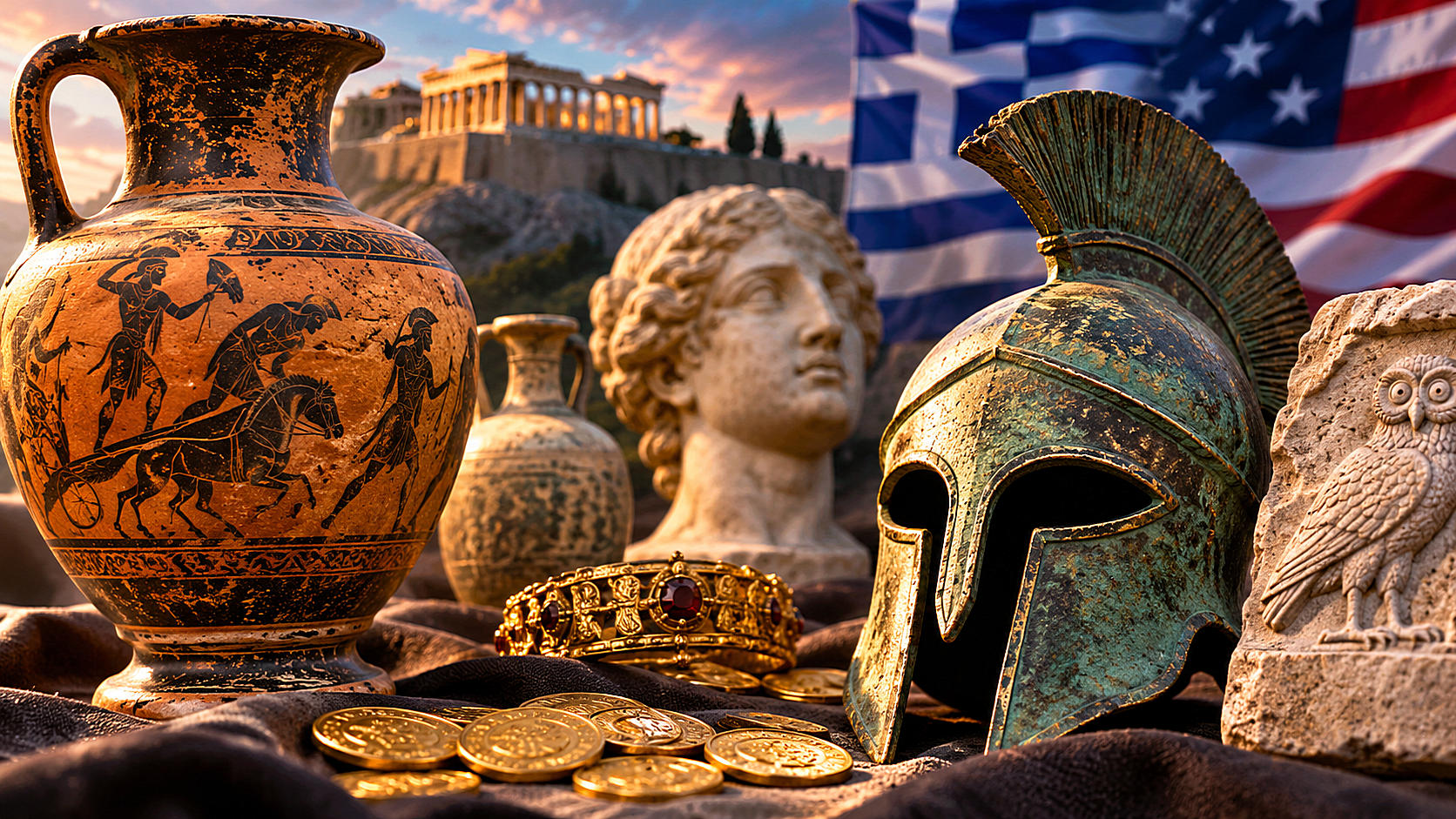
Federal investigators in Tampa are examining thousands of artifacts, some possibly 5,000 years old. As Greece steps up efforts to recover stolen antiquities, an extraordinary collection in Florida could become part of a much larger international dispute.
Federal investigators in Tampa are examining objects that may have existed long before Julius Caesar was born, before Rome became an empire, and perhaps even before the Great Pyramid of Giza was built. Whoever created them has long since vanished. Yet the objects have survived long enough to end up in U.S. Immigration and Customs Enforcement’s custody.
Special Agent Leanna Richardson, the federal investigator assigned to the case, described the experience in a news release issued by Homeland Security Investigations. She had never imagined holding something created more than 4,000 years ago. Examining the collection, she said, was like visiting a museum with a personal archaeologist, except that she could actually touch the exhibits.
The collection includes coins, terracotta vessels, statues, jewelry and weapons, with possible origins stretching across Europe, Africa and the eastern Mediterranean. It ranks among the largest antiquities seizures in Homeland Security Investigations history.
The first public glimpse came in June, when local reporters were shown more than 12,000 objects intercepted by Customs and Border Protection. By August, the collection had grown considerably. The agency has not explained the increase, identified the previous owners or disclosed its value.

Researchers from the University of South Florida and the University of Pennsylvania are helping investigators establish which pieces are genuine and where they originated. Their findings could eventually interest governments thousands of miles away, particularly Greece, which has recently recovered some remarkable treasures from abroad.
The Greek Jug That Crossed Europe
In October, Greek Culture Minister Lina Mendoni received 22 antiquities returned by Israel at the National Archaeological Museum in Athens. Among them were ancient drinking cups, perfume vessels and amphorae recovered during an investigation into illegal antiquities trading. It was the first such repatriation from Israel to Greece.
The following day, as Greece ratified an agreement with Serbia to combat antiquities trafficking, Mendoni explained what these returns meant for her country. “The repatriation of a cultural artifact is not only about making amends for an unfair act committed in the past,” she said. It could also lead to closer cooperation between countries.
American investigators have become important partners in that effort. In September, New York prosecutors returned 15 antiquities worth nearly $3 million to Greece. Until recently, they had been part of the Metropolitan Museum of Art’s collection.

One was a small terracotta jug made around 1750 B.C., centuries before the first Olympic Games. Its narrow spout and carefully shaped body survived the collapse of the civilization that produced it. The vessel eventually ended up in a burial site in southern Greece, where it remained for thousands of years until somebody dug it up.
According to Manhattan prosecutors, looters from the Argolis-Corinthia region stole the jug before it passed through Switzerland and Britain on its way to New York. At the Met, visitors could admire the 3,700-year-old vessel without knowing its modern journey began with an illegal excavation.
The same return included bronze helmets and armor looted from a sanctuary on Crete during the 1960s. The objects eventually reached an American collector before being donated to the museum, where they remained for decades.
The case illustrates how the international antiquities market could conceal stolen objects. Dealers supplied convincing ownership histories, prestigious museums exhibited the pieces, and wealthy collectors paid extraordinary sums to possess them.
Manhattan District Attorney Alvin Bragg‘s Antiquities Trafficking Unit has recovered more than 6,400 cultural treasures worth over $490 million and returned more than 6,150 to 39 countries.
On Oct. 7, Greece and the United States renewed their cultural heritage agreement, extending restrictions on imports of certain Greek antiquities until 2031. Between 2021 and 2026, the United States returned 425 cultural objects to Greece, including 98 under the agreement.
The Problem With Sending History Home
Whether anything in the Tampa collection will follow a similar route remains an open question. No European government has publicly claimed any of the seized objects, and their precise origins remain unestablished.
Even identifying an artifact as ancient Greek would not necessarily settle the matter. Greek merchants and settlers carried coins and pottery across the Mediterranean, leaving traces of their civilization in territories that now belong to other countries. A Roman coin might have traveled just as far before being buried, discovered and eventually sold to an American collector.
Ancient objects can also be bought and owned legitimately, and federal seizure alone does not make them the property of a foreign government. Investigators must establish grounds for forfeiture, while potential owners may challenge the proceedings. International agreements do not automatically invalidate transactions conducted decades earlier.
John Yancey, then an acting special agent in charge at Homeland Security Investigations Tampa, told local reporters investigators were especially interested in how the person possessing an artifact obtained it. Establishing that history may require old auction catalogs, museum inventories and records from dealers who have long since disappeared.
Some objects may ultimately prove to be modern reproductions, while others may have been legally owned for generations. Investigators may also find pieces removed illegally from archaeological sites, with no record of their disappearance.
The Greek jug that traveled through Switzerland, Britain and New York eventually made it home after nearly four millennia. Somewhere among the objects in Tampa, another journey may be about to begin.