
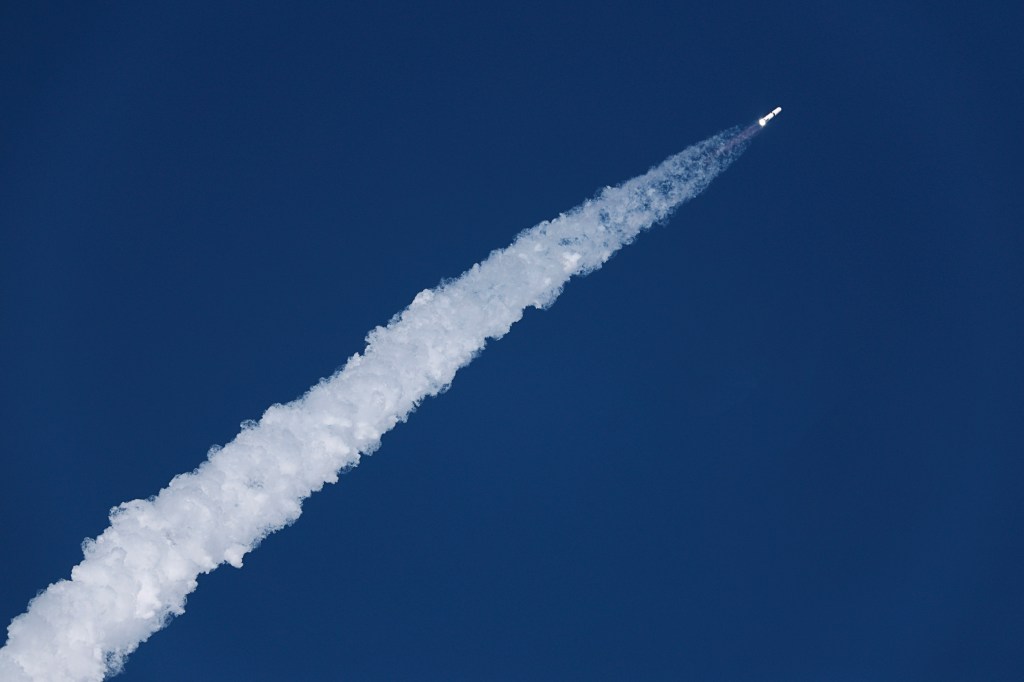
CAPE CANAVERAL — The shouts on the beach were just like a stadium crowd celebrating a touchdown. That’s because that’s exactly what they were doing.
The hundreds of rocket fans that had come out to watch the second-ever launch of Blue Origin’s big New Glenn rocket from Cape Canaveral Space Force Station on Thursday then huddled around smartphones to watch the nail-biter happening 375 miles out in the Atlantic.
The rocket’s first-stage booster was trying to succeed where its predecessor had failed in January during the first launch of New Glenn: sticking the landing.
— Jeff Bezos (@JeffBezos) November 13, 2025
As the video feed showed it hovering just over the recovery vessel, the roar from pockets dotting the beach rose to a frenzy, with voices exploding into exalting shouts of joy as the smoke cleared, revealing the booster standing tall.
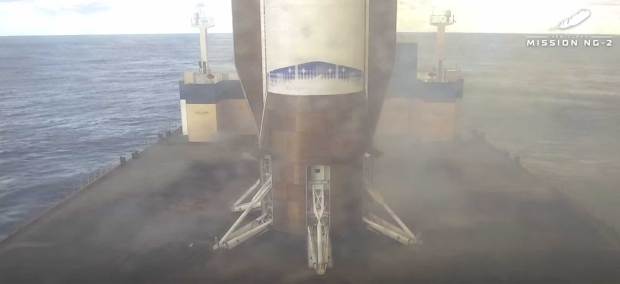 The Blue Origin New Glenn first-stage booster on the NG-2 mission safely touched down on the recovery vessel Jacklyn stationed in the Atlantic after launching from Cape Canaveral Space Force Station’s Launch Complex 36 on Thursday, Nov. 13, 2025. (Courtesy/Blue Origin)
The moment was a pivotal one for Jeff Bezos’ rocket company as it became only the second to manage an orbital launch booster landing, joining the ranks of Elon Musk’s SpaceX.
It accompanied another milestone for the company in flying with a paying customer for the first time, carrying a pair of Mars-bound satellites for NASA that it was able to successfully deploy.
The mission launched from Canaveral’s Launch Complex 36 at 3:55 p.m., climbing into clear, blue skies just ahead of a Carnival Cruise Line ship venturing out from Port Canaveral and a smaller ship that had just ventured in.
Crowds that had spilled onto the sands from Cherie Down Park about 6 miles south of the port let out a collective moan and were waving their hands to will the ships out of the way of their view.
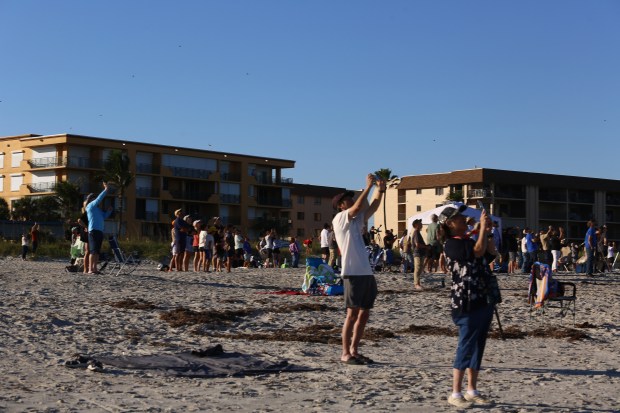 Crowds gather on the beach adjacent Cape Canaveral’s Cherie Down Park to watch the launch of Blue Origin’s New Glenn rocket on the NG-2 mission from Cape Canaveral Space Force Station’s Launch Complex 36 on Thursday, Nov. 13, 2025. (Richard Tribou/Orlando Sentinel)
Cheers rose as the rocket rumbled over the Space Coast with a exhaust trail billowing up as it climbed in altitude.
“Tell you what man, watching it like over video definitely isn’t the same. Feeling that rumble in your chest and the roar of the crowd,” said Armando Juajardo of Seattle, who was in town on vacation. “First one. Mark that one off my bucket list.”
The booster, named “Never Tell Me The Odds,” will now make its way back to Port Canaveral aboard the recovery vessel Jacklyn, named after Bezos’ mother.
“I’ve never seen anything so beautiful in my life,” said Blue Origin commentator Tabitha Lipkin amid cheers fed from the company’s Merritt Island campus, where New Glenn is manufactured, as well as Blue Origin viewing sites in Huntsville, Alabama; Kent, Washington; and Van Horn, Texas.
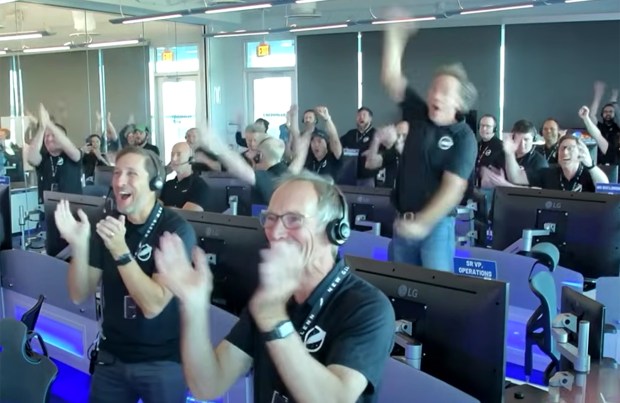 Jeff Bezos watches as the first-stage booster for the NG-2 mission touches down successfully as employees celebrate around him. (Courtesy/Blue Origin)
The feed showed founder Jeff Bezos in mission control watching the moment of touchdown, stoic and smiling with arms crossed while employees jumped in celebration, clapping and pumping fists all around him.
The company lost the booster named “So You’re Telling Me There’s A Chance” on the NG-1 mission on the rocket’s debut launch in January. Now, this second mission’s booster with its seven BE-4 engines can be refurbished as part of Blue Origin’s plans to reuse them up to 25 times.
Some fun stills! Congrats Team Blue and NASA on an amazing day. Never tell me the odds! pic.twitter.com/jUr31RoOgH
— Dave Limp (@davill) November 13, 2025
The launch comes after scrubs Sunday and Wednesday for weather issues both on and off-planet.
NASA had been concerned of the effects of the solar wind on its payload, shutting down Wednesday’s attempt, while Sunday’s was stymied by bad weather at the launch site.
The twin spacecraft deployed are for a mission called ESCAPADE, which stands for Escape and Plasma Acceleration and Dynamics Explorers. Dubbed Blue and Gold. They were built by fellow aerospace company Rocket Lab for NASA and the University of California Berkeley’s Space Science Laboratory.
The mission falls under NASA’s Small Innovative Missions for Planetary Exploration (SIMPLEx) program at a cost of $75 million including $20 million paid to Blue Origin for the ride.
“ESCAPADE is really exciting because it’s a trailblazer,” said principal investigator Robert Lillis with UC Berkeley Research. “It’s an example of how academia can work together with industry and with government in a more streamlined way to do top-level science with less oversight and just sort of a commercial-forward and new space, maybe lighter regulation-touch, approach.”
The value of the mission, he said, will not only help understand how Mars’ atmosphere may have shifted over time, but also how it might affect future robotic or human missions to the Red Planet.
“We really, really want to understand the interaction of the solar wind with Mars better than we do now,” Lillis said. “We know that atmospheric escape from Mars is a major driver for the evolution of the Martian climate. We know that Mars, at least, was episodically warm and wet for a couple billion years, but hasn’t been so for about 2 billion years or so, and we think atmospheric escape is a major reason for that.”
A flock of seabirds take flight on the beach in Cape Canaveral south of Jetty Park with Blue Origin’s New Glenn rocket on the launch pad at Cape Canaveral Space Force Station in the distance on Wednesday, Nov. 13, 2025. (Richard Tribou/Orlando Sentinel)
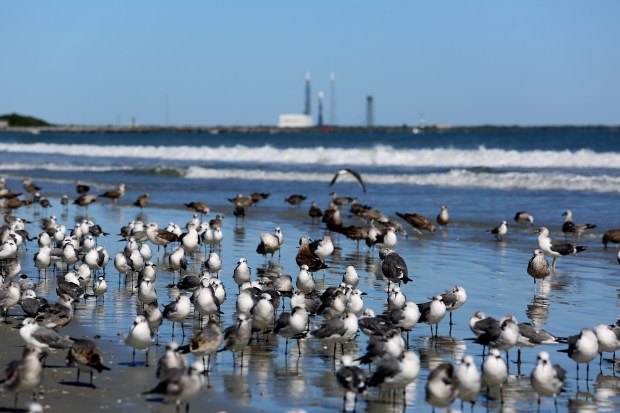
A flock of seabirds crowd the beach in Cape Canaveral south of Jetty Park with Blue Origin’s New Glenn rocket on the launch pad at Cape Canaveral Space Force Station in the distance on Wednesday, Nov. 13, 2025. (Richard Tribou/Orlando Sentinel)
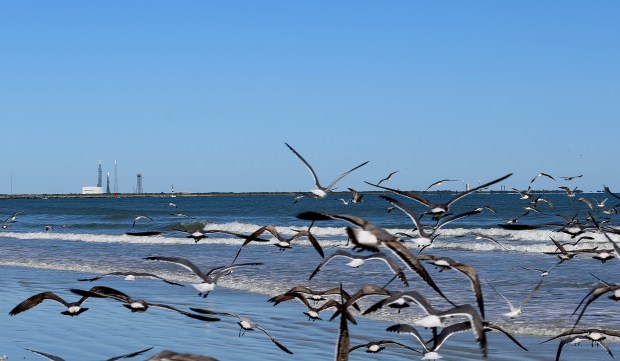
A flock of seabirds take flight on the beach in Cape Canaveral south of Jetty Park with Blue Origin’s New Glenn rocket on the launch pad at Cape Canaveral Space Force Station in the distance on Wednesday, Nov. 13, 2025. (Richard Tribou/Orlando Sentinel)
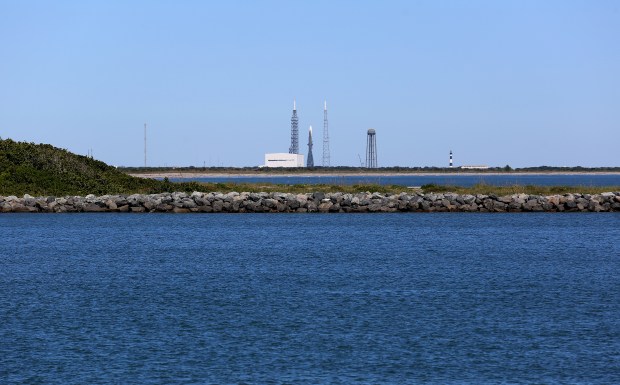
Blue Origin’s New Glenn rocket sits on the launch pad at Cape Canaveral Space Force Station, seen from about 5 miles south from the pier at Jetty Park in Port Canaveral on Wednesday, Nov. 13, 2025. (Richard Tribou/Orlando Sentinel)
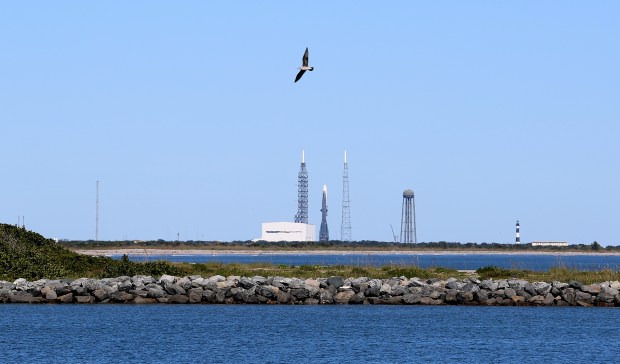
Blue Origin’s New Glenn rocket sits on the launch pad at Cape Canaveral Space Force Station, seen from about 5 miles south from the pier at Jetty Park in Port Canaveral on Wednesday, Nov. 13, 2025. (Richard Tribou/Orlando Sentinel)
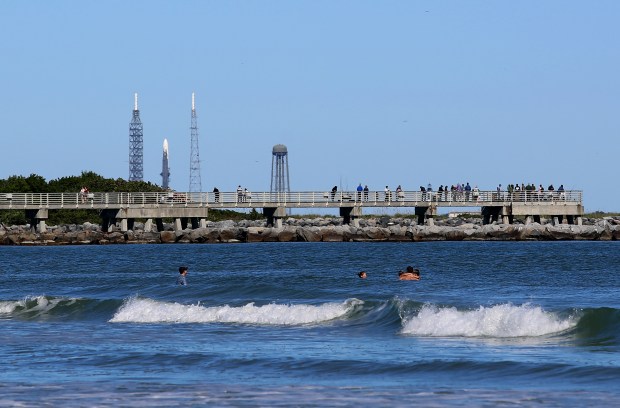
Fishermen and visitors hang out on the end of the pier at Jetty Park in Port Canaveral with Blue Origin’s New Glenn rocket seen sitting in the distance about 5 miles north on the launch pad at Cape Canaveral Space Force Station on Wednesday, Nov. 13, 2025. (Richard Tribou/Orlando Sentinel)
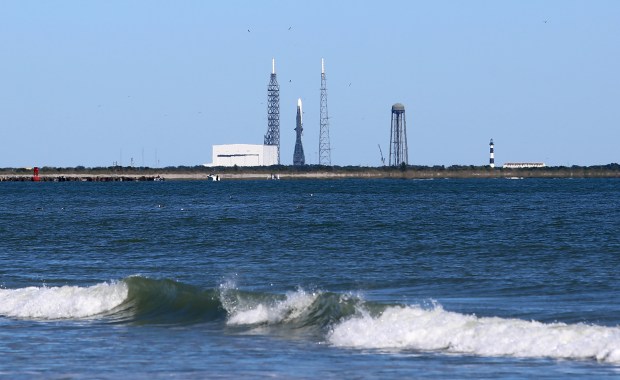
Beachgoers play in the surf in Cape Canaveral with Blue Origin’s New Glenn rocket seen sitting in the distance about 5 miles north on the launch pad at Cape Canaveral Space Force Station on Wednesday, Nov. 13, 2025. (Richard Tribou/Orlando Sentinel)
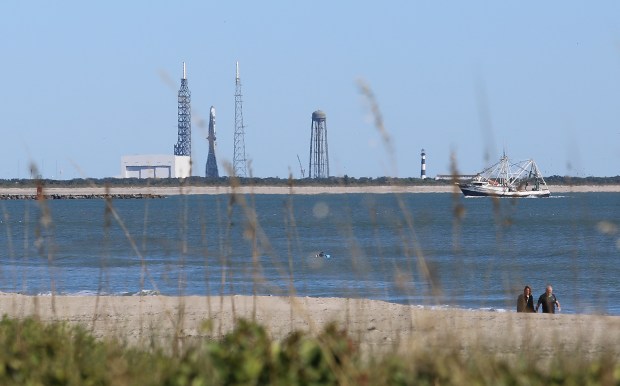
Blue Origin’s New Glenn rocket sits on the pad at Cape Canaveral Space Force Station’s Launch Complex 36 on Wednesday, Nov. 12, 2025. A second try to get the NG-2 mission of the ground was scrubbed because of space weather concerns damaging the payload. (Richard Tribou/Orlando Sentinel)
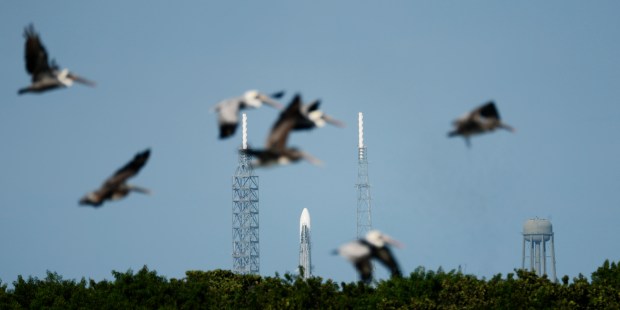
A pod of pelicans fly past as New Glenn NG-2 sits on the pad at Launch Complex 36A at Cape Canaveral Space Force Station, as the launch is scrubbed, on Sunday, Nov. 9, 2025. Blue Origin announced it would not try to fly again until at least Wednesday because of forecast weather. The launch window is from 2:50-4:17 p.m. (Ricardo Ramirez Buxeda/Orlando Sentinel)
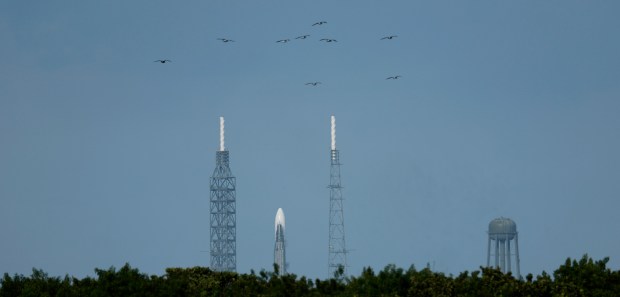
Shore birds fly past the New Glenn NG-2 sits in the pad at Launch Complex 36A at Cape Canaveral Space Force Station, as the launch is scrubbed, on Sunday, Nov. 9, 2025. (Ricardo Ramirez Buxeda/Orlando Sentinel)
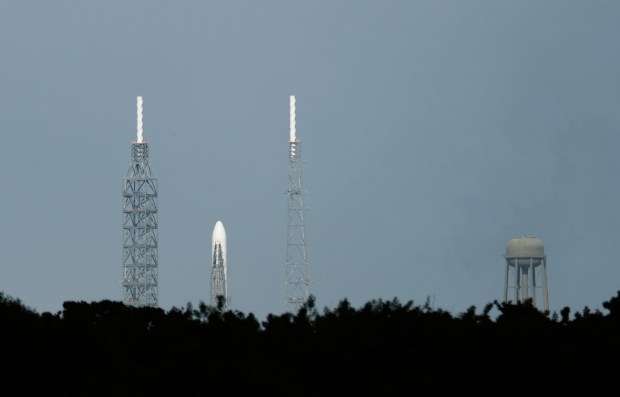
New Glenn NG-2 sits in the pad at Launch Complex 36A at Cape Canaveral Space Force Station, as the launch is scrubbed, on Sunday, Nov. 9, 2025. (Ricardo Ramirez Buxeda/Orlando Sentinel)
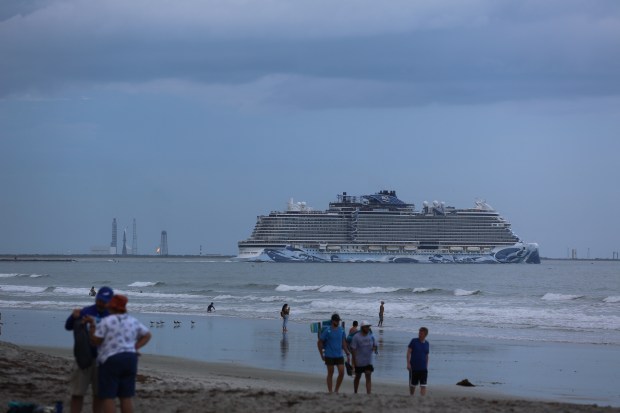
A cruise ship leaves Port Canaveral after Blue Origin scrubbed the launch attempt of its New Glenn seen in the background at Cape Canaveral Space Force Station on Sunday, Nov. 9, 2025. (Richard Tribou/Orlando Sentinel)
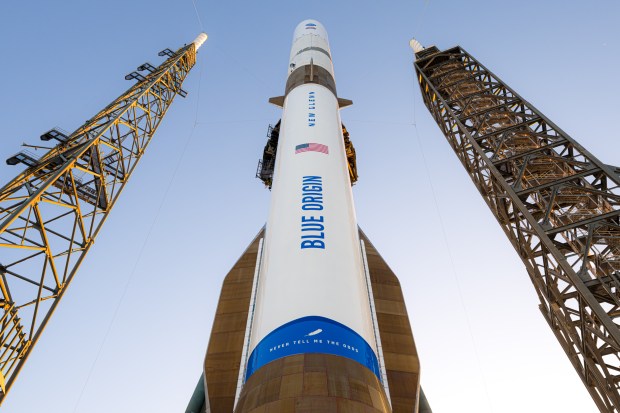
Blue Origin’s New Glenn sits on the pad at Cape Canaveral Space Force Station’s Launch Complex 36 ahead of the planned NG-2 launch. (Courtesy/Blue Origin)
Show Caption
1 of 13
A flock of seabirds take flight on the beach in Cape Canaveral south of Jetty Park with Blue Origin’s New Glenn rocket on the launch pad at Cape Canaveral Space Force Station in the distance on Wednesday, Nov. 13, 2025. (Richard Tribou/Orlando Sentinel)
That science, though, won’t begin until after the spacecraft arrive by 2028 at the earliest.
They were originally aiming to launch in late 2024 and would have had an 11-month trip to Mars. Now, though, they’re heading up to what’s essentially a parking spot in space called Lagrange Point 2 about 1 million miles away, which allows them to sit and wait for Earth and Mars to get back to a reasonable distance apart before heading on their interplanetary way next year.
Once they get there, they will orbit Mars and observe plasma and magnetic fields around the planet to help understand what processes strip atoms from Mars’ magnetosphere and upper atmosphere. That could help explain why Mars’ atmosphere is so thin, and how it may have evolved over time.
Blue Origin’s New Glenn rockets are manufactured at nearby Merritt Island, then rolled over to LC-36, which underwent a multiyear, $1 billion dollar revamp. It held up well after the first launch, said Laura Maginnis, Blue Origin New Glenn vice president of mission management.
After this mission, one of the big ones on tap will be the company’s uncrewed Blue Moon Mark 1 lunar lander. It’s set to pave the way for the eventual Blue Moon Mark 2 lander contracted by NASA to support future Artemis missions.
New Glenn also has been tapped for several missions from Bezos’ other company, Amazon, to launch hundreds of its Project Kuiper constellation, which was renamed Thursday to Amazon Leo.
“We’ve got a very full manifest plan for next year. We’re really excited to get into a really high cadence following this NG-2 mission,” Maginnis said. “We’ve got a lot of hardware in the pipeline, a lot of customers excited to fly, and we’re looking forward to getting moving with that.”