
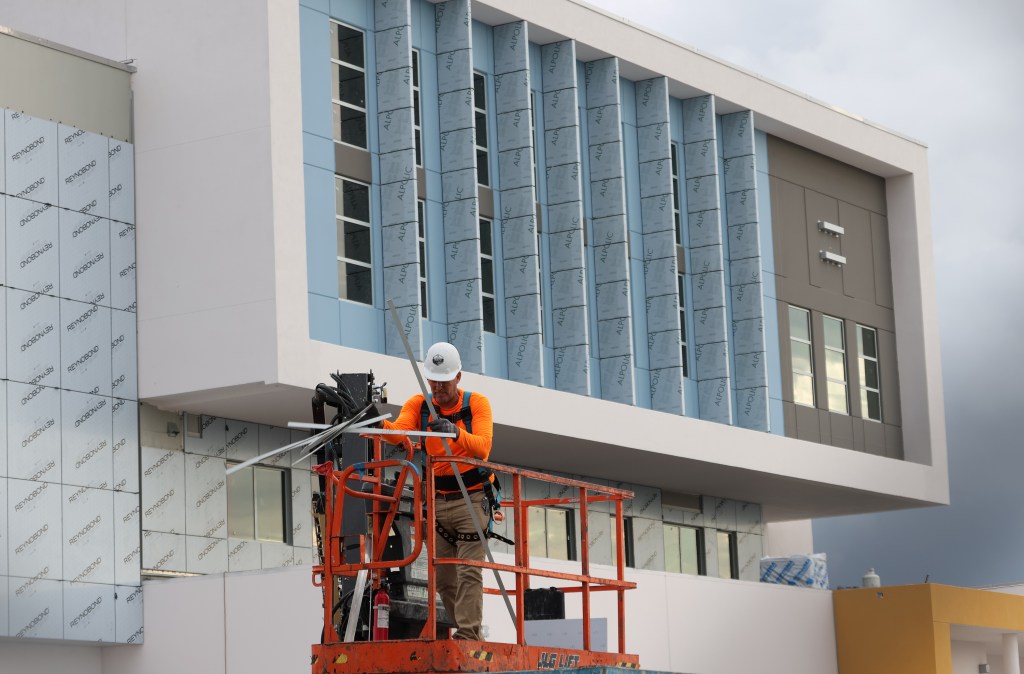
A roof collapse at Rickards Middle School became a symbol of the many problems with construction in Broward schools, and a project to rebuild the school has done little to restore confidence.
Construction of the new school, which is on the same site in Oakland Park as the old school, has been riddled by years of delays. Now the gymnasium, one of two large, new buildings planned for the campus, has received a red tag — an order requiring any work to stop.
The red tag is due to structural issues involving joists that were used during roofing work — a problem that has some similarities to issues identified in a 2021 engineering review of the roof collapse at the original building.
The new gym, as well as a main building, have faced many other problems as well, including structural flaws, numerous design changes, unapproved installation of doors, stairs and fire sprinklers and failed inspections, according to monthly construction progress reports reviewed by the South Florida Sun Sentinel.
A project once planned to be finished by August 2024 now has a targeted completion date of summer 2026 for the main building and January 2027 for the gymnasium.
“It is catastrophically alarming that we are in this predicament now,” School Board member Sarah Leonardi, who represents Rickards, told the South Florida Sun Sentinel. “I have made it very clear every step of the way that this is completely unacceptable.”
Leonardi and others familiar with the project say they believe a major factor in the delays is the district’s decision in 2021 to reuse the architectural design of a school in Miami-Dade County that didn’t even start construction until 2022.
The Miami-Dade school went through a number of design changes, many of which then had to be incorporated into the Rickards design and some of them after construction had started, causing delays. Officials from Miami-Dade schools didn’t provide answers to questions from the Sun Sentinel, despite repeated requests.
“The prototype that the board was urged to approve, with promises of being a faster, safer, and less expensive option, is in fact extremely flawed, much to my disappointment,” Leonardi wrote to Superintendent Howard Hepburn on Aug. 1, following a tour of the construction site. “The numerous problems with the design of this prototype should have been caught by those who pushed this design on the board, and I trust that you will investigate that and hold those individuals accountable.”
Hepburn, who started in April 2024, said he can’t speak to why the district chose the design. But he blames contractors and architects, not his own staff, for recent issues, including the gymnasium work stoppage.
“It’s unfortunate that there have been many bumps in the road, and we’re going to hold the contractors and also the architects accountable for the issues that have arisen within the past year,” Hepburn told the Sun Sentinel. “Whatever we need to do moving forward, we’ll work with our legal team to see what type of recourse we have.”
The architectural firm for the project, Zyscovich, couldn’t be reached, despite attempts by phone and through the website of its parent company, Stratus.
An executive with CORE Construction, the general contractor, issued a statement to the Sun Sentinel saying, in part, that the company has “an outstanding record of delivering high-quality schools on time and on budget,” including in Broward County.
“We take any construction issues seriously and are working closely with the School Board to resolve all concerns quickly and transparently,” Ted Cava, senior vice president for CORE, said in the statement. “The safety of students and staff and the quality of our work are always our top priorities.”
Until the new Rickards campus is complete, students, teachers and staff will continue to occupy a portable campus on the site that lacks many of the basic features of a normal middle school, including a cafeteria and gymnasium. This is the fifth school year that students, teachers and staff have been housed in the temporary buildings.
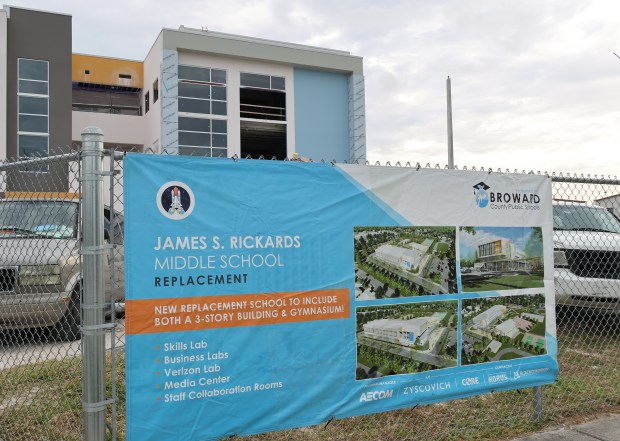 Construction continues at Rickards Middle School in Oakland Park, Thursday, Nov. 6, 2025. (Joe Cavaretta/South Florida Sun Sentinel)
“We can see the new building. We can see the structure. We took a tour of it in August, but there was nowhere near completion on the inside,” said Scott Rubinchik, a language arts teacher at the school. “So it’s frustrating, and it presents a set of unique challenges, but as teachers, we show up and fight through it every day.”
Rickards was already in the middle of a $10 million renovation when the media center roof collapsed during the school day on March 5, 2021. Students and teachers described the incident as traumatizing, sharing stories of climbing over rubble and being hit by falling debris. No one was seriously injured, although about 10 people were taken to the hospital, complaining of headaches and issues related to asthma and anxiety.
The main building was determined to be a total loss. Since no nearby middle schools had enough room to house all of Rickards’ students, the School Board agreed in the summer of 2021 to install a temporary campus on site while a permanent campus was built.
History of construction issues
Construction has been the subject of significant scrutiny for the Broward School District. Four grand jury reports released over 25 years all criticized the way the district handled everything from selecting contractors to inspecting buildings.
The most recent grand jury report, completed in 2021, blasted the slow progress and ballooning costs of construction projects funded through an $800 million bond referendum that voters approved in 2014. Eleven years later, more than 100 out of 335 projects are still not complete.
The 2021 grand jury report was released shortly after the Rickards roof collapse. While the grand jury didn’t yet have details on what caused the breach, the report still highlighted the incident as a visual symbol for what has gone wrong over the years with district construction.
But district officials promised in the summer of 2021 that construction of the new Rickards Middle School would be different.
They said they could save $5 million, avoid a lot of errors and change orders, and open in 2024 — a year early — if they bypassed a competitive bidding process to secure an architect and, instead, reused a design created for another school.
During a public workshop, district facilities staff pitched a design by Zyscovich Architects for Ammons Middle School in Miami, which was not yet under construction. The Ammons project didn’t have a gymnasium, so the district reused a Zyscovich design for a gym at Parkway Middle in Lauderhill that had been built about a decade earlier.
School Board members praised the design reuse idea at a meeting on Nov. 3, 2021.
Then-Board member Rosalind Osgood called it an “out-of-the-box” approach that she hoped could be replicated at future schools. Laurie Rich Levinson said at the same meeting, “I am definitely in favor of a reuse prototype when we can optimize our timeline and costs involved.”
But the district’s Facilities Task Force, which provides an oversight role on school construction and maintenance issues, was more skeptical.
Nathalie Lynch-Walsh, who was chairwoman at the time, emailed the Rickards project manager in November 2021, pointing out that a 2003 grand jury had questioned previous decisions by Broward to reuse designs of schools that were not yet complete. That grand jury report said schools built with reused designs from 1987 to 1996 were not holding up as well as older schools with original designs.
“We cannot overemphasize the importance of analyzing and evaluating new designs for schools prior to their reuse,” the 2003 report said. “We strongly recommend that the School Board carefully analyze every school design that it intends to use as a prototype to ensure that the design is structurally sound before it is used as a prototype.”
Lynch-Walsh, contacted recently, said she believes a root cause of the problems with the main building can be traced back to the decision to choose the Ammons reuse.
“There is an inherent risk of unnecessarily repeating past mistakes in the reuse of a design that has not yet been successfully constructed, including costly delays,” she told the Sun Sentinel.
In a recent email, district spokeswoman Keyla Concepcion referred to the design of the main Rickards building as a “partial reuse,” saying only the exterior shell was used.
She said the “interior layout and systems” of the building “were substantially redesigned” to meet the district’s own building specifications.
“Due to the extent of these modifications, the reuse did not translate cleanly, resulting in coordination conflicts within the construction documents,” she said.
Concepcion said Zyscovich Architects “did not fully resolve these conflicts before permitting,” and CORE, the general contractor, didn’t identify problems during a required review it conducted before construction started.
CORE was hired by the district in March 2022, following a competitive bidding process. But more than a year later, construction had yet to start.
When School Board member Leonardi asked for an update from district staff in June 2023, she was told the project was no longer on target to be completed in 2024.
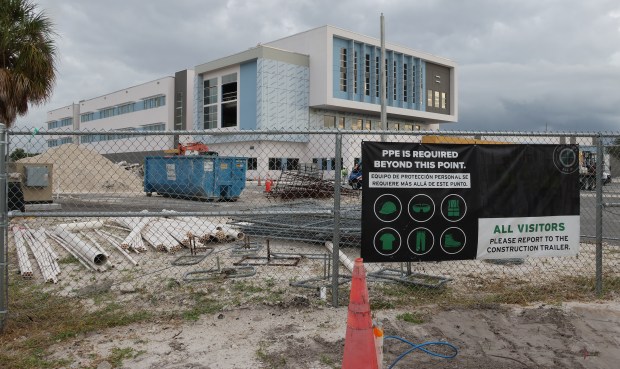 Construction continues at Rickards Middle School in Oakland Park, Thursday, Nov. 6, 2025. (Joe Cavaretta/South Florida Sun Sentinel)
“Persistent delays due to the staffing shortages, which have affected many companies and government agencies, have delayed that date,” the June 2023 memo stated. “For example, the civil engineering design plans were delayed due to the inability of the surveying crew to complete the final site surveys.”
Construction costs also rose, with the Rickards budget increasing from an initial estimate of about $60 million to a new budget of $82 million in September 2023. The School Board approved the expense at a Sept. 12, 2023, meeting. Rickards parents, teachers and supporters attended the meeting and voiced concerns about the delays.
Peter Licata, who had just been hired as superintendent, pledged to make Rickards and other delayed projects a priority.
“There’s been a lot of mistakes in the past. It’s not going to happen on my watch,” Licata said at the meeting. “We’re not going to play around here anymore. We’ve got to get these projects done.”
Construction started a few weeks after the meeting.
But about six months later, Licata was gone. He announced in April 2023 he was retiring, citing health issues. His chief facilities officer, Deborah Czubkowski, who was also new to the job at the time, resigned shortly after Licata left.
The School Board named Licata’s second-in-command, Howard Hepburn, as the new superintendent. Hepburn assigned facilities oversight to Wanda Paul, a recently hired administrator he’d worked with in the Palm Beach County School District, where Paul helped oversee a construction program considered far more successful than Broward’s.
But construction delays continued, including at Rickards.
A May 2024 report prepared by AECOM, the company hired to manage most school construction work, stated the engineer on the project had made numerous structural changes to the main building, causing the district to seek an external review of the changes.
A December AECOM report cited structural failures on tilt wall panels, requiring a structural revision.
A subsequent report in February 2025 said construction of a small building that would house a chiller, “has not begun due to the condition of an existing underground utility running under the foundation.”
The same report also said CORE was installing doors, stairs and fire equipment in the main building that had not been approved by the district’s building department.
By July, an AECOM report said that “design inconsistencies and the resulting massive volume of change orders” are creating major concerns. The design changes were affecting about 80% of the main building, and CORE was “running out of unaffected areas to work on,” the report said.
While work progressed slowly in the main Rickards building, it stopped completely in the gymnasium on Aug. 5. The district’s building department red-tagged the construction after a failed structural inspection related to slanted joist seats at the wall line in the roof area, a building department report said.
CORE “obtained a corrective method from the joist manufacturer and proceeded to implement it before the Engineer of Record had reviewed and approved the proposed fix,” Concepcion said.
“Construction continued and the repairs were subsequently covered without approval of the fix or verification, preventing the design team and threshold inspectors from confirming that the fix complied with the approved design and load requirements.”
Public records show that CORE, after having difficulty getting sign-offs from the engineers assigned to the project, hired an outside engineering firm to inspect the joists. The outside firm found no issues with the repair, but the engineer assigned to the project wouldn’t accept the findings, records show.
To resolve the issue, Zyscovich directed CORE Construction to remove grout and expose selected joist ends “to confirm whether the installed repairs meet the structural design criteria.
Concepcion said the plan is currently under review to ensure that removal activities will not damage adjacent structural components. The review is expected to start soon “with a target of full resolution and re-inspection within approximately two months, pending verification and approvals from the design team and Building Department,” Concepcion said.
Joists were also mentioned in a structural review of the original Rickards building.
A 2021 engineering review from the firm Wiss, Janney, Elstner Associates blamed the roof collapse of the original building on failures of bolts used to connect L-shaped brackets from the wall to the roof joists. This was considered a structural flaw that dated to when Rickards was built in the late 1960s.
Concepcion said the issue that triggered the red tag in the new gymnasium “is unrelated to the roof collapse of the original school building; it is specific to the current construction and is categorized as an installation error, not a design flaw.”
Leonardi told the Sun Sentinel that she wants all these issues resolved, even if it causes further delays in the project.
“I want to make it very clear that I will not allow the superintendent to allow students or people in any building that is not safe,” she said.