
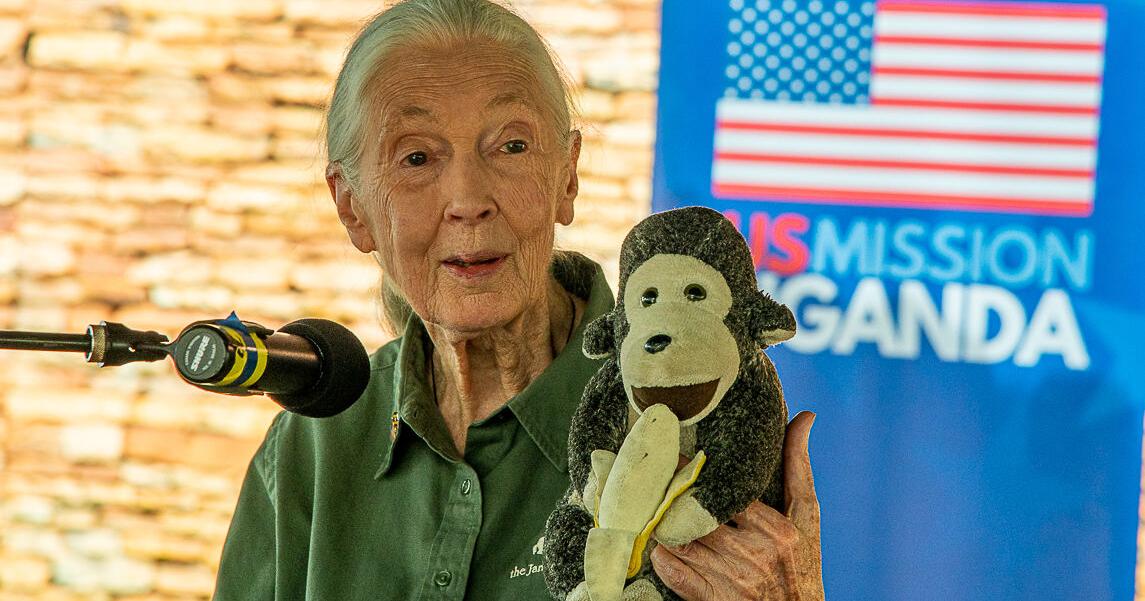

World-renowned primatologist, conservationist and humanitarian Dr. Jane Goodall visits United States Mission Uganda to promote her ongoing work in conservation, youth empowerment and animal welfare in April 2022.
Courtesy of U.S. Embassy Uganda (via Flickr)
Dr. Jane Goodall, a world-renowned primatologist, conservationist and humanitarian, was laid to rest on Wednesday at Washington National Cathedral after having died in October at age 91 from natural causes.
The news of Goodall’s death had an immediate impact on members of the UCF community, from faculty to students.
Dr. Christina Kwapich, a UCF biology assistant professor, said she felt a great sense of loss after reading a headline on the Apple News app.
After sharing the article in a GroupMe chat with her research lab members, students and postdoctoral researchers, Kwapich described everyone as “devastated” and said the news was a shock to all of them.
“I immediately thought this is a giant of that era who’s now gone,” Kwapich said.
Kwapich and other UCF College of Sciences faculty members use Goodall’s influence while teaching courses related to her work. Kwapich, who is teaching Special Topics in Zoology this semester, discusses topics such as animal behavior and behavioral ecology with her students.
“She’s contributed so deeply to the foundation of how we understand ourselves and our evolution — also to the field of animal behavior — that I think if you take any class at UCF tangentially related, you will get this content,” Kwapich said.
Goodall was known for her discoveries of chimpanzees in East Africa, including their behaviors and how they are actually omnivores, not herbivores, and for taking an unorthodox approach to animal research by humanizing her subjects.
UCF biology senior lecturer Dr. Christa Diercksen spoke about how Goodall influenced how she teaches primates and alternative reproductive strategies when she taught the Animal Behavior course.
Diercksen said Goodall gave a window into the world of most primates by finding humanlike personalities among the animals, despite facing criticisms for going against the norm.
“If you’re in anthropology or behavior, you’re supposed to be careful about attributing human qualities to your subjects because you’re not supposed to be anthropomorphizing them,” Diercksen said. “But yet [Goodall] broke a lot of those rules and named her subjects, so they weren’t just numbers.”
Dr. Frank Logiudice, a UCF biology senior instructor who teaches Animal Behavior this semester, described Goodall as a groundbreaking animal behaviorist who brought awareness that animals have complexities and a range of behaviors that had not been appreciated.
“About a hundred years ago, one of the preeminent animal physiologists said that only humans think and only humans have feelings, and all other animals just have rigidly programmed instincts,” Logiudice said. “[Goodall’s] discovery showed that there were differences in personality with individual chimpanzees, and they did a lot more cognitive actions than we thought they would.”
UCF graduate teaching assistant and anthropology doctoral candidate Kelly McGehee teaches Primatology this semester and said she teaches about Goodall’s work, including at the Gombe National Park, where the chimpanzees use sticks to fish for termites.
McGehee believes Goodall contributed to how ethics in scientific research has redefined her field, saying she hopes that Goodall’s enthusiasm for primates inspires her students to research and learn how much she contributed to the subject.
“We have a tendency to see them as just animals, but chimps are our closest relatives,” McGehee said. “There’s so much to them that I don’t think people realize, even before I taught primatology.”
McGehee said Goodall had done more for her beyond the chimpanzees, but as a woman in STEM, she was bringing her work to the forefront of anthropology.
“The point of our field is to make a difference, give voices to people and animals that don’t have them,” McGehee said. “To approach humanity from a scientific perspective, and approach science from a humanities perspective.”
Even after Goodall’s death, Kwapich reflected on how the world-renowned scientist resonated with the way she now sees things.
“Jane Goodall, to me, was someone who revealed the complex social lives of animals through rigorous field research,” Kwapich said. “She understood the complexity of these individual animals, didn’t dismiss them as less than human and identified them as equally complex. The important thing is that they are living creatures and that’s what Jane Goodall instilled in people.”