
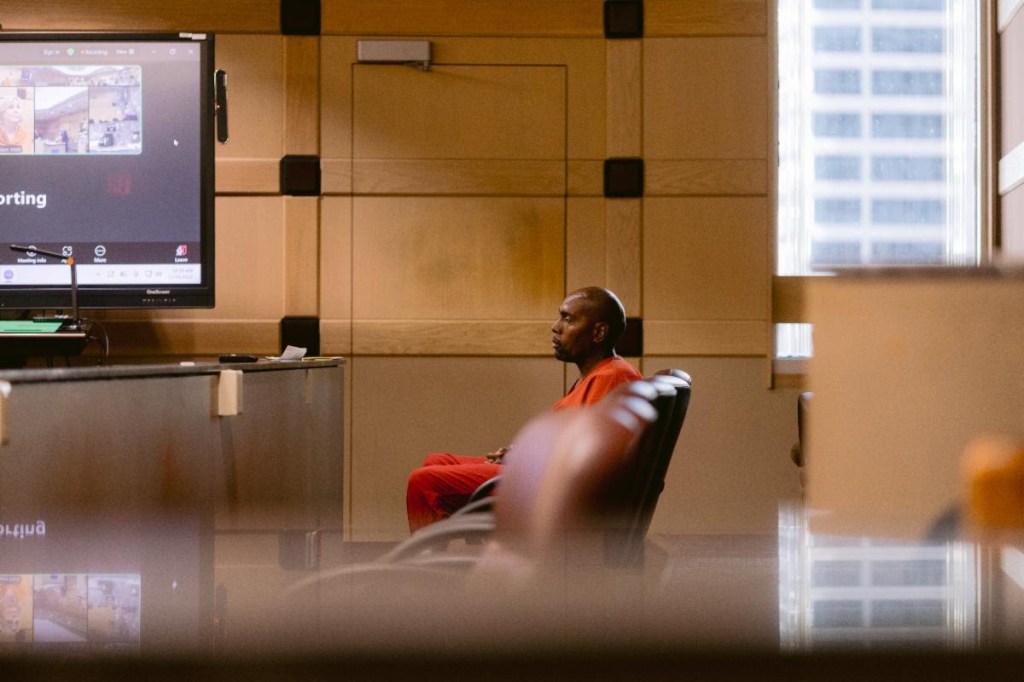
Tavares Hutchinson was sentenced to life in prison based on one man’s claim that he robbed him of his wedding ring and gold necklace in 1999.
The wedding ring was never found. Neither was a gun. But a Broward jury convicted the 23-year-old of robbery with a weapon, a crime he has always maintained he did not commit. Then, about midnight Friday, after more than 26 years behind bars, the now-49-year-old walked out of the Broward Main Jail as a free man.
Asked how he was feeling Saturday afternoon, Hutchinson told the South Florida Sun Sentinel, “Winning.”
“I’m just happy to be free,” he said.
For years, Hutchinson had fought his sentence from prison unsuccessfully. Then, in February 2024, he asked the Broward State Attorney’s Office Conviction Review Unit to review his case. An investigation between the unit and the Innocence Project of Florida found “significant evidence both undermining the integrity of the conviction and pointing to Tavares’ factual innocence,” the nonprofit said in a news release Friday.
The Innocence Project had asked for Hutchinson’s conviction to be fully vacated, but ultimately reached an agreement with the Broward State Attorney’s Office to have him sentenced to time served and immediately released. On Friday, a Broward judge resentenced Hutchinson.
“A man who otherwise was going to die in prison, based on his sentence, is now able to live a full and productive life in society and actually be able to be an asset to our society,” Brandon Scheck, IPF’s legal director and Hutchinson’s attorney, told the Sun Sentinel Saturday. “I think that’s really awesome and significant.”
An alleged robbery
Hutchinson’s years behind bars stem from an alleged encounter on a June night in 1999, when a man named Dan Sharpe was walking home from a Narcotics Anonymous meeting in Fort Lauderdale shortly after marrying his wife the same evening, according to a Conviction Review Unit memo completed in September.
About 10:30 p.m., he told police he was approached by an armed Black man who placed a gun to the small of his back and told him to “give it up.” After Sharpe said he had no money, the man took his wedding ring, according to what he told police at the time. He later added that the man also took his gold necklace.
A “Be On the Lookout” was issued over the robbery. A few hours later, police stopped a car four miles away on suspicion of a DUI, according to the review unit’s memo. Hutchinson was the passenger; another man was driving. During the stop, the police officer said he saw a gold necklace in one of the car door’s pockets and matched Hutchinson with the suspect from the robbery BOLO, despite his height, weight and clothing not fitting the description.
The police officer took the gold chain, went to Sharpe’s home and asked him if it was the same necklace, according to the memo. Sharpe said it was. The officer then brought Sharpe to the scene of the traffic stop and asked him if Hutchinson was the man who robbed him. Sharpe said he was. That was enough for police to arrest Hutchinson, who denied robbing Sharpe.
Sharpe was the sole witness in the case, and would later recant his testimony. The memo noted that Sharpe has “repeatedly demonstrated unreliability as a witness.”
In January of 2000, a jury convicted Hutchinson after about a half-hour of deliberation.
“Although we have transcripts of the proceeding, we will never know what the jury’s reasoning was behind the conviction,” prosecutors wrote in the memo. “They were not interviewed; they were not even polled.”
A judge sentenced Hutchinson to life in prison, which he would later contest as an illegal sentence. The severe sentence stemmed from Hutchinson’s status as a repeat offender. He had prior convictions including stealing a purse from a car as a minor, which he confessed to at the scene; possession of cocaine; possession of cannabis; and driving with a suspended license.
The “most serious of his crimes” occurred when Hutchinson was still a minor, prosecutors wrote in the memo. He and three of his friends robbed a Little Caesar’s with a BB gun. Afterward, Hutchinson was the only one among his friends to be “fully forthright and remorseful,” confessing and apologizing, the memo said.
In the years following his January 2000 sentencing, Hutchinson filed a series of unsuccessful appeals from prison. Over the last 26 years, he said he sometimes lost hope that he would ever get out.
“I had to train myself to imagine myself free,” Hutchinson said Saturday. He would lie down on his bunk and picture himself hugging his lawyer or getting released. “If I would’ve sat in there continuing to imagine myself in prison, I would still be in prison.”
‘I sent the wrong man to prison’
Several discrepancies in the evidence, many of which were brought to light recently, undermined the case against Hutchinson and suggested his innocence, according to the Innocence Project.
The only evidence that tied Hutchinson to the alleged crime was Sharpe’s “misidentification” of both him and the necklace Sharpe said was stolen, according to the prosecutors’ memo.
Sharpe was actively using drugs, had memory issues and “regularly said things that were not true,” prosecutors said in the memo. The police officer had written in the original report that Sharpe seemed “very interested in being driven home so that the police could ‘verify to his wife that he was robbed,’ implying that his report might be motivated by his need for a cover story,” prosecutors said.
Sharpe ended up serving time in prison himself in the years after Hutchinson’s conviction and was designated a “mentally disordered sex offender,” prosecutors wrote. In a 2002 case against him, he was accused of forging a letter from a victim recanting her testimony. Then, while in prison in Arizona in 2020, Sharpe wrote two affidavits asserting that his claims about Hutchinson were incorrect, according to the memo.
“I know in my heart that I sent the wrong man to prison,” Sharpe wrote in one of the affidavits.
When attorneys with both the Conviction Review Unit and the Innocence Project of Florida interviewed Sharpe this March, he again recanted his initial claims about Hutchinson. He also contradicted his original account of the robbery. His recent recounting had “major discrepancies,” including about where the alleged robbery happened and how many people were present, prosecutors wrote, adding, “both versions of the story of the robbery cannot be true.”
Evidence didn’t match
The stolen chain Dan Sharpe described did not match the chain collected from Hutchinson as evidence, according to the memo, and the jury never learned that Sharpe had described a completely different necklace during his testimony at trial.
Sharpe said the chain was uncommon, gold and silver with “Gucci-style links.”
“What is in evidence is a very ordinary chain,” prosecutors wrote in the memo. “It appears to be a Figaro-style chain, which is an extremely popular style of chain … It is completely gold in color, the clasp is inscribed with ’14k’ and it is not in any way silver.”
Hutchinson also did not match the description of the robber: a 6-foot-tall, 200-pound man with gold teeth wearing a white shirt, a white hat and dark pants. At the time, Hutchinson was 5-feet-10-inches tall and weighed 165 pounds. He also did not match the alleged robber’s age or skin complexion, and while Sharpe said the robber had only some gold teeth, Hutchinson had a complete set, six on top and six on bottom, the memo said.
Perhaps most notably, Hutchinson has a “pronounced shoulder deformity” from childhood scoliosis surgery, but Sharpe did not note anything similar in his description, according to the memo.
Police also found no weapon, hat or wedding ring in the car where Hutchinson was a passenger. They would never recover the alleged wedding ring or gun.
Sharpe identified Hutchinson as the robber during a “show-up,” where a victim or witness is shown only one person to identify. And police presented Hutchinson to Sharpe after telling him that Hutchinson had the missing necklace he described.
“No defense motion to suppress the identification was ever filed, so we will never know how the court may have analyzed these factors,” the memo said. “These issues were never fully explored in front of the jury, so we will never know if going through this analysis would have led to a different verdict.”
The man who was driving Hutchinson that night, Paulonzeo Vickers, told the review unit in an interview this April that Hutchinson had obtained his gold necklace days earlier from a man at a gas station in exchange for drugs. The jury never got to hear Vickers’ side of the story, according to the memo. No attorney contacted him until the Innocence Project of Florida did this year.
One of the case’s initial prosecutors, Maria Schneider, wrote in an Oct. 5, 1999, memo about the concerns she had early on, calling it “one of the worst cases I have had in a while.” But once a detective did a follow-up investigation and interview with Sharpe, she felt it was enough to move forward, according to the memo.
Despite the fact that police never recovered a gun, Hutchinson was convicted of robbery with a weapon. Jurors expressed confusion related to the enhanced charge at trial but never received clarification, according to the memo. If their questions had been answered, Hutchinson instead could have been found guilty of the lesser charge of robbery.
‘Not an exoneration’
Advocates with the Innocence Project of Florida say Hutchinson never committed the robbery and should have had his conviction vacated. But after the Conviction Review Unit revisited his case, prosecutors opted not to vacate it, instead agreeing to sentence him for time already served.
This will leave the conviction on Hutchinson’s record. He cannot seek compensation from the state for the time he spent behind bars, something only those deemed wrongfully convicted are able to do, Scheck said.
“We are thankful that Tavares is coming home after more than 26 years in prison for something he clearly didn’t do,” the Innocence Project said in the release. “Yet, we are concerned he remains wrongfully convicted despite a full reinvestigation of the case that undermined the State’s already weak case and now points squarely toward his innocence.”
The State Attorney’s Office said that it opted not to overturn Hutchinson’s conviction after reviewing “the strengths and weaknesses of the case.”
“This was not an exoneration,” Paula McMahon, a spokesperson for the State Attorney’s Office, said in a statement. “After reviewing all of the facts and circumstances and the strengths and weaknesses of the case and consulting with the listed victim, witnesses, and other parties, prosecutors decided that it was in the interests of justice to modify Mr. Hutchinson’s sentence to the 26 years, five months, and 24 days he has served in Florida’s state prison system for the robbery with a weapon and resisting without violence convictions.”
Despite not getting the conviction vacated, both Hutchinson and Scheck said they were thankful to the State Attorney’s Office for revisiting the case in the first place.
“I’m humble,” Hutchinson said Saturday. “I’m appreciative of the Conviction Review Unit, and them giving me an opportunity to be free. I have no hard feelings.”
He spoke from the car, where Innocence Project employees were driving him to Tallahassee. He will begin staying at a prisoner reentry program there, which he opted to do. The program helps those released from prison after long sentences to reintegrate into society and find employment.
Hutchinson said he plans to go to technical school, then possibly get a job in electricity or HVAC. Meanwhile, Scheck will continue to work on Hutchinson’s case in the hopes that more evidence will ultimately exonerate him.
Hutchinson is optimistic that it will.
“As we speak, I’m imagining being exonerated,” he said.