
How much you earn as an adult, at least in your 20s, depends somewhat on how much money your parents had when you were growing up.
Regardless, across the board in Miami-Dade — whether they grew up in a high-, middle- or low-income household — most millennial earners make, on average, somewhere between 8% and 9% less than the generation preceding them, according to data from Harvard University’s Opportunity Insights team. The analysis compares how people born in 1978 and 1992 fared financially in their late 20s.
The average 27-year-old Miamian who grew up in a low-income household made almost $3,000 less in 2019 than in 2005, accounting for inflation. Of the millennials in the U.S.’s 10 largest metropolitan areas, only those in Philadelphia and Washington, D.C., have seen a greater or equal drop in earnings compared to their Gen X counterparts.
Across Miami-Dade, and even in Broward and Palm Beach counties, “we’re not seeing the mobility that we want to see and the opportunities that we want to see,” said Ned Murray, the associate director of Florida International University’s Metropolitan Center.
The earnings bleed started nearly two decades ago, in the years surrounding the Great Recession.
Miami was uniquely impacted by the 2007 financial crisis, Murray explained. That meant many Miami millennials, the youngest of whom were 11 at the time, grew up in more financially precarious households than children of the previous generation.
Many industries, particularly those that pay lower wages — which are rife in Miami’s local economy — laid off full-time workers and switched to part-time, contingent or contract-based employment, Murray said. Those workers have more irregular hours and earning potential and often don’t have employer-based benefits, like healthcare or retirement plans.
In the years during and immediately after the financial crisis, the number of involuntary part-time workers in Florida — those who wanted to work full time but could only find part-time employment — tripled, analysis from the Federal Reserve Bank of St. Louis shows.
Basically, the nature of employment changed dramatically after the financial crisis, Murray said, and that heavily impacted Miami’s workers, who disproportionately hold jobs in the affected service, tourism and construction sectors.
That dynamic has persisted in the decades since the recession, noted Murray — and it left millennials coming from more financially precarious households and entering a less supportive job market.
How much your parents earned isn’t everything, though. A big part of the economic mobility equation depends on where you grew up, said Sarah Oppenheimer, Opportunity Insights’ executive director.
On the whole, neighborhoods with lower poverty rates, higher employment, more stable family structures and better quality schools give kids a greater shot at economic mobility.
Who you know also matters, added Oppenheimer. The degree to which low- and high-income people are friends with one another tracks closely with mobility, especially for lower-income residents, Opportunity Insights’ data shows.
That means that even if your household didn’t have much money when you were growing up, being part of a community with high levels of parental employment and family stability increases your odds of seeing material gains later in life.
But in Miami, such exposure isn’t the norm. Neighborhoods are highly segregated by race and income, the data shows, meaning kids who grew up just blocks apart can expect wildly different adulthoods.
For instance, the average worker in their 30s who grew up middle class in Brownsville statistically earns $22,000 less than the same person raised a block or two away in Hialeah.
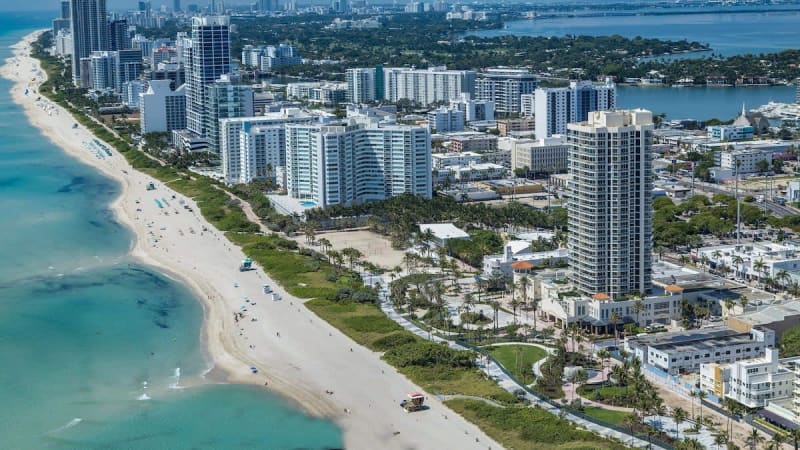
Or someone who grew up middle-income in Miami Beach’s North Beach in the early 2000s, on average, earned $8,000 less at the age of 35 than a middle-class child who grew up a few blocks north in Surfside.
If that same person were from Overtown, they could expect to earn almost $16,000 less than someone born two blocks east, closer to Biscayne Bay in downtown Miami, according to Opportunity Insights’ analysis of Census data.
What can bridge those gaps?
Zoning changes, particularly those that allow for the construction of affordable, mixed-income housing — and not just in low-income neighborhoods — can help provide housing stability and increase exposure across income levels, said Oppenheimer.
For Murray, supporting small businesses is a must. According to the Metropolitan Center, more than 80% of Miami-Dade businesses have fewer than 10 employees, and small businesses — those with fewer than 500 employees — employ more than half of the county’s workforce.
Those establishments “make up the soul of Miami-Dade,” said Murray. Getting those businesses capital and workforce development support can help them stay afloat. Especially in lower-opportunity neighborhoods, that can provide crucial sources of stability and employment and, with them, better opportunities.
“These all require such levels of commitment and support that just don’t exist right now,” Murray lamented.
That’ll have to change — at least if Miami’s “ever going to get serious about economic mobility,” he added.
This story was produced with financial support from supporters including The Green Family Foundation Trust and Ken O’Keefe, in partnership with Journalism Funding Partners. The Miami Herald maintains full editorial control of this work.