
This article first appeared on The War Horse, an award-winning nonprofit news organization educating the public on military service. Subscribe to their newsletter.
The caravan of executions started with a U.S. Army veteran in March.
It continued in May with a former Army Ranger who served in the Gulf War, then an Air Force veteran in July, a former National Guard member in August, and a Navy veteran in October.
On Thursday, a former Marine became the latest casualty, and next week, yet another Army veteran is scheduled to die in what Florida Gov. Ron DeSantis has called the “most veteran-friendly state in the nation.”
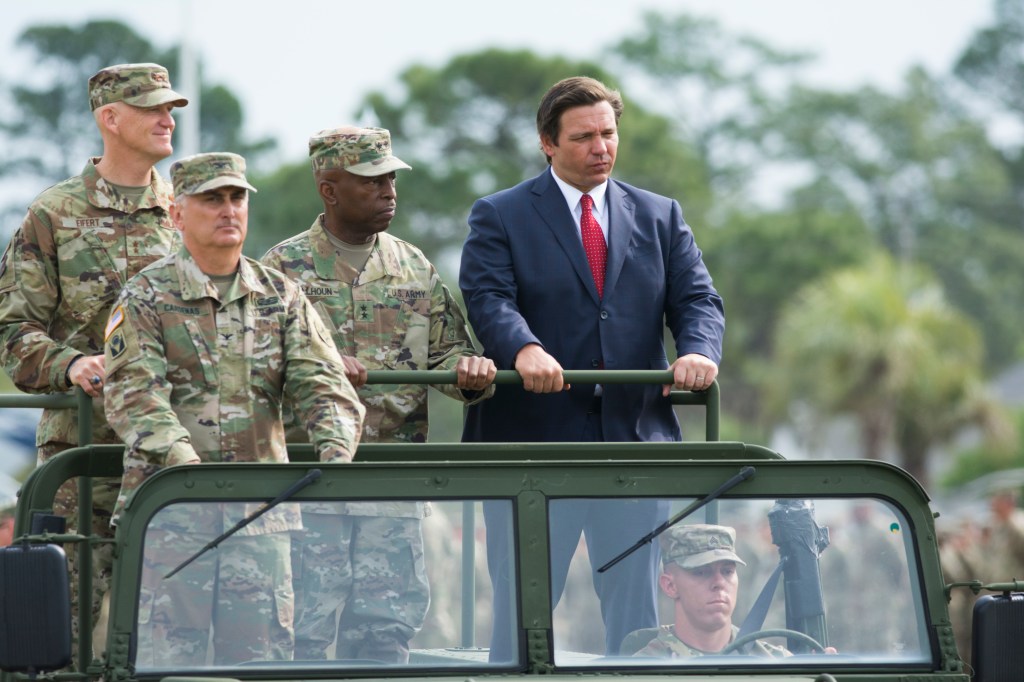
He’s the one who signed all seven of their death warrants. The governor wielding the executioner’s pen is a Navy veteran himself.
“They are coming so hard and so fast that it’s hard to keep track,” said William Kissinger, a Vietnam veteran who spent over four decades behind bars in Louisiana and now advocates on behalf of veterans on death row. “It’s heartbreaking.”
It’s also historic. Florida is on pace to more than double its record of eight executions in a year since the U.S. Supreme Court reinstated the death penalty nearly a half century ago. The number of military veterans on the list is startling.
While veterans represent an estimated 12% of Florida’s 256 death row inmates, they account for nearly 40% of the 18 death warrants that the governor has signed this year.
DeSantis, a former JAG officer who served as a legal adviser to SEAL Team One in Iraq, has ignored the pleas of some veteran advocates and refused to address the disproportionate ratio of former service members he is sending to the Florida State Prison’s execution chamber.
“I don’t think he [DeSantis] is targeting vets specifically,” said Art Cody, a retired Navy captain and director of the Center for Veteran Criminal Advocacy. “He is just not taking [their military backgrounds] into consideration.”
But should he?
Should military service matter?
While death penalty opponents and tough-on-crime hard-liners clash over the moral arguments and political motivations of DeSantis’ historic urgency, another debate is suddenly raging: Should an inmate’s military service matter when a judge, jury, or governor decides who deserves the ultimate punishment for society’s most heinous crimes?
The U.S. Supreme Court weighed in on that question 16 years ago in a case out of — none other than — Florida. The justices overturned the death sentence of Gregory Porter, a decorated Korean War veteran convicted of killing his former girlfriend and her boyfriend, because his attorney had presented no evidence about the combat that left him “a traumatized, changed man.”
“Our Nation has a long tradition of according leniency to veterans in recognition of their service, especially for those who fought on the front lines,” the court stated in a 2009 opinion. “Moreover, the relevance of Porter’s extensive combat experience is not only that he served honorably under extreme hardship and gruesome conditions, but also that the jury might find mitigating the intense stress and mental and emotional toll that combat took on Porter.”
What makes the recent surge in veteran executions stand out, veterans advocates say, is how they contrast with the historic declines in death sentences nationally and the rising understanding of the traumatic impact of military service.
A new report released this week by the Death Penalty Information Center tallied more than 800 veterans sentenced to death in the U.S. since 1972.
About one-fifth of those veterans served in a major conflict, with the largest group—106 veterans—from the Vietnam War. About 40% of those Vietnam veterans had a known diagnosis of post-traumatic stress disorder and many had been exposed to Agent Orange, the report found.
Jeffrey Hutchinson, the Gulf War veteran executed in Florida this May, traveled what the report called the “battlefield-to-prison” pipeline. The former Army Ranger’s appeals for mercy included his diagnoses for PTSD, traumatic brain injury, and neurotoxin exposure.
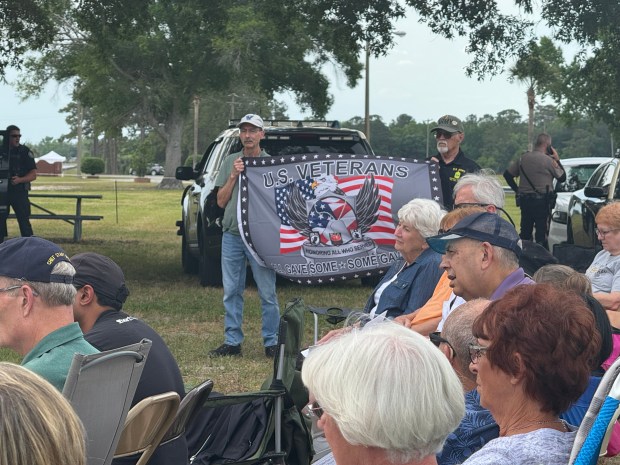 Veterans and capital punishment opponents have congregated outside the Florida State Prison to protest each execution of a veteran, including this gathering on May 1 when Jeffrey Hutchinson was put to death. (Photo courtesy of Maria DeLiberato of Floridians for Alternatives to the Death Penalty)
“In many cases in Florida, the juries that sentenced these veterans to death never understood how seriously they were harmed by their experience in the military and what effect those injuries had on their ability to conform their behavior to the law,” said Robin Maher, executive director of the Death Penalty Information Center, a nonprofit research center that focuses on how the death penalty is implemented. “Gov. DeSantis is in a position to recognize that and do something about it.”
Victims’ advocates argue that Hutchinson’s horrific crimes speak for themselves: He was convicted for the murder of his girlfriend and her three children, after busting down the front door of their north Florida home on Sept. 11, 1998, and finding them in the master bedroom. He shot mom Renee Flaherty and her kids, seven-year-old Amanda and four-year-old Logan, all in the head. Then he turned the gun on nine-year-old Geoffrey.
“The terror suffered in that moment is incomprehensible to this court,” the trial judge said.
Justice for victims’ families
Until this month, DeSantis said little about why he has so dramatically accelerated the pace of executions in the Sunshine State. Before this year, Florida had executed nine people—including two veterans—since the Republican became governor in 2019. Six of those were in 2023, critics note, as DeSantis launched an unsuccessful campaign for the White House.
The governor said during an appearance in Jacksonville earlier this month that he’s trying to do his part for victims’ families.
“We have lengthy reviews and appeals that I think should be shorter,” DeSantis said. “I still have a responsibility to look at these cases and to be sure that the person’s guilty. And if I honestly thought somebody wasn’t, I would not pull the trigger on it.”
But the governor has failed to address why so many of those inmates this year are veterans.
“By the time I’m writing about one, he has already signed another death warrant,” said Kissinger, a former airman first class and Vietnam War veteran who has led appeals to the governor on behalf of Florida’s veterans on death row.
Kissinger was among 161 veterans who signed a letter calling on DeSantis to stop signing death warrants for veterans, including former National Guard member Kayle Bates, convicted for the 1982 murder of an office manager in Lynn Haven near Panama City.
A week before Bates’ execution in August, many of those petitioners gathered in Tallahassee, urging DeSantis to reconsider, arguing that executing veterans affected by war and denied mental health care was “not justice.”
They called the executions a “final abandonment.”
When The War Horse reached out to DeSantis’ office with questions about Bates and whether the governor takes into account an inmate’s military service, a spokesperson replied: “Kayle Bates was executed after receiving the death penalty for murder, sexual battery, kidnapping, and robbery. His sentence had nothing to do with his status as a veteran.”
The Case of Kayle Bates
In 1982, Bates was an active member of the National Guard when he was charged in the brutal murder of Janet Renee White. Prosecutors say he abducted White from her office, stole her diamond ring, attempted to rape her, and stabbed her to death.
The trial of Bates, who was Black, opened with a prayer from the victim’s minister, who asked for the judge and the all-white jury to have “wisdom.” With no mention of Bates’ military background, he was sentenced to death within an hour of deliberations.
But the Florida Supreme Court threw out his original death penalty and ordered the trial court to reconsider his sentence. This time, attorney Tom Dunn, a U.S. Army veteran, represented Bates with one aim: to persuade the jury that Bates was not the “worst of the worst,” and that life in prison, not death, was appropriate.
Dunn presented Bates’ military service and lack of criminal history, and put forth 18 character witnesses, including fellow National Guard members.
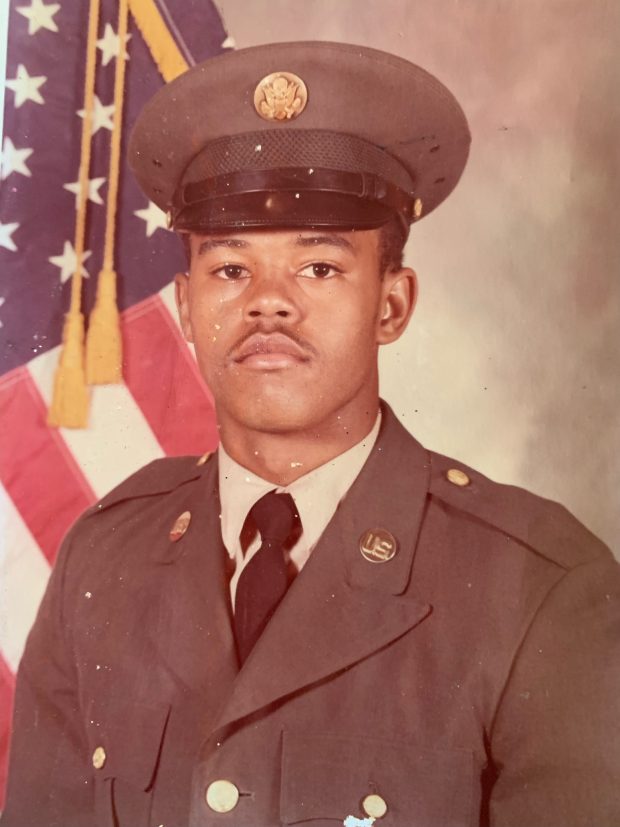 Former National Guard member Kayle Bates was executed in August. He is pictured here upon his graduation from basic training. (Source: Tom Dunn)
They testified about how Bates’ deployment to the Miami riots, two years before his arrest, had affected him. Bates was among thousands of National Guard members sent into Miami after an all-white jury acquitted four white police officers in the beating of Arthur McDuffie, a Black Marine Corps veteran, left in a coma after a traffic stop in December 1979. For three days, Black neighborhoods in and around Miami burned. Vehicles were set on fire, people were dragged and beaten, and businesses looted. At least 18 people were killed and hundreds injured.
Bates’ wife described him as distant and plagued by nightmares, and she said he often woke up screaming and not recognizing where he was. A forensic neuropsychologist testified that the trauma Bates endured could have influenced his later behavior.
Ultimately, the jury voted nine to three to sentence Bates to death again. In a U.S. federal court, the lack of a unanimous decision would lead to a hung jury and no death sentence. That is not the case in Florida.
A 42-year path to execution
On July 18, 2025, almost 42 years after Bates’ conviction, Gov. DeSantis signed a letter addressed to the warden of the Florida State Prison in Raiford about 140 miles away.
The death warrant was brief, outlining Bates’ court rulings, and concluded with a note saying that the governor’s office did not find executive clemency “appropriate” for him. It did not provide any further explanation for the decision.
Janet White’s husband, Randy, had been waiting for this resolution for four decades. He said he attended every hearing and every trial to “let Renee know that justice has finally been served for her,” he told USA Today. He attended the execution, but not out of revenge, he said. He had actually made peace and forgiven Bates years ago as a way to move forward.
“You’ve got to find a shorter route than 43 years,” he told USA Today. “There’s got to be a better system that will see all these appeals through quicker.”
Florida is one of the seven states in the U.S. where a dedicated clemency board listens to pleas to commute sentences and is required to make recommendations to the governor. But unlike in the other states, Florida’s four-member board is headed by the governor himself. The state has not granted clemency to a death row prisoner since 1983.
It did not do so for Bryan Jennings, a Marine Corps veteran, has been on death row for more than four decades for the rape and murder of a six-year-old girl in Brevard County in 1979. He was executed Thursday. Next week is the scheduled execution of Richard Randolph, an Army veteran who was convicted of the 1988 rape and murder of his former manager.
For Kissinger, who has become a vocal advocate for criminal justice reform in Florida, the quest to be heard has become an endless battle. As the dizzying pace of executions keeps growing, he has repeatedly requested a meeting with the governor to discuss veterans on death row.
He knows it’s a long shot.
“I keep waiting on emails,” he said. “I keep waiting on some sort of acknowledgement.”