
TEMPLE TERRACE — In Temple Terrace, the oak canopy that arches over many of its streets isn’t just part of the city’s scenery, it’s part of the city’s identity. But arborist Joe Ferris says that canopy is aging, and the time to act is now.
“I think overall, we’re in a good condition,” Ferris said. “I think we’ve got maybe 20 years before we start seeing things die off. So now’s the time to start replenishing that canopy, so that as those do die off, you’ve got new trees that are coming to in health and growth.”
Ferris echoed the findings of Bio-Tech Consulting, which is completing an urban forest assessment and management plan for the city. The firm catalogued every tree on city property, except for those on the golf course, to better understand the health of Temple Terrace’s urban forest.
At a Nov. 3 informational session at the Lightfoot Center, Bio-Tech environmental lead Jeremy Cooper told residents that while the city’s canopy is in good shape, it could be better.
The study documented 2,748 trees across 61 different species. The largest tree, a live oak, measured 62 inches in diameter, while the tallest, a bald cypress, soared to a height of 85 feet. Most were classified in fair to good health.
However, the data revealed some concerns. Roughly 30% of the city’s canopy consists of trees in the 24-inch diameter range, suggesting that many could reach the end of their life cycle within the next 20 years.
“That’s a little bit concerning,” Cooper said. “So, the timing of this project is beneficial for the city, just because we can start injecting a little youth into our urban forest.”
Another issue: 70% of the trees catalogued are varieties of oaks, a total Cooper said is “extremely high.”
Cooper said typically, you don’t want a species being more than 10% of your urban forest because of pathogens and pests. “If you have something that affects a specific species, it can be pretty detrimental when you’re so dominant in one species,” he said, citing neighborhoods in the Northeast where an emerald ash borer infestation wiped out entire streets of ash trees within months.
City officials, who approved the $54,000 study, plan to address those issues through a strategic management plan being put together by Bio-Tech and will eventually be voted on.
The city would likely pay for the plan from its $1.4 million tree fund reserves.
That plan will mainly focus on increasing canopy coverage by 10% over the next two decades, while also diversifying tree species.
Using satellite imagery and an advanced geographic information system, Bio-Tech found that Temple Terrace currently has 41% tree coverage, 30% impervious surfaces and 27% potential planning areas. Cooper cautioned, however, that just because an area can be planted on, doesn’t necessarily mean it should be, citing proximity to powerlines or soil that isn’t ideal.
The city has lost 6.7% of its tree canopy since 2013, largely from development and storm damage. Ferris said there is no official figure on the number of trees lost during Hurricane Milton.
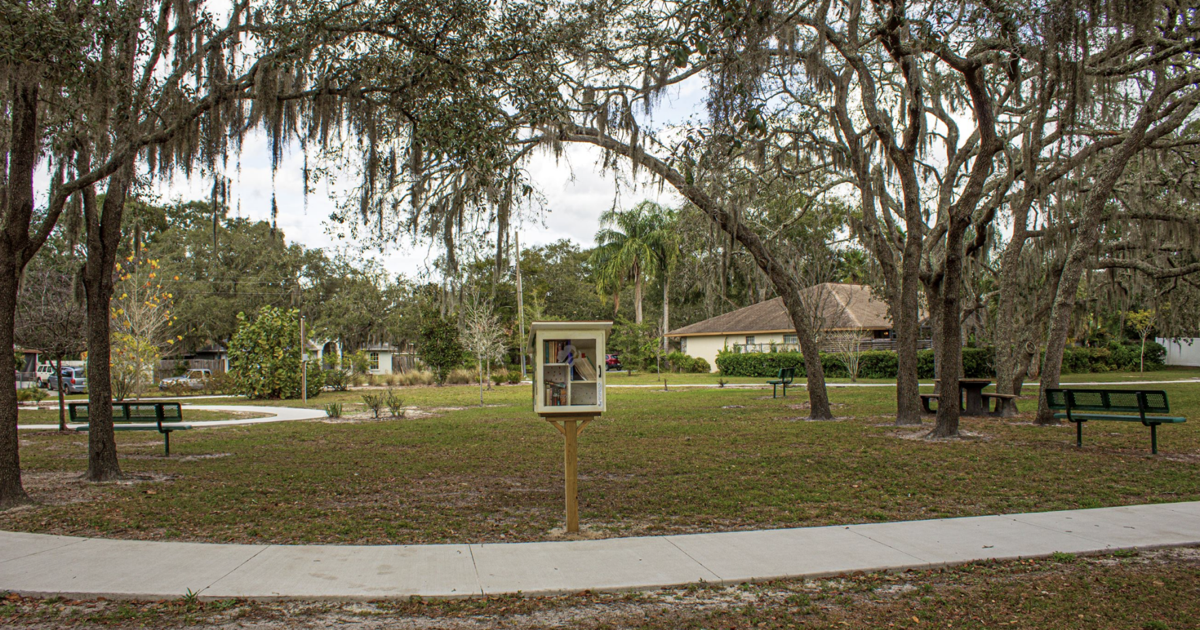
As part of the effort, Bio-Tech is proposing a special initiative to revive Serena Park’s “Arbor Room” as a demonstration site for the city’s Adopt-A-Tree program.
“We want to create a flexible model that can be used to establish new revitalization projects,” he said. “We want to do some planting on there so that people can come out, they can get information on the trees that are available to them, to get for free through the city, and that they can see them fully grown and understand what they’re going to look like when they plant them in their yard.”
Residents at the meeting raised questions about maintenance, invasive species and how tree planting and maintenance might affect homeowner’s insurance. Cooper said Bio-Tech and the city would address those with strategies for “smart planting.”
The study marks the first comprehensive tree inventory and management plan in Temple Terrace’s history. And for a community with such a vigorous tree program and standing as a Tree City Community since 2008, Ferris says it will fill an important gap.
“It really is like the missing piece of the puzzle,” Ferris said. “We already have great programs in place, and this will be the final piece of the puzzle and help maintain the canopy for the next generation. If we act now, 20 years from now we’ll have more.”