
PORT ST. LUCIE — Motorists in Port St. Lucie may soon face red-light cameras at the city’s 10 most accident-prone intersections after the City Council gave preliminary approval Nov. 10.
Police Chief Leo Niemczyk introduced the ordinance with a warning. “Traffic fatalities are a major concern,” he said. “In 2025, we’ve already surpassed 2024. The main causes are driving under the influence and right-angle crashes. Red-light cameras are designed to prevent right-angle collisions. We studied all intersections to identify which would benefit most from camera enforcement.”
Chief Niemczyk highlighted the top three dangerous intersections: Cashmere and St. Lucie West boulevards with 264 crashes since 2022, 75 right-angles and 52 red-light citations; Southwest Tradition Parkway and Southwest Village Parkway with 235 crashes, 29 right-angle, 163 citations; and Southwest Bayshore Boulevard and Southwest Port St. Lucie Boulevard, which had the most total crashes at 384, including 48 right-angle incidents and 72 citations.
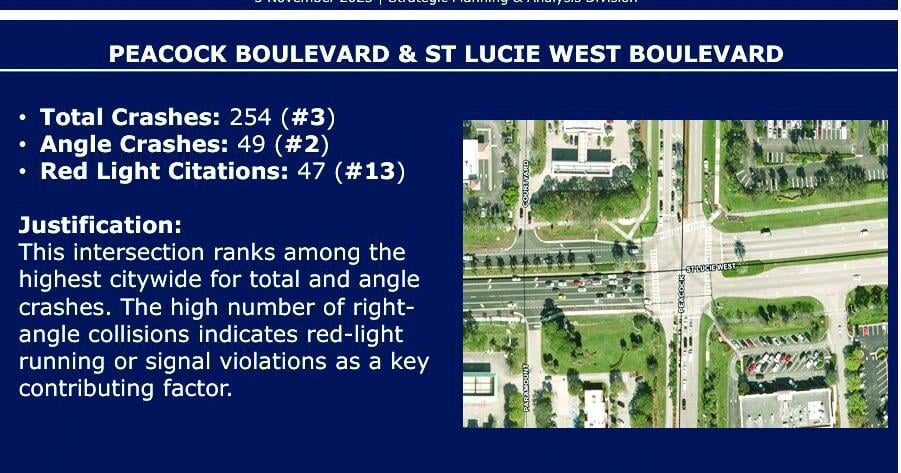
Other intersections on the list included Peacock and St. Lucie West Boulevard (254 crashes, 49 right-angles), Southwest Gatlin and Southwest Port St. Lucie Boulevard (249, 38), California and St. Lucie West boulevards (201, 48), Southwest Gatlin and Savona boulevards (219, 35), U.S. 1 and Southeast Lennard Road (208, 38), U.S. 1 and Southeast Port St. Lucie Boulevard (214, 17), and Southwest Bayshore Boulevard and Southwest Crosstown Parkway (179, 21).
“Even one traffic fatality is too many,” Niemczyk said. “Right-angle crashes are the most dangerous, accounting for about 25 percent of total crashes and the majority of fatalities in 2025.”
Councilman Anthony Bonna questioned whether the ordinance aligns with Florida Department of Transportation’s Target Zero campaign, aimed at reducing fatalities from distracted driving. “I’d only support it if the ordinance aligns with Target Zero. Stopping abruptly for a red-light camera could increase rear-end crashes. We need data on fatalities to justify this,” he said.
Niemczyk acknowledged rear-end crashes can increase slightly with cameras but emphasized that right-angle crashes decrease, reducing overall fatalities. About 70 percent of traffic deaths involve right-angle collisions, he said. Hometown News verified that 16 people died in Port St. Lucie traffic accidents last year, including two pedestrians. The two fatalities this year involved a pedestrian and an e-bike rider, neither from running a red light.
Vice-Mayor Jolien Caraballo asked about camera operation. Chief Niemczyk explained there is a three-second grace period and that violations occur when a vehicle crosses the stop line after the light turns red. “Education is important,” Caraballo said, emphasizing the need to inform residents about the system.
Mayor Shannon Martin agreed. “From a safety standpoint, we cannot hire our way out of this problem. Most crashes are due to bad-driver behavior. If these are the top 10 most dangerous intersections, we should move forward immediately.”
The ordinance cites the registered vehicle owner rather than the driver, with an administrative fine but no points assessed. Councilman David Pickett recounted his own experience in Cocoa, where a camera ticket was issued despite him not fully running a red light, highlighting the importance of public education.
The cameras are expected to save manpower while reducing right-angle collisions. The City Council voted 3-1 for first reading approval. Councilwoman Stephanie Morgan was absent, and Councilman Bonna dissented due to his commitment to Target Zero.
The initiative marks a significant step for Port St. Lucie in curbing traffic fatalities and enhancing intersection safety, particularly at high-risk locations identified through recent crash data. Officials stressed that public awareness and driver education will be key to ensuring compliance and maximizing the system’s effectiveness.
In response to email questions sent to Chief Niemczyk by the Hometown News on Nov. 16 for some of the statistics requested by Councilman Bonna, Public Information Officer Dominick Mesiti responded the following day with the answers.
“In 2025, we have had 15 fatalities from 14 different crashes to-date,” he wrote Nov. 17. “None of the fatal crashes in 2025 occurred at any of the proposed intersections. However, the 10 intersections selected were based on crash and citation data analysis from Jan. 1, 2022 through October of 2025. Intersections were evaluated based on total crash volume, frequency of angle crashes (“T-bone” crashes which tend to result in serious injuries and/or death), and the number of documented red-light citations. These metrics were used to identify locations where camera enforcement would likely yield the greatest safety benefit.”