
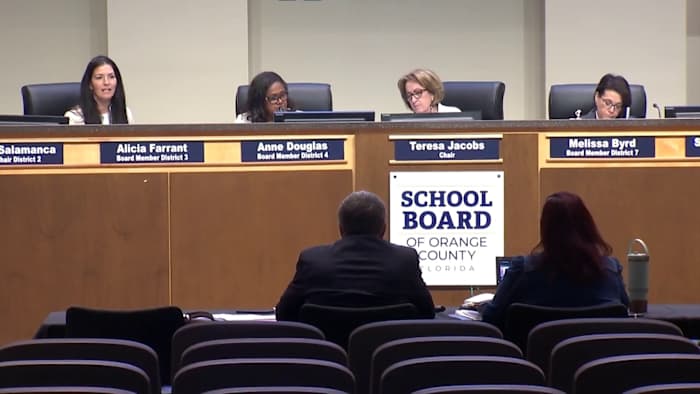
ORLANDO, Fla. – Orange County school board members expressed concern and confusion Tuesday surrounding the potential implications of a recently enacted law that allows charter schools to move into underused schools in the district.
“I don’t even know where to start with this hastily and poorly written rule and law,” said Stephanie Vanos, a school board member representing District 6.
The board met for a work session Tuesday to discuss a few items, including a law concerning “Schools of Hope.”
The Florida Department of Education defines “Schools of Hope” as a charter school operated by a “hope operator” that serves students from one or more persistently low-performing schools. The “hope operator” is a non-profit organization that operates three or more charter schools and has a record of serving students from low-income families.
[WATCH: Orange County Public Schools to pause new construction amid enrollment decline]
Per Florida Statute 1002.333, school districts “must permit any school of hope to use all or part of underused, vacant, or surplus school district facilities, and receive facility-related services.”
During the work session, several school board members wondered aloud whether the co-habitation of charter school classes and Orange County public school classes would put a strain on the district’s resources.
“My biggest concern, really, as a board member, is the funding aspect,” said Alicia Farrant, who represents District 3. “How do we fund this?”
The district would be required by law to allow schools of hope to move in without paying rent, while the district would also be on the hook for covering services like food and transportation.
[WATCH: Orange schools face $25M shortfall after enrollment drops nearly 7K students]
Superintendent Maria Vazquez suggested that “Schools of Hope” sharing space with existing schools could have more than just financial implications.
“Neighborhood schools are community anchors,” Vazquez said. “Co-location can fracture a school’s identity, divide parent organizations, and create confusion about who’s accountable for the overall campus experience.”
Farrant, who has touted her position advocating for school choice, agreed with the other members of the board regarding concerns over “ambiguous” language in the law. However, she asked them to reflect on the circumstances that precipitated the passage of the law.
“Something I’m sure we don’t really want to think about is we’re in this predicament because we have schools that are not servicing our kids in the ways that they should,” Farrant said.
Vazquez and the board’s general counsel also disclosed Tuesday that the district has received letters from charter schools seeking to move into underused schools. They said many of those requests were rejected for various reasons, including the fact that two of the operators are not yet authorized as “Schools of Hope” operators in Florida.
Breaking News Alerts
Get breaking news alerts delivered to your inbox.
Copyright 2025 by WKMG ClickOrlando – All rights reserved.