

By the time most people meet Rodrigo Ruano, MD, PhD, they’ve already been told something no expectant parent wants to hear — that their pregnancy isn’t routine. For them, the path forward feels uncertain.
For Dr. Ruano, it’s where possibility begins – where medicine pushes forward, and innovation turns the impossible into a chance for both mother and baby.
What began as an early interest in the early diagnoses of birth defects evolved into a career that has redefined what’s possible in maternal-fetal medicine. Today, Dr. Ruano is recognized internationally for advancing surgical techniques in maternal-fetal surgery, and leads a team that treats some of the most complex pregnancies — from performing life-saving surgeries on babies still in the womb to guiding mothers with serious medical conditions through safe deliveries.

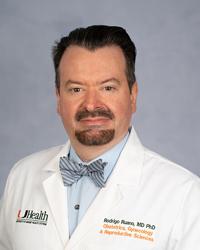
Rodrigo Ruano, MD, PhD
(Jackson Health System)
As the leader of the UHealth Jackson Fetal Care Center, his expertise makes him sought after in the field – but it’s his calm presence, hope, and compassion that families remember most.
“I love what I do, I really do,” he says. “With science, ethics, and experience, we can provide hope for the most complex situations in maternal-fetal medicine and congenital conditions. We have a great team, and we are here for the patients.”
A native of Brazil, Dr. Ruano earned his medical degree and completed his residency in obstetrics and gynecology at the University of São Paulo. Drawn to the rapidly evolving field of fetal medicine and surgery, he pursued specialized training in Paris, France, at the University of Paris. There, he learned to perform laser therapy for twin-to-twin transfusion syndrome and mastered procedures such as placing shunts to treat fluid buildup in the fetal chest (pleural effusions) and lower urinary tract obstructions. He also trained in fetal blood transfusions (a procedure to give blood directly to a baby in the womb) and fetal endoscopic tracheal occlusion, a surgery that temporarily blocks the baby’s windpipe to help the lungs develop when a congenital diaphragmatic hernia is present – a condition in which the baby’s diaphragm doesn’t form properly before birth, allowing abdominal organs to move into the chest.
Under the mentorship of leaders in the field, Dr. Ruano learned to pair advanced surgical skill with genuine connection, blending innovation with compassion for every family in his care.
In 2010, Dr. Ruano brought his expertise — and his drive to keep pushing what’s possible — to the United States.
“I didn’t plan to specialize in fetal surgery. In a way, it found me,” Dr. Ruano said. “I wanted to be able to give these patients hope and the opportunity to be treated so they would have a better chance and life. Now, I can’t imagine doing anything else.”
Today, he and his team at the UHealth Jackson Fetal Care Center care for women at with high-risk pregnancies, ranging from common conditions such as diabetes, gestational diabetes, and chronic hypertension to more complex challenges, such as heart disease, cancer (even those going through treatment), spina bifida, vein of Galen malformations, and congenital conditions.
Working alongside the pediatric specialists at Holtz Children’s Hospital, home to the Schatzi and Stanley Kassal Project: Newborn Neonatal Intensive Care Unit (NICU) — a Level IV NICU known for some of the best survival rates in the country — his team delivers coordinated, world-class care for both mothers and babies.
“At UHealth Jackson Fetal Care Center, we specialize in the most complex fetal conditions,” Dr. Ruano said. “We offer advanced in-utero procedures rarely attempted elsewhere, and we have exceptional outcomes for mothers and their babies.”
In addition to fetal surgeries for conditions such as spina bifida and the removal of fetal tumors in the lungs or spine, Dr. Ruano’s team provides comprehensive care for mothers who do not require surgery but benefit from specialized monitoring and risk management. Often, they collaborate closely with a patient’s regular obstetrician to guide testing, track potential markers, and refine care plans throughout the pregnancy.
Beyond the clinic and operating room, Dr. Ruano channels what he observes in daily practice into ongoing research in maternal-fetal medicine. His current work focuses on pregnancies among women of advanced maternal age — particularly those in their 40s and 50s — a group his team increasingly cares for as assisted reproductive technology makes later-in-life pregnancies more common.
“In the past, this was not possible, but now it’s much more common,” Dr. Ruano said. “There are higher risks, but we are working to better understand them and lower those risks. Through our work and research, we’re exploring why our outcomes are so good and how we can do even better.”
Each year, advances in fetal surgery and maternal care reveal new possibilities—treatments and technologies that didn’t exist when Dr. Ruano first began his training.
For him, that progress is deeply personal: every discovery is another way to give mothers more options, babies more chances, and families a future that once seemed out of reach.