
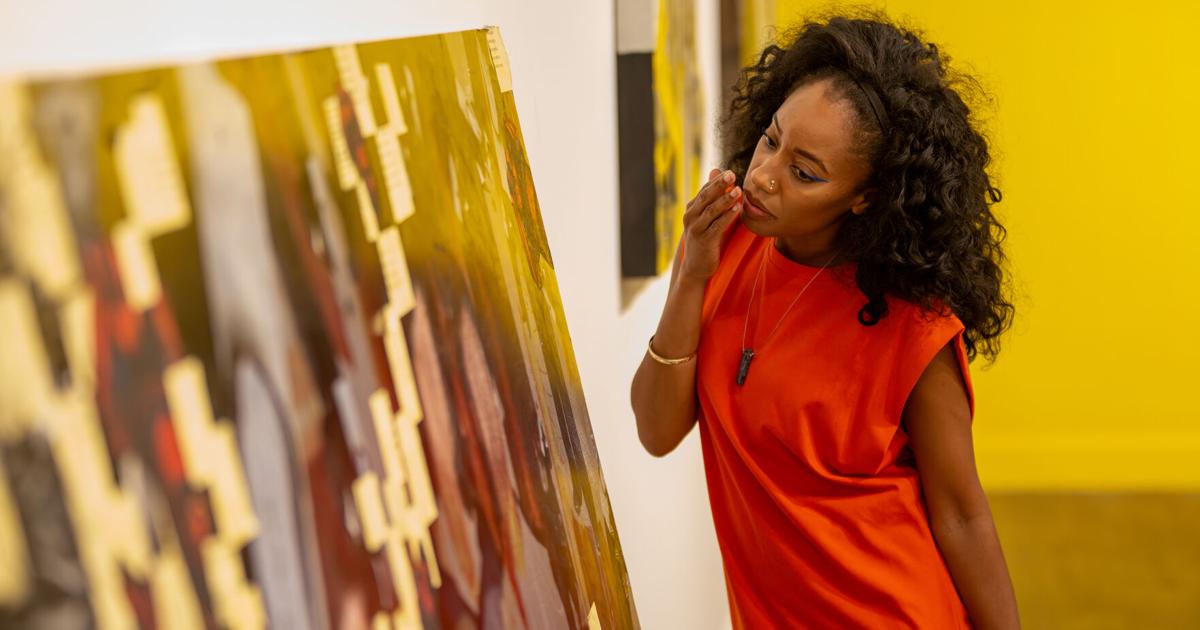
When Roscoè B. Thické III, a Miami-born visual artist, was invited to curate an exhibition for the Marshall L. Davis, Sr. African Heritage Cultural Arts Center, he wasn’t immediately sure which direction to take.
“I think initially I wanted to do something on the city and how it affected me,” he said. “But it got deeper.”
Thické’s idea for the exhibition’s theme finally took shape as he completed a residency in Paramaribo, Suriname with the Diaspora Vibe Cultural Arts Incubator, where long days of meditation and writing gave him space to reflect.

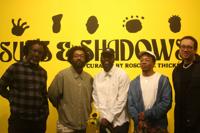
(L-R) T. Eliott Mansa, Mark Delmont, Roscoè B. Thické III, Reginald O’Neal and Lance Minto-Strouse pose together on the exhibition’s opening night Nov. 14.
(Béatrice Vallières for The Miami Times)
“I think about my parents. I think about me growing up in the neighborhood — how I lived right up the street from here. How that overlaps. So I think that’s where legacy came from,” he said.
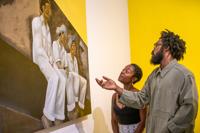
Mark Delmont discusses his piece, “As if they had wings.” The piece depicts construction workers perched high above the ground with no safety gear.
(Gregory Reed)
The exhibit, which opened on Friday, Nov. 14, and will run through Feb. 28, invites viewers to reflect on the circular nature of legacy, on family, and on grief. In a small, intimate setting, it spotlights the work of five Miami-born visual artists, Reginald O’Neal, Mark Fleuridor, Mark Delmont, T. Eliott Mansa, and Lance Minto-Strouse.
A companion book features work by writer and activist Vincella Myah Smith, filmmakers Monica Sorelle and Faren Humes, architect Teri Watson, and Thické’s 16 year-old daughter Jada Forbes.
The exhibition also marks the 50th anniversary of the Liberty City institution, which offers arts instruction for children and serves as a vital hub for Black cultural life in South Florida.
Suns & Shadows
The exhibit’s name, Suns & Shadows, echoes a poem displayed on the gallery wall, welcoming visitors as they enter.
“Because in Blackness, a shadow is not the absence of light,” one passage reads. “It is the evidence of presence./ A trace of protection.”
Made from fragments and lines pulled from the pages Thické filled during his residency, the text served as a prompt to guide the artists’ work.
“Legacy and memory go hand in hand with a lot of Black artists’ work,” Thické said. “I didn’t realize that before, but then when I started talking to people and stuff like, ‘Oh, you did this piece because of your grandma, you did this piece because of this,’ I’m like, wow, it went hand in hand.”
O’Neal, whose paintings often reflect on life in the historically Black neighborhood of Overtown, presented two original pieces, titled “I wrote your name in the concrete” and “The opposite side of headcracks is losers.”
Each piece takes the form of a concrete slab presented on the floor — one embedding a painted portrait of his brother, who passed away earlier this year, the other holding a set of dice.
“If you ask me about somebody that I love, it would be hard for me to express that. But I could make a painting about it and try to make the painting feel like that love that I feel,” O’Neal said. “So the painting of my brother, it was just like this… It’s just a way in which I could talk about loss, and grief, and trying to remember a person.”
“If you ask me about somebody that I love, it would be hard for me to express that. But I could make a painting about it and try to make the painting feel like that love that I feel.” -Reginald O’Neal
(Béatrice Vallières for The Miami Times)
Minto-Strouse’s piece, “Guidance from the Matriarchs,” is based on a picture of his mother, aunt, and grandmother in Jamaica. They face the camera, but their faces have been intentionally obscured.
“I was having a wall block when I was making the work and I just ended up going to the studio and talking to him [Thické],” Minto-Strouse said. “And from that, I knew what I wanted to represent and who I wanted to give my flowers to and show love to.”
The artist, who recently completed a fellowship at the Yale Norfolk School of Art, is also a former student of the Marshall L. Davis Center’s afterschool program.
“Coming back after all these years is a very full circle moment,” he said.
Full circle
It’s also a full circle moment for Thické, who spent part of his childhood in Liberty City near the Center. His grandmother’s home, which used to be located just a few blocks away, is immortalized in his 2022 photo series and film 1402 Pork N Bean Blue.
“I think it feels amazing to have grown up in the shadows of this building… and to now be putting on a show here, and also get the opportunity to put other people on in their journey,” he said.
Thické’s connection with the neighborhood is part of why he was approached to lead the project, said Bayunga Kialeuka, gallery manager at the Marshall L. Davis, Sr. African Heritage Cultural Arts Center.
“I wanted to engage local artists that have a true sense of the pulse of the arts community,” Kialeuka said, adding that he saw in Thické’s work the narrative sensitivity he looks for in a curator. “I like the idea of engaging people that are terrific storytellers.”
As for Thické, the story he hopes visitors take away from the exhibition is simple:
“Wherever you want to get, you can definitely get there, because whoever you look up to, whoever you idolize, they were once where you are at.”
Suns & Shadows will be on display at the Marshall L. Davis, Sr. African Heritage Cultural Arts Center until Feb. 28, 2026. A digital version of the exhibition’s book is available online at https://www.behindmuseumglass.com/.