
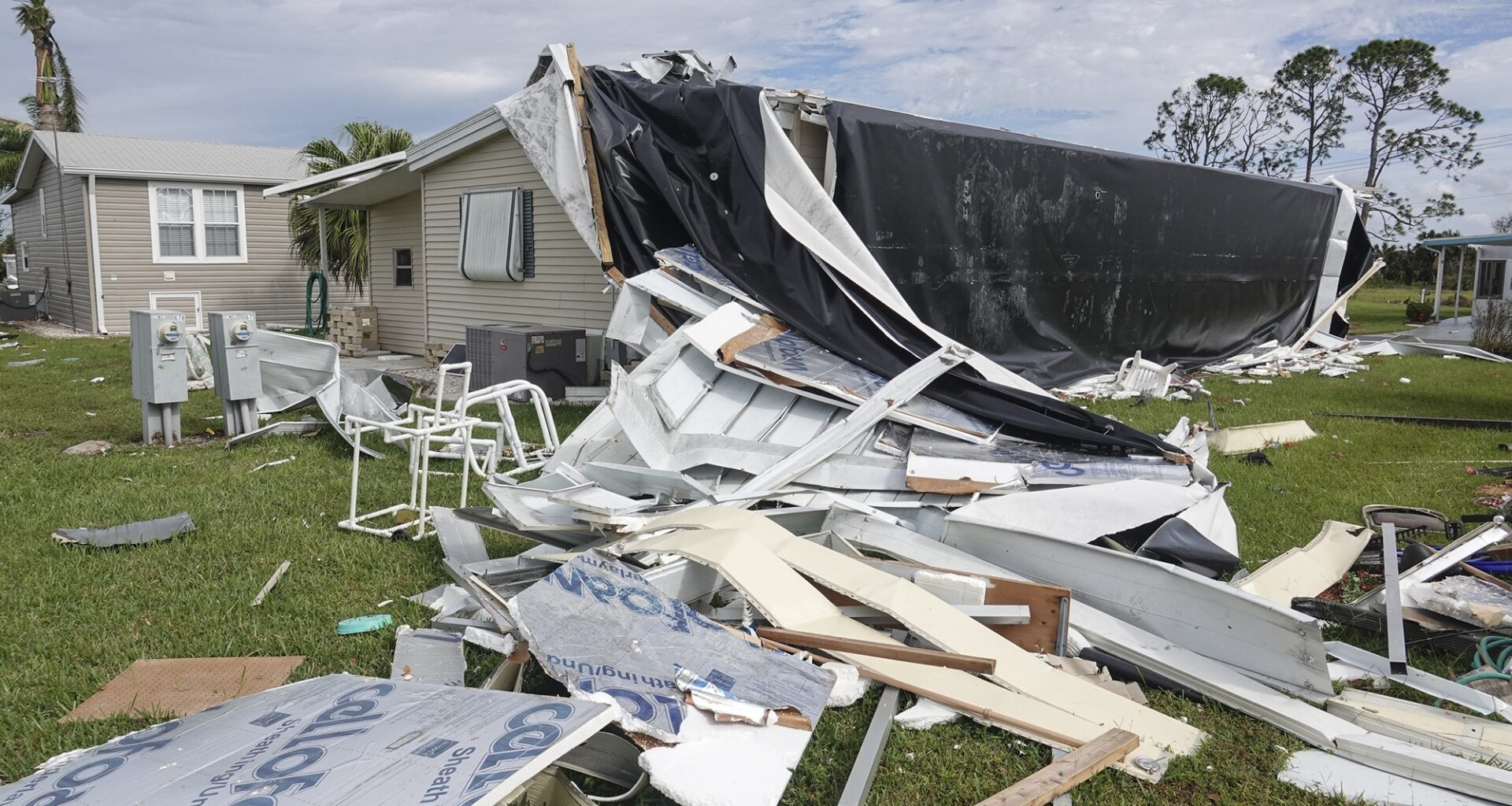
Florida Gov. Ron DeSantis’s bid in 2022 to stave off the mass exodus of national insurers from the Sunshine State, described at the time as a “Christmas gift” to the industry, was a mirror image of the batch of handouts given out in the aftermath of Hurricane Andrew three decades earlier. That initial effort unleashed a flood of small, undercapitalized insurers with reinsurance-heavy capital structures, and pushed policyholders receiving coverage through the Florida Joint Underwriting Association, a pool of insurers providing coverage for risks that can be difficult to insure, into the private market. Compared to other disaster-prone states, Florida has one of the highest concentrations of property insurer insolvencies in the U.S.
In my first-ever report for the Prospect, I chronicled how Florida’s property insurance playbook has homeowners paying more for less, while insurers rake in exceptional profits from soaring premiums. Much like the play Florida legislators ran after Hurricane Andrew, the market-friendly reforms DeSantis passed in the wake of Hurricane Ian have failed to stabilize the state’s insurance market, instead reproducing “many of the same conditions that left homeowners exposed in the last crisis,” according to a new analysis from the Insurance Fairness Project.
Florida began depopulating the Citizens Property Insurance Corporation, the state’s present-day insurer of last resort, in January 2023. Citizens must place policyholders with a private carrier if that insurer’s premium is within 20 percent of their Citizens premium. Oftentimes, those policyholders end up having to foot the bill for pricier policies on the open market, which the Insurance Fairness Project argues is “precariously balanced on the same weak foundations that failed in the past.”
The market-friendly reforms Gov. DeSantis passed in the wake of Hurricane Ian have failed to stabilize the state’s insurance market.
Depopulation has resulted in roughly 355,000 policyholders losing their coverage with Citizens, a number that is expected to grow. Over the summer, the Florida Office of Insurance Regulation (OIR) approved more than a dozen private insurers to assume hundreds of thousands of policies from Citizens through the end of the year.
But these replacements don’t stand on a strong foundation. “Four of the new insurers either appear to have been restructured from a company that became insolvent in the past decade; have strong ties to a company that became insolvent in the past decade; or have ties to a company that faced financial trouble and was on the brink of insolvency,” the analysis explains. One of those insurers, Viceroy Preferred Insurance Company, shares its board of directors with Monarch National Insurance Company, which was fined $325,000 in September over its mishandling of claims. Monarch was previously a subsidiary of FedNat Insurance Company, the sixth property insurer to declare insolvency after Hurricane Ian, and is now owned by Hale Partnership Capital Management, a hedge fund headquartered in Charlotte, North Carolina. David Lockhart, president of Viceroy and Monarch, is FedNat’s former chief financial officer.
Monarch is one of several insurers, including three other new Florida entrants, to have been issued $2 million in fines by OIR for “misconduct” over mishandled hurricane claims.
Other new insurers with checkered pasts include Patriot Select Property and Casualty Insurance, formerly the insolvent Anchor Insurance; and Apex, which arose out of another insolvent firm, Interboro Mutual Indemnity Insurance Company.
The common thread among other insurers approved by OIR to assume Citizens policies seems to be twofold: their history of high claim denials and outstanding ratings from a privately held ratings agency called Demotech, which accepts payments from the insurers that it rates. Demotech is registered with the Securities and Exchange Commission (SEC) and is one of the few ratings agencies accepted by Fannie Mae and Freddie Mac for residential insurance companies. It rose to prominence in Florida during the 1990s after the state invited it to rate new insurance market entrants that major ratings agencies wanted nothing to do with. Since then, Demotech has become deeply entrenched in both Florida and Louisiana’s property insurance markets.
According to Weiss Ratings, an independent ratings agency that does not accept payment from insurers, 14 insurance companies closed more than 50 percent of homeowner claims without payment last year. Five of the 14 are either new insurers in Florida after the 2022 reform, or are insurers led by executives at new insurers.
People’s Trust Insurance Company, one of the new Florida firms, was at the top of that list, denying three-quarters of all claims filed by policyholders in 2024. Each of the 14 insurers closed more claims without payment than they had in 2023. Slide Insurance Company closed a little more than half of homeowners’ claims without payment in 2024. It is also among the new market entrants in Florida rated positively by Demotech.
Slide, which has an “A” rating from Demotech, received a “C-” from Weiss. Eight other Florida insurers either have higher ratings from Demotech than other independent ratings agencies, or don’t have any independent ratings at all. As The Wall Street Journal reported, insurers rated by Demotech were 30 times more likely to become insolvent than those evaluated by major ratings agencies. Between 2017 and 2025, 17 insurers declared insolvency within a year of receiving “A” ratings from Demotech.
“Insurance companies basically control the process,” said Martin Weiss, founder of Weiss Ratings. Insurers can partner with any ratings agency approved by Fannie Mae and Freddie Mac. “It’s a voluntary rating. If the company decides to opt out of the partnership, it has the opportunity to do so.” Weiss told the Prospect that the ratings process “is tied to the benefit of the insurance companies,” which can appeal downgrades.
Slide’s happily married executives have drawn the ire of OIR for taking home tens of millions of dollars in annual compensation, including bonuses and stock awards. Slide Chief Executive Officer Bruce Lucas and his wife Shannon, the company’s chief operating officer, share a four-story, 9,600-square-foot waterfront home hailed by Tampa Magazine in 2022 as a “massive modern masterpiece.” As the article observes, “Shannon was particularly involved in designing the home. She has a knack for interior design, having recently completed their vacation house in Turks and Caicos.”
The power couple also contributed $26,400 to political action committees supporting DeSantis and former Florida Chief Financial Officer Jimmy Patronis’s campaigns for federal office. Patronis now represents Florida’s First Congressional District.
“Florida has a sort of uniquely acute history of having a very cozy relationship between its political leadership and the insurance industry,” said Jordan Haedtler, a climate finance strategist at Climate Cabinet.
Earlier this year, a Tampa Bay Times investigation found that OIR had seemingly suppressed a report showing that many insurers in Florida were reporting losses while directing generous amounts of investment income to shareholders and affiliates, which masked how profitable they really were. Haedtler told the Prospect this “illustrates some of the flaws of our state-based regulatory system.” He recently co-authored a separate report outlining how states can strengthen insurance regulation by streamlining all aspects of their operations, which include disaster relief, land use, and building codes, among others. According to Haedtler, these operations can span multiple agencies.
“Many states are basically treating the entire issue of their insurance crisis as silos,” he said. “Our main recommendation is to bring all these things together under one agency and to coordinate the actions of these different state instrumentalities to stabilize insurance markets long-term.”
In its recent analysis, the Insurance Fairness Project called on Florida to “move beyond cosmetic fixes,” citing the need for “transparent and reliable financial ratings, and enforceable accountability mechanisms” that protect consumers when the next disaster strikes.
“What we need is a complete revamping of the structure of the insurance industry in Florida,” Weiss told the Prospect. “We effectively have to build the market from scratch.”
Recommended Reading