
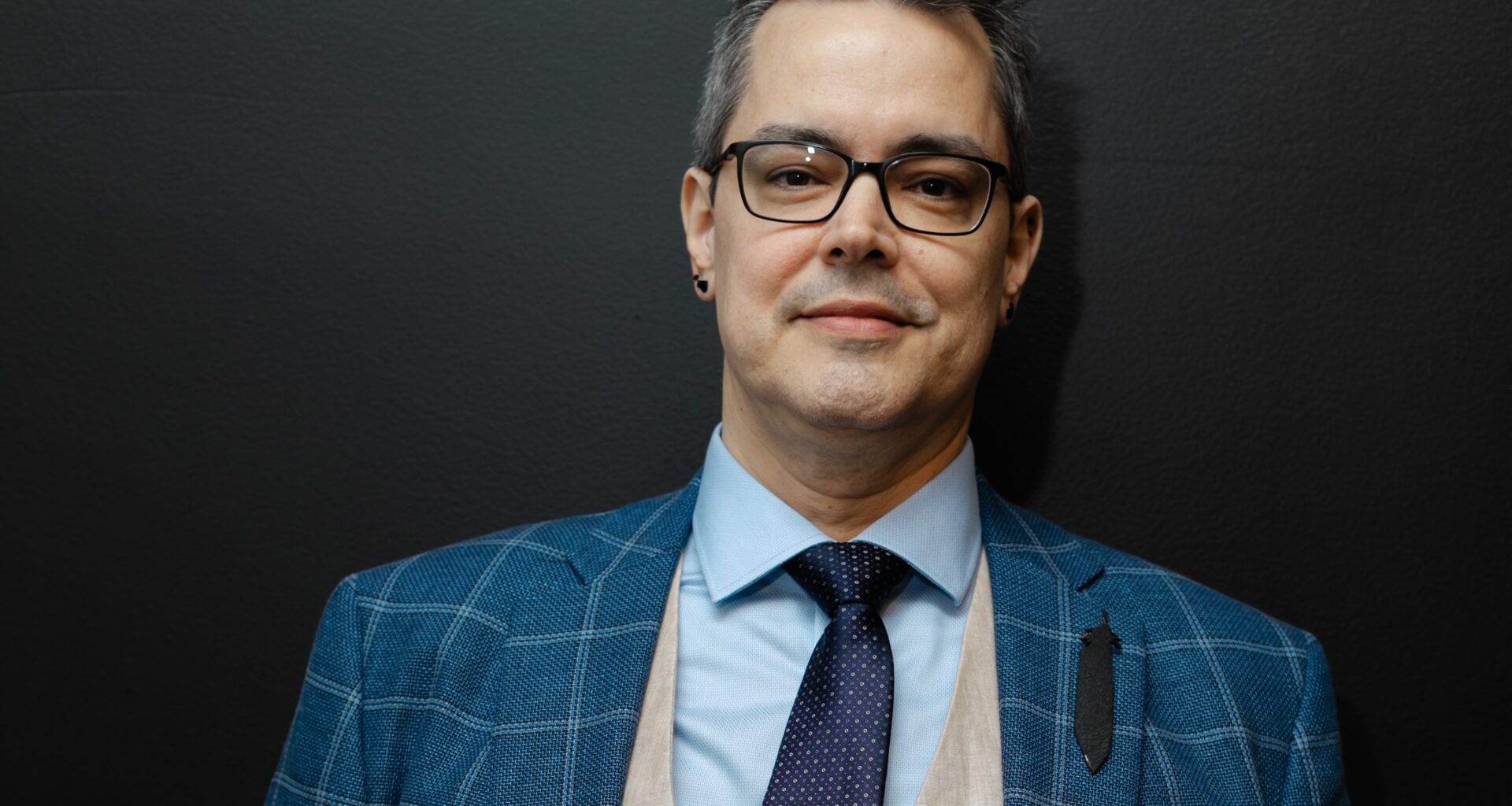
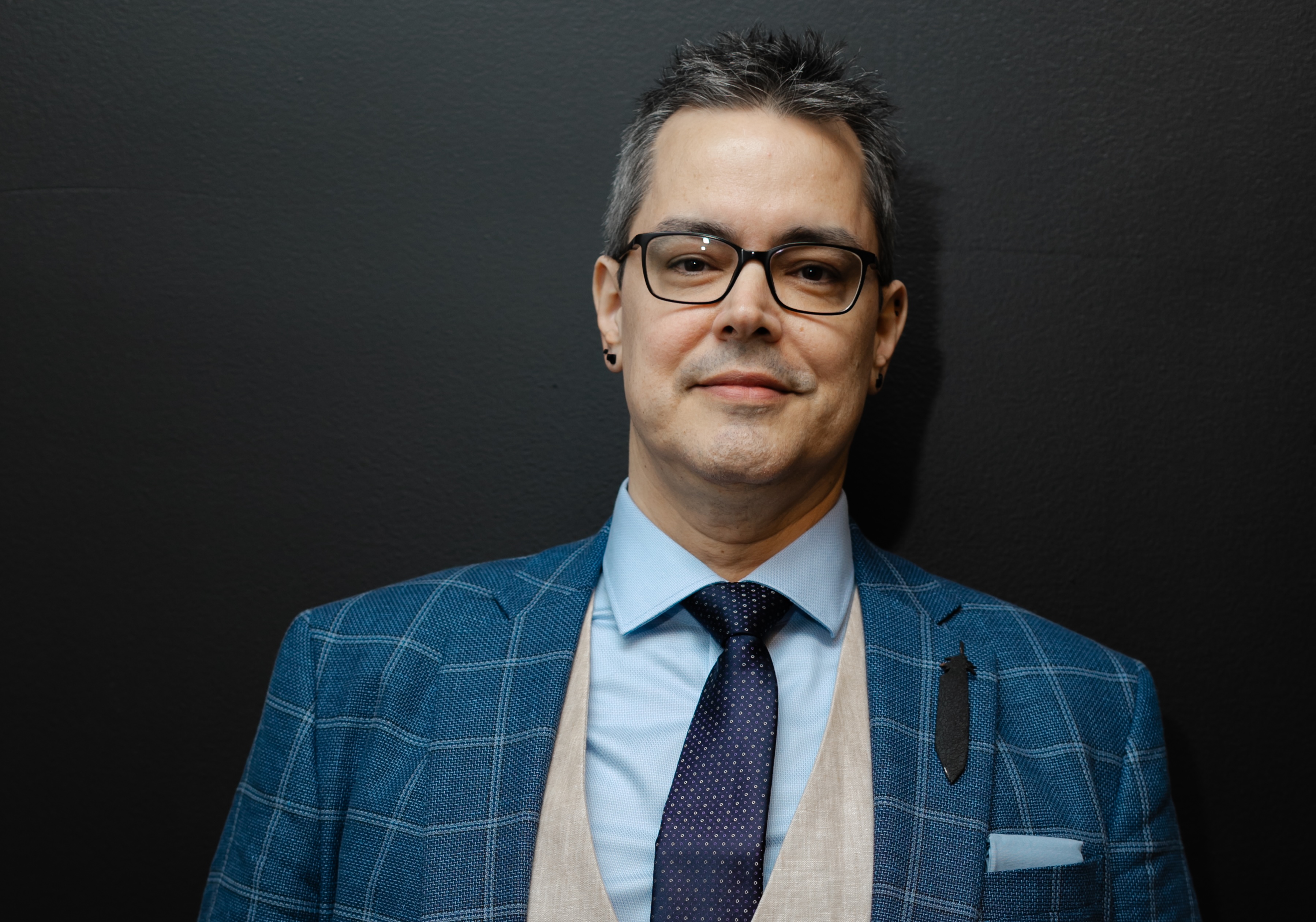
There are clear similarities between the author and his protagonist.
Aaron John Curtis’ first published novel, Old School Indian (Hillman Grad Books, 2025), tells the story of Abe Jacobs, a middle-aged bookseller in Miami and member of the Saint Regis Mohawk Tribe who hasn’t yet fully realized his poetic talents when he finds out he has a potentially terminal disease.
Now, if you know anything about the author, you might see some parallels between his life and Abe’s. Sure, both their names start with the letter “A” and they both have two first names, but the likenesses go far deeper. Curtis, a member of the Mohawk Tribe, worked at Books & Books in Coral Gables for more than 20 years and, in 2016, was diagnosed with a rare autoimmune disease (he’s now in remission).
“I used the bones of my life,” Curtis explains of his new book. The work is categorized as autofiction, or fictionalized autobiography. Neither memoir nor pure fiction, Curtis and Abe may share a lot of similarities, but the plot differs drastically from the author’s life.
That intimacy with the character, along with Curtis’ sense of humor, attention to plot details, and brutal honesty, is what makes the book so captivating. Abe is a complicated guy in the most unsettling time of his life. He heads to his parents’ home in the Saint Regis Mohawk Reservation at Akwesasne in Upstate New York, where he’s forced to sort out historical trauma, a complicated marriage, ambivalence about his heritage, and creative regrets as death looms. He’s also someone you’d like to call your friend. His story is interspersed with well-crafted poetry written by the protagonist, or rather Abe’s distinctly Indigenous alter ego, Dominick Deer Woods, who narrates the story and, in a moment of magical realism, even makes a guest appearance.
When news happens, Miami New Times is there —
Your support strengthens our coverage.
We’re aiming to raise $30,000 by December 31, so we can continue covering what matters most to you. If Miami New Times matters to you, please take action and contribute today, so when news happens, our reporters can be there.
The novel has been well-received by readers and critics alike. It was a USA Today Bestseller and received a rave review from The Boston Globe (the headline reads: “Curtis’ Old School Indian is terrific”) and starred reviews, including by Publishers Weekly.
While most of the action takes place on the reservation, the book is also set in Miami, where scenes showcase the city’s charms and expose its excesses. He shouts out Open Mic Night at Churchill’s Pub, the Villain Theater, South Beach Wine & Food Festival, and many other foundational haunts and events that define the city’s cultural body.
Reading a ton of advance copies of contemporary fiction during his time at Books & Books helped Curtis “get a sense of what’s happening in the publishing industry, and where you fit in,” he says. “Having all of those free books thrown at you gives you a leg up.” With Native authors like Tommy Orange and Oscar Hokeah gaining popularity, he adds, “Native fiction is a trend. A lot of people are stepping into that space because people realized there were hundreds of different Nations and hundreds of stories to tell.”
Curtis had long been working on his craft, including completing two other novels. He was discouraged by the frequent rejection writers face. But after his diagnosis, he didn’t know how much time he had left, so he hunkered down. “My spare time was going to be devoted to this pursuit,” he says. He wrote a short story that eventually became Old School Indian and presented it to his writing group. “It was all the fear of dying young and anger at myself that I had been working on this for ten years, and nothing had been published. All of this came out in the story, and they really liked it.”
His first versions were written in first person, and he described them as very angry, fearful, and bitter toward an “imagined white reader.” Authors in his writing groups helped him shape the form and style. Miami-based author Diana Abu-Jaber encouraged him to write it in third person to make it less hostile and add some distance. Curtis listened. “[Dominick Deer Woods] was a lot more understanding toward Abe’s foibles and a lot more empathetic toward his choices,” he says.
Another writer in the group suggested he add a healer to the story. At first, Curtis thought it was such a trope — until he remembered his Great Uncle Butch was actually a healer. This inspired Uncle “Budge” Billings, whose gift of healing allowed Curtis to make the story more cinematic. The character was so popular with readers that, while on tour, people told him they wanted a standalone backstory on Brudge.
On the book tour in May, Books & Books hosted Curtis for an event. “It was like coming home,” he says. His uncle Alex Jacobs created the artwork for the book’s cover, which was featured in Elle magazine. Curtis asked him to send some art to hang on the gallery wall at the bookstore.
“There’s always a buzz when the art is good,” Curtis says. “And you could hear them commenting under their breath, ‘This is good.’ When it was all set up with his work — which is on my family’s walls — in this space, that’s what I’ve been working for. I couldn’t talk, I was so choked up. We sold almost all of the prints overnight, and he sold out over the course of a month.”
During the book signing that evening, a man asked Curtis, “How does it feel to be on the other side of the table?” He was overcome and couldn’t answer at the time. Now, he has the words: “It’s been surreal.”
Aaron John Curtis at the Miami Book Fair. 12:30 p.m. Saturday, November 22, at Miami Dade College, 300 NE Second Ave., Room 8202, Miami; miamibookfair.com.