
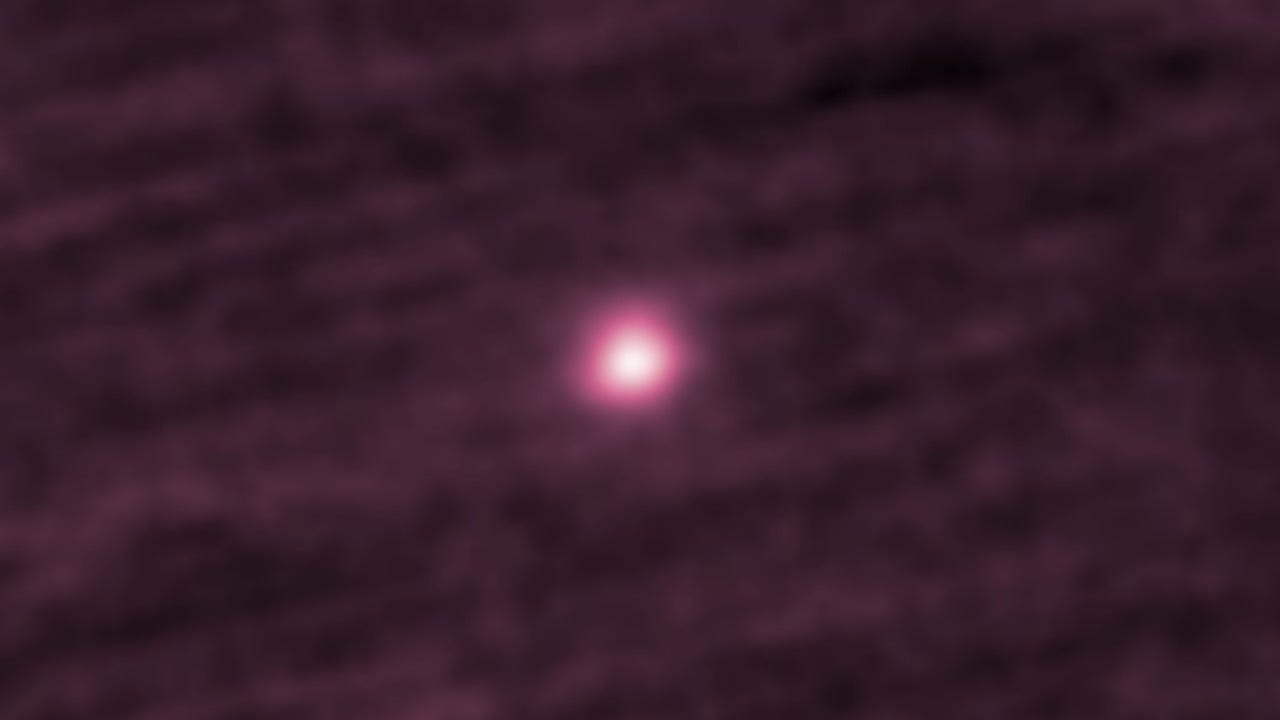
 Explaining the interstellar comet 3I/ATLAS
We are learning more tonight after NASA says they have discovered an interstellar comet that’s wandered into our own backyard. The quick-moving object was spotted by NASA with the ATLAS telescope in Chile over the summer. Ken Gayley is an astronomy professor at the University of Iowa. He joins LiveNOW’s Austin Westfall to answer questions about the online conspiracies that suggest 3I/ATLAS might be an artificial object or even a probe from another civilization.
The interstellar object 3I/ATLAS has piqued the curiosity of space enthusiasts and beyond, and NASA offered new images and more information Wednesday of what they say is a comet.
Here’s what to know about the comet and what NASA is saying:
What is the 3I/ATLAS comet?
Big picture view:
The object known as 3I/ATLAS was discovered this summer after it entered our solar system from elsewhere in the galaxy. It got its name because it is the third interstellar object known to have visited our solar system (3I), and because ATLAS was the telescope in Chile that discovered the object.
What we know:
The interstellar object had been believed to be a comet — which NASA confirmed Wednesday, despite several fun internet theories about it being alien technology.
What they’re saying:
“This object is a comet. It looks and behaves like a comet, and all evidence points to it being a comet. But this one came from outside the solar system, which makes it fascinating, exciting, and scientifically very important,” said NASA associate administrator, Amit Kshatriya.
“We love that the world wondered along with us” what it was, said Dr. Nicky Fox, the associate administrator with NASA Science.
What we don’t know:
The exact nature and make-up of 3I/ATLAS remains unclear.
Dr. Tom Statler, the lead scientist for solar system small bodies with NASA, said the size and shape of the nucleus are still being determined, but that the size range is estimated to be between a couple of thousand feet and a couple of miles in diameter.
And it’s also not known where exactly it came from.
“There is circumstantial evidence, given how fast it has come into our solar system, that it came from some very old solar system around a very old star,” Statler said. “Quite possibly, we can’t say this for sure, but the likelihood is that it came from a solar system older than our own solar system itself, which gives me goosebumps to think about frankly, because that means that 3I/ATLAS is not just a window into another solar system, it’s a window into the deep past – and so deep into the past that it predates even the formation of our earth and the sun.”
Local perspective:
The comet had been visible by telescope through September, before it got too close to the sun, and is likely to reappear in December on the other side of the sun.
The Hubble Space Telescope captured a picture of the comet back in August.
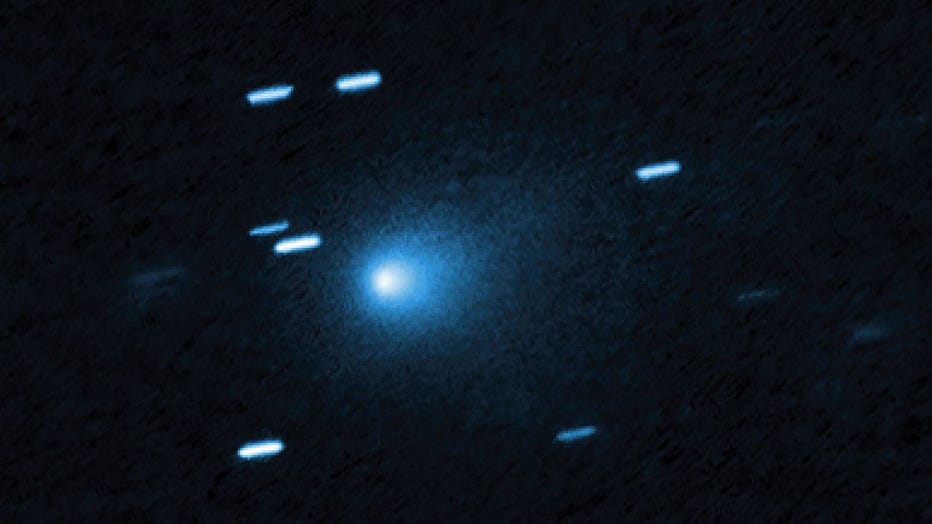
Hubble captured this image of the interstellar comet 3I/ATLAS on July 21, 2025, when the comet was 277 million miles from Earth. Hubble shows that the comet has a teardrop-shaped cocoon of dust coming off its solid, icy nucleus. Image: NASA, ESA, Dav
RELATED: Mysterious interstellar comet 3I/ATLAS has no tail: What 2 experts say
NASA new 3I/ATLAS photos
And NASA released new images during their press event on Wednesday.
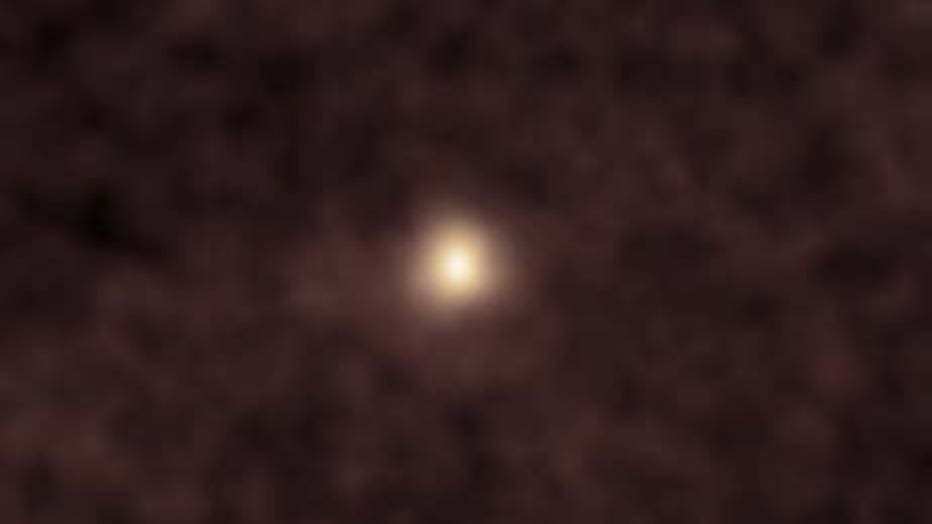
A faint image of comet 3I/ATLAS as observed by ESA/NASA’s SOHO mission between Oct. 15-26, 2025. The comet appears as a slight brightening in the center of the image. Lowell Observatory/Qicheng Zhang (NASA)
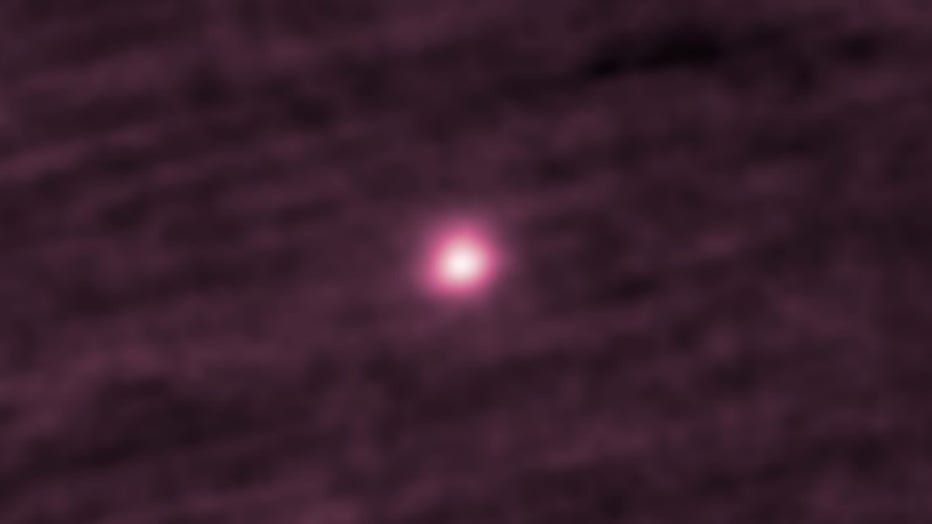
This image shows the 3I/ATLAS interstellar comet as a bright, fuzzy orb in the center. Traveling through our solar system at a staggering 130,000 miles (209,000 kilometers) per hour, 3I/ATLAS was made visible by using a series of colorized stacked im
Where is 3I/ATLAS?
Timeline:
The object was discovered on July 1, 2025, out near Jupiter. Scientists say it was discovered early during its journey through our solar system, giving experts ample time to watch and study the icy snowball.
Earlier in October, the comet approached Mars and came within 18 million miles of the red planet. On Oct. 30, it was the closest it would ever be to the sun, NASA said.
It made its closest approach to the sun in late October.
In December, it will swing back and be closest to Earth — though still about 167 million miles away. 3I/ATLAS will be closest to Earth on Dec. 19, and then head towards Jupiter, where it will pass that planet’s orbit in the spring of 2026.
What’s next:
“It’d be fabulous if we could trace back the incoming trajectory of the solar system … but things are not quite so simple,” Statler said. “Our galaxy is a big and complicated place.”
Meanwhile:
Various NASA instruments and science teams are all working in tandem to study and learn as much as we can from the comet.
The Source: Information in this article was taken from NASA, a Space.com report, and from comments given by Harvard astrophysicist Avi Loeb. Background information was taken from The Associated Press and previous FOX Television Station reportings. This story was reported from Detroit.