
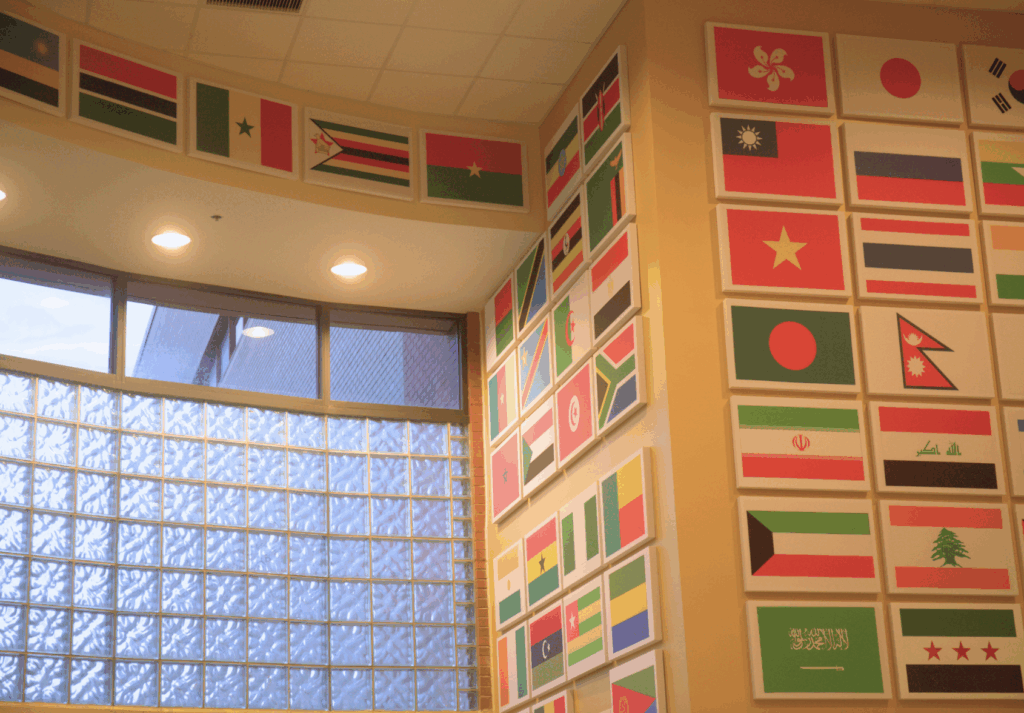
 Policies that push students and staff out cost USF its talent, diversity and global competitiveness. ORACLE PHOTO/MAIA HENNAWY
USF’s campus feels global the moment you step onto it.
You hear it in the different languages spoken on the way to class and see it in the diverse perspectives international students and faculty bring into discussions.
Last year, USF celebrated its standing as the top college destination in Florida for international students, according to a USF Newsroom article.
However, recent state policies and rhetoric are directly threatening USF’s ability to remain appealing to international students and faculty.
International faculty and students matter at USF because they not only offer significant economic benefits but also diverse perspectives and innovations.
Related: OPINION: USF’s international students deserve better
During a trip to USF on Oct. 29, Gov. Ron DeSantis announced that he will be asking the Board of Governors to “review and limit” H-1B visas for international employees at state universities.
DeSantis pulled multiple examples of employees on an H-1B visa, even going as far as asking if hiring a clinical assistant professor from the West Bank “is just social justice,” during the Oct. 29 press conference.
Limiting H-1B visas would affect some staff who are originally from other countries, preventing them from continuing to work at universities.
DeSantis defended this action by stating that hiring domestic candidates first “serves the American workforce,” according to a press release from the Executive Office of the Governor.
But serving the American workforce means allowing students to access the best instructors, whether they are domestic or international.
Recent policies are not just impacting faculty. The BOG also repealed the Latin American and Caribbean Scholarship on Nov. 6.
This ruling effectively ended the almost thirty-year-old scholarship, which was available to students from 50 countries.
The LAC scholarship allowed eligible international students to pay in-state tuition and awarded them $500 per semester.
Nearly 10% of the USF student body is international, meaning the discontinuation of the LAC scholarship may seriously hinder some students’ ability to remain at USF and disincentivize others from applying in the future.
USF has spent nearly two decades promoting the value of “study abroad and international students’ contributions to the campus community,” according to the USF Newsroom.
But these new federal and state policies effectively undermine over a decade’s worth of work.
Nationally, there has been a 17% drop in new international college student enrollment for fall 2025, according to the Power of International Education’s 2025 report on International Student Enrollment.
Among the main reasons for decreased enrollment were the visa application process, feeling unwelcome in the U.S. and the current political climate, according to the report.
In August, the State Department revoked over 6,000 student visas, saying they were in response to assault and support for terrorism.
As the federal government revokes international students’ visas, Florida universities are beginning to follow suit.
USF students are also facing visa losses, sometimes “without notice or explanation to the university,” according to The Oracle.
Creating barriers for international students and faculty is not fair to the rest of the university community. It effectively eliminates meritocracy, something the DeSantis administration has promoted in the past.
Related: USF professors worry about international students amid political pressure
International and diverse perspectives in the classroom and on campus have incredible benefits and economic impact.
International students actually make room for more domestic students because of the additional revenue they generate, according to Business Insider.
Even more striking, immigration can increase employment opportunities for domestic workers and does not negatively impact their wages, according to a 2024 explainer from the Migration Policy Institute.
International students also contributed over $1.4 billion to Florida’s economy in 2024-25, according to OpenDoors’ 2025 annual census of international students in the U.S..
If international students leave the state and USF, they will inevitably take their innovations, economic power and academic contributions elsewhere.
Serving the American workforce, DeSantis’s stated goal, is best achieved by allowing international faculty and students to continue to thrive at USF and the state of Florida.
If Florida wishes to continue to boast values like freedom and meritocracy, then the hypocrisy of these new policies must be considered.