
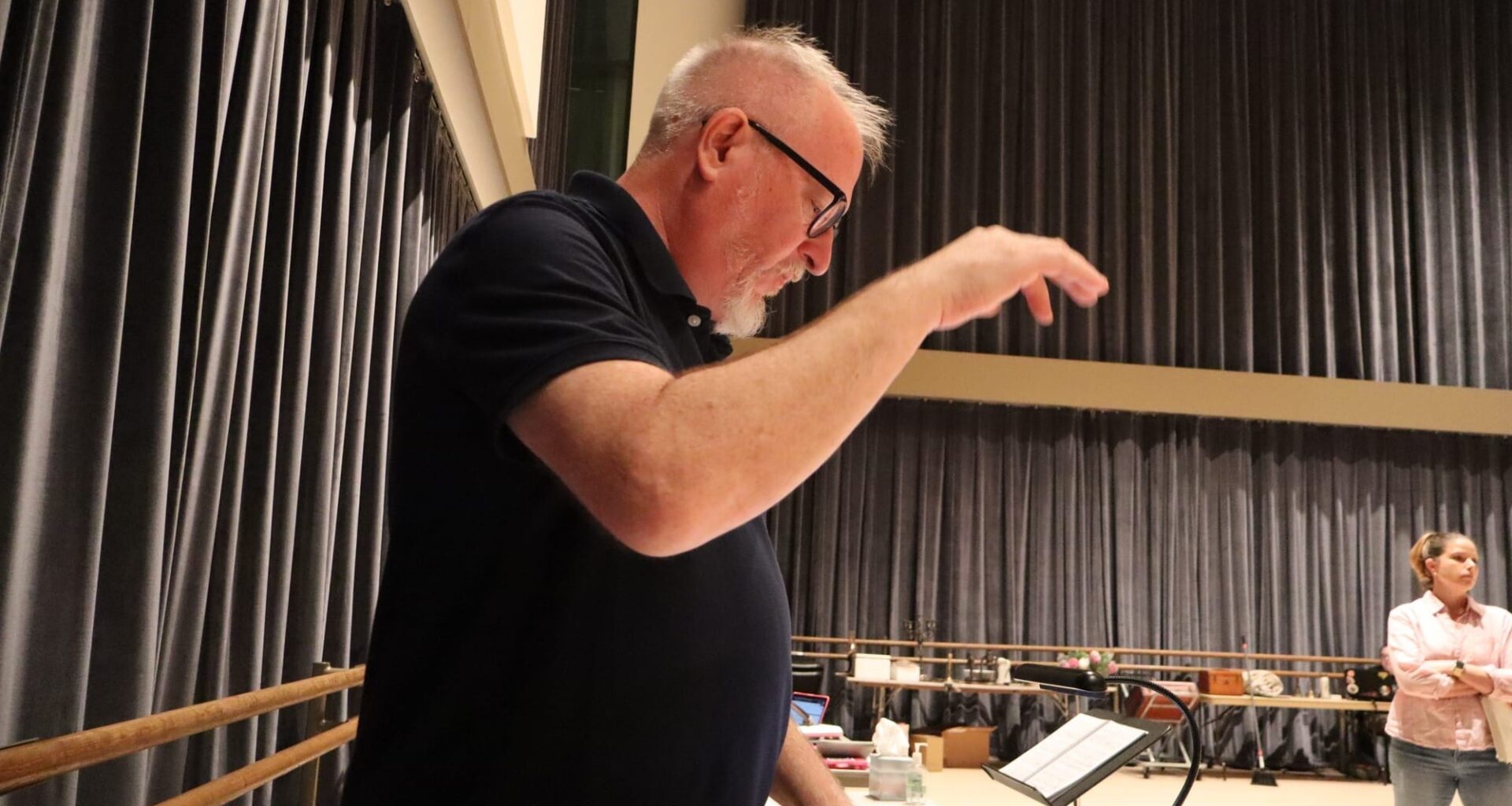
 Conductor Andrew Bisantz leads a rehearsal for Opera Tampa’s The ‘Turn of the Screw. ‘ Credit: c/o Opera Tampa / via TB Arts Passport
Opera Tampa didn’t have to get weird this season—but they did. And that choice is the quiet heartbeat under “The Turn of the Screw,” a psychological ghost story that lands like a dare: You say you want bold programming? Come see what that actually feels like.
For conductor Andrew Bisantz, the draw isn’t just the ghosts. It’s the way the story refuses to sit quietly on the stage—or in your mind.
“The story is… to be clichéd slightly… timeless,” he said. “These emotions, the rawness of them, are never very far from us.”
This is his fourth time conducting Britten’s chamber opera, and still, he keeps coming back.
“It’s a piece that’s just full of eeriness, atmosphere, unreliable narrators,” Bisantz said. “There’s all sorts of questions as to what actually happens in the story, but the audience… will be taken along quite the journey with this production.”
And that’s part of the point: “The Turn of the Screw” isn’t distant or dusty. It hits now because it deals in the one emotion we all recognize instantly—dread—and the one place we can’t escape it — a dark room where something is about to happen.
A classic ghost story, re-armed for a live audience
Opera Tampa could have given audiences another season of crowd-pleasers. Instead, they doubled down on the uncanny: “The Turn of the Screw,” “The Shining,” “The Magic Flute,” “Macbeth.” A whole season designed to make you lean forward in your seat.
Why? Because horror works differently when the orchestra is right below you.
“This comes as close to having operatic jump scares as you can… in a stage work,” Bisantz said.
No screen. No distance. Just you, the pit, and a story that refuses to let you look away.
If you’ve ever wondered what happens when fear isn’t mediated by a camera—when it doesn’t cut away, doesn’t fade to black, doesn’t let you breathe when you want to—this is the show.
Behind the tension: an opera built like a trap
“For musicians, all of us consider ‘Turn of the Screw’ to be Britten’s masterpiece,” Bisantz said.
What makes it so gripping isn’t just the plot. It’s the architecture.
“The opera itself is built as actually a musical palindrome,” he said. “You get to the halfway point at the end of Act 1 and then, as the screw turns, everything… unravels in exactly the opposite direction in Act 2.”
Everything tightens as the story tightens. The music coils as the paranoia rises. Even the score is working against you—in the best way.
But Bisantz insists audiences don’t need to walk in with a degree in music theory.
“I’m sure Britten didn’t want people to focus on the fact that he used a 12-tone row,” he said. “Just how the piece impacts them overall.”
Because that’s the hook: this is craft you feel before you understand it.
Sophistication that lands like instinct.
A structure built to burrow under your skin.
Civility on the surface. Terror underneath.
What keeps this opera evergreen—and what makes it feel especially sharp in 2025—is the tension between what the characters say and what they can’t. Between the politeness of the setting and the panic living underneath it.
“What… they are doing is playing with the idea of civility… and how underneath, in all of us, just lurks this dread and fear and existential terror,” Bisantz said. “We’d like to think it’s far from us, but it never really is.”
Fear in this story isn’t a monster or a scream. It’s what happens when someone insists everything is fine—while you feel the opposite in your body.
That’s a feeling today’s audiences know intimately.
Maybe too intimately.
Thirteen instruments. Two children. One house that won’t stay quiet.
One surprise of “Turn of the Screw” is its scale. It sounds enormous, but the ensemble is tiny—by design.
“Britten scored this for 13 instruments only,” Bisantz said. “The colors that he produces with this 13-member ensemble is so fascinating and so perfect for this story.”
That closeness translates directly to the audience. You aren’t watching a spectacle manufactured from afar—you’re in an unsettlingly intimate room with the sound.
Add to that the two child performers—playing roles written with startling musical sophistication—and the effect is almost voyeuristic. Like watching innocence and corruption wrestle in real time.
So… why go?
Because this is the kind of risk audiences say they want from their arts institutions—and Opera Tampa is actually doing it.
This is their first Britten in company history.
Their smallest orchestra of the season.
Their most psychologically charged work.
Their boldest creative swing in years.
And you get to be in the room for it.
If you’re the kind of person who wants Tampa Bay’s arts scene to keep growing, evolving, and taking real artistic risks—showing up matters.
If you’re the kind of person who wants an experience you feel, not just one you admire—this is your night.
And if you’re the kind of person who loves a ghost story that won’t explain itself—Britten built one that lingers.
“I hope that they have the experience… which is it does linger,” Bisantz said. “It doesn’t go away.”
A company turning a corner
For Bisantz, this isn’t just a one-off. It’s part of what feels like a new appetite—both from Opera Tampa and from the audiences they’re serving.
“I’m really excited to see Opera Tampa take this step into newer repertoire,” he said. “I really firmly believe that we are in the golden age of American opera composition.”
And he doesn’t hide his pride at being the one to bring Britten to Tampa for the first time.
“Benjamin Britten is a composer who’s very close to my heart,” he said. “To again be the one to do it for the first time for Opera Tampa… it’s really thrilling.”
Because at the end of the day, “The Turn of the Screw” isn’t just a ghost story.
It’s a signal.
An invitation.
A turning point.
And maybe, if Tampa keeps saying yes to nights like this, a beginning.

This article appears in Nov. 20 – 26, 2025.
Related