
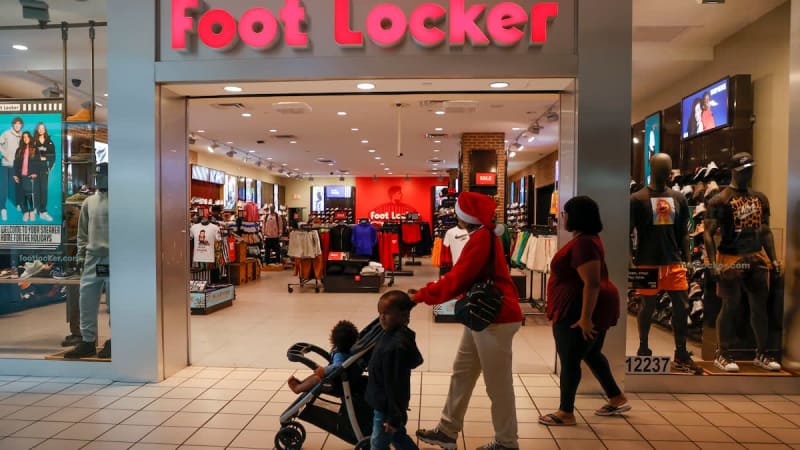
 Shoppers walk past a Foot Locker store at University Mall in Tampa on Wednesday, Dec. 21, 2022.
St. Petersburg officials have spent years trying to lure a flashy corporation to the city to promote job creation.
Foot Locker was supposed to be the big catch. After negotiations stalled in 2021,the Fortune 500 sneaker giant was offered $475,000 in incentives as well as potential tax breaks last yearin exchange formoving its headquarters here and creating hundreds of permanent jobs.
In March, the company announced it had leased a 110,998-square-foot building at 570 Carrillon Parkwayand intended to move in by early 2026.
But two months later, Dick’s Sporting Goods announced it was buying Foot Locker. Soon after, the plan to set up a headquarters in Tampa Bay fell apart.
Mayor Ken Welch’s administration confirmed the deal was dead in a letter sent to council members last week.
Foot Locker won’t receive any financial incentives for failing to uphold its commitment, the letter explained.
So where did it all go wrong?
“When one company buys another, normally it puts a strain on their balance sheet,” said retail analyst Bruce Winder. “They have to find a way to lower the total cost structure of the two firms.”
Dick’s is currently based in Pennsylvania. Paying for an extravagant new headquarters hundreds of miles away no longer made sense, he said.
But it looks like Foot Locker will retain its office space in St. Petersburg and potentially bring jobs.
Brian Feil, principal at the Feil Organization, which owns 570 Carrillon Parkway, confirmed that Foot Locker will still have to pay for its lease. The building is not currently being marketed for sublease. It’s unclear how long the original lease was for.
St. Petersburg City Council member Copley Gerdes said his understanding is that new jobs are coming, even without the headquarters.
“Obviously, we’d love the headquarters from a headline standpoint, but when there are jobs being created by the buildout, there’s leasing happening, there’s jobs being created outside of the headquarters, those are all good things, and we should be focused on that,” he said.
Neither Foot Locker nor Dick’s Sporting Goods responded to requests for comment from the Tampa Bay Times.
Foot Locker was supposed to create 300 local jobs, with salaries averaging $120,000 per year. The company was also considering New York and Atlanta before it landed on St. Petersburg.
“St. Petersburg has done well in positioning itself for the live-work-play environment,” Lee Arnold, executive chairperson of Colliers International Florida, said in a previous interview with the Times. “Incentives can make a big difference in attracting a company to relocate when competing with other cities,” he said.
Richie Floyd was one of two City Council members who voted against the Foot Locker incentive package.
There’s an important lesson to be gleaned from the fallout: “A corporation is going to do what’s in their best interest at all times,” he said. “I think when we do economic development deals, they should be benefiting our community in a way that’s more direct than doing trickle-down tax economics.”
Floyd said the majority of jobs in the city are created by small, locally owned businesses. He said he would like to see more resources directed toward them, not large corporations.
The city has already taken a step in this direction with the Tampa Bay Innovation Center, a business incubator launched by Cathie Wood’s Ark Invest, which relocated from New York City to St. Pete in 2021.
Tampa Bay has struggled to attract major companies, though not for a lack of trying. When former Tampa Bay Lightning owner Jeff Vinik began buying up lots in downtown Tampa, part of his vision for Water Street was to land a Fortune 500 employer. One of Water Street’s largest office tenants is ReliaQuest, a homegrown cybersecurity firm recently valued at $3.4 billion. Utility company TECO moved into office space in Midtown Tampa, leaving its old downtown space behind.
In 2017, Tampa’s and St. Petersburg’s mayors launched a long-shot bid to recruit Amazon’s HQ2. The region didn’t rank on a list of 20 finalists, and the headquarters ended up in Arlington, Virginia.
This summer, St. Petersburg-based Jabil announced it had chosen North Carolina over Florida to build a new $500 million AI manufacturing center, where it will create 1,200 jobs. It didn’t help that Gov. Ron DeSantis eliminated six Florida tax incentive programs in 2023.
In the case of Foot Locker, a shaky economy this year may not have helped the case for a new headquarters. Before the sale to Dick’s closed, Foot Locker posted a $360 million loss during the first quarter of 2025 and shed 56 stores across the globe.
“Foot Locker has had a couple of tough years,” said Winder, the retail analyst. “That’s often why companies buy another company, because their valuation is lower.”
Despite this,Michael Swesey, president and CEO of the St. Petersburg Economic DevelopmentCorp., said the Foot Locker deal proved that St. Pete is capable of attracting a big company.
“The strengths that drew Foot Locker here — our business-friendly climate, competitive taxes, deep talent pool, high quality of life, and inclusive community — are stronger than ever,“ he wrote in an email. ”With new Class A space coming online and major projects like the Halcyon and Gas Plant District ahead, St. Pete’s momentum is only accelerating.”