
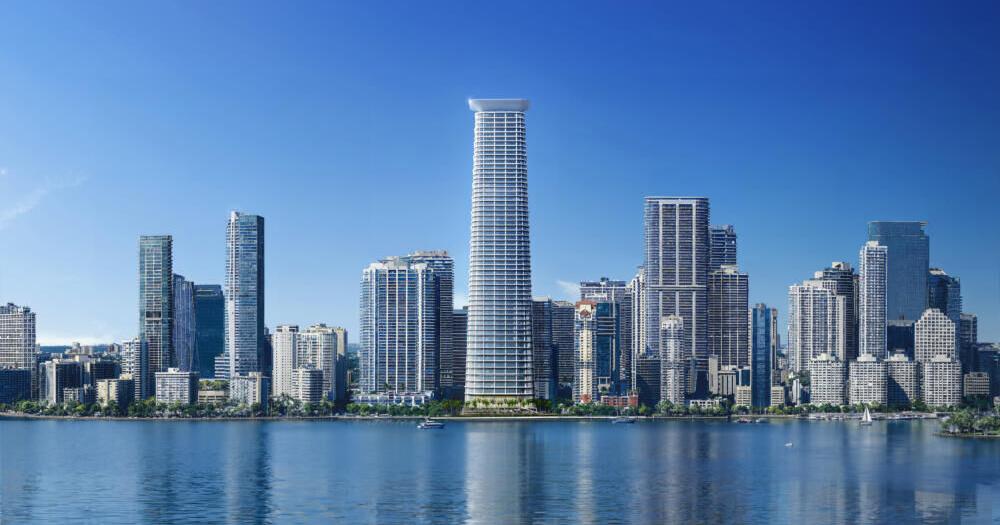
For anyone who crosses the Rickenbacker Causeway each morning, it’s impossible to miss the rising skyline of Brickell, and soon, one of its tallest and most transformative towers may belong to Citadel.
Ken Griffin’s global financial firm is moving forward with plans for a supertall headquarters on 1201 Brickell Bay Drive, a project that would become one of the tallest buildings on the East Coast outside New York City.
According to multiple development filings and reporting from Commercial Observer, Citadel’s proposed global headquarters is designed by architects Foster + Partners and is expected to rise roughly 1,049 feet, having already secured FAA height approval.
The project would include over 1.3 million square feet of Class-A office space, a luxury hotel of more than 200 rooms, retail space, and a publicly accessible waterfront baywalk.

Courtesy of Citadel Securities
Citadel, which started its major relocation of employees to Miami in 2022, is positioning the tower as a landmark global hub, further cementing the city’s emergence as a financial and technology destination.
The building’s design, described as sleek and sculptural, is engineered for Miami’s environmental challenges, including high winds, a rising water table, and coastal flood risk.
The development sits at the heart of Brickell’s high-density corridor, directly across from Biscayne Bay and within panoramic view from Key Biscayne. Residents on the island, particularly those in the Towers, Key Colony and Ocean Club, could see the tower rise over the next several years as permitting and site preparation advance.
Beyond its architectural statement, the project signals a broader shift: Miami’s financial district is accelerating its transformation from regional hub into a global headquarters destination. Citadel’s move follows years of momentum in Brickell, including major expansions in finance, technology and hospitality, and increases infrastructure, transit and housing demands.
While a construction start date has not set, the project cleared its most critical hurdle with FAA approval and is moving through Miami-Dade’s Rapid Transit Zone process, which allows high-intensity development near rail corridors. Once built, the tower would instantly become one of Miami’s most recognizable structures.