
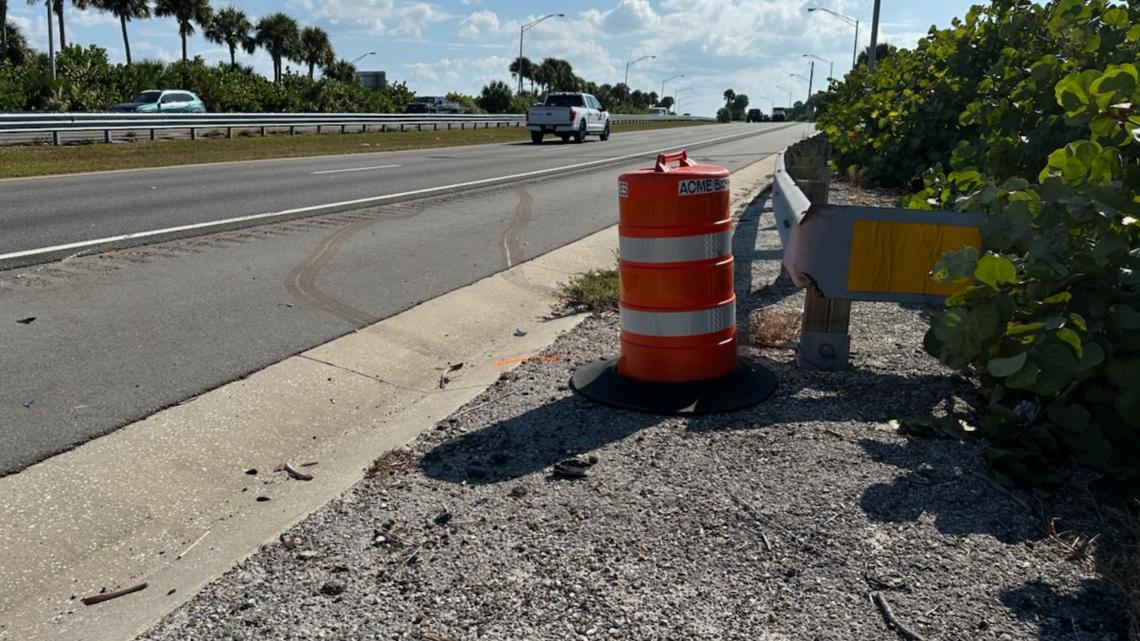
A highway safety advocate’s concerns were renewed this week after a weekend crash near the Sunshine Skyway Bridge.
PINELLAS COUNTY, Fla. — As millions of people hit the road for Thanksgiving, a national safety advocate is warning drivers that not all roadside hardware is designed to protect them — and in some cases, it may do the opposite.
Steve Eimers, a highway safety advocate who has pushed for reforms in guardrail standards nationwide, says a type of guardrail end terminal deemed unsafe by the federal government decades ago can still be found along some of Florida’s busiest roadways.
His concerns were renewed this week after a weekend crash near the Sunshine Skyway Bridge left a backseat passenger dead. Investigators say the driver fell asleep at the wheel before veering off the road and hitting a tree. According to the Florida Highway Patrol, the car came to rest in front of an aging guardrail — one Eimers says could have made the tragedy even worse.
“That’s a major point of concern,” Eimers said. “We have to take responsibility as drivers to wear seatbelts, but we also rely on DOTs across the country to follow more than 30 years of federal guidance. And yet we still have these BCT terminals on the roadside.”
The device Eimers is referring to is the Breakaway Cable Terminal, or BCT, the end piece of a guardrail system designed in the 1960s and installed widely through the 1980s.
“It’s a very old, obsolete piece of safety equipment,” Eimers said. “It has not been considered crashworthy under modern testing standards. Even under the 1993 NCHRP Report 350 standards, it could not pass crash testing.”
A U.S. Department of Transportation report documenting a 44-mph crash test showed the BCT failed to perform as intended. The Federal Highway Administration in 1994 issued a memo declaring BCTs “no longer acceptable for installation on high-speed, high-volume roads.”
While the agency did not order states to immediately remove existing BCTs, it directed transportation departments to replace them when damaged or when roadwork occurred in the same area and to upgrade them to terminals that meet crashworthy standards.
“This is a high-priority location,” he said of the guardrail near the Skyway Bridge. “And even here, we still have a piece of equipment that hasn’t been crashworthy for the better half of a century.”
When 10 Investigates asked the Florida Department of Transportation back in 2023 about BCTs still in service, the agency said upgrades occur by what was recommended in the memo.
“As new construction projects take place, or as guardrails are damaged, FDOT replaces guardrails with current inventory from our Approved Product List (APL),” the department said in a statement.
Eimers believes that approach isn’t enough.
“It’s not crashworthy. It cannot redirect our modern vehicle fleet,” he said. “It doesn’t work. And we’ve known that for 50 years, with federal guidance for 30 years telling us it doesn’t work. We have to invest our dollars in upgrading our barriers.”
Over the last two years, 10 Investigates has been checking out potentially problematic guardrails lining our roads as part of the series Unguarded. Because of the team’s reporting, the state launched a statewide review that uncovered one third of the state’s guardrails needed to be repaired or replaced. It’s all part of a 30-minute Emmy-winning special, Unguarded, streaming now on 10 Tampa Bay+. Look for it under Special Reports.